
Overcoming barriers to highland conditions, young indigenous people are gradually lighting up the "fire" of starting a business, rising to get rich in parallel with the goal of protecting the environment and preserving cultural roots.
Born in 1999, Pham Viet Hoang (Muong ethnicity) - Secretary of the Youth Union of Luong Thien village, Thach Lap commune - is a typical face honored as an advanced example in ethnic minority youth in Thanh Hoa province in 2025.
Early realizing the difficulties of starting a business in his hometown, Hoang shared: "It is a journey with many barriers, from production habits, small-scale thinking to learning conditions, resources... If you are not persistent and have no will, it is very easy to give up halfway".
In 2022, Hoang and his colleagues awakened the local tourism potential with the "cloud hunting" camping model at Hich hill, Hang Con. Not stopping at tourism, he continued to bring Bao ginseng to plant on rocky mountains combined with beekeeping for honey. This model brings in hundreds of millions of VND in revenue each year, creating seasonal jobs for 5-7 workers.
At the end of 2025, storm No. 10 made landfall, heavily damaging production infrastructure, but Hoang did not flinch: "After the natural disaster, we almost had to start over. The more difficult it is, the more determined young people must be, not allowing themselves to give up.
Stepping into 2026, he continues to implement a project to grow sweet tangerines and lychees on sloping land and raise hill chickens.
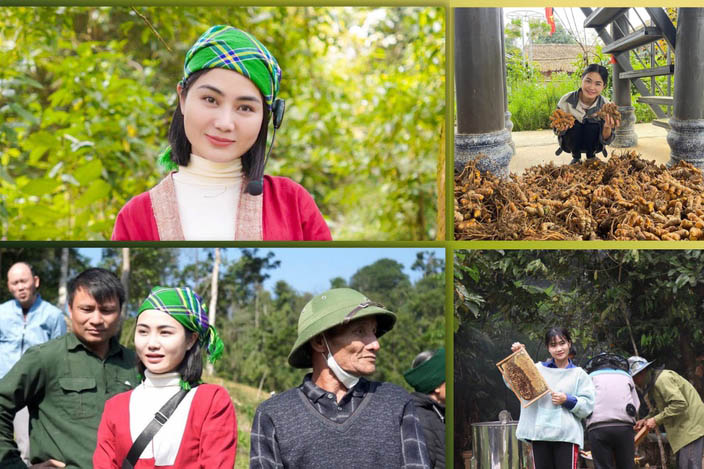
And Ms. Nguyen Le Ngoc Linh (born in 1990, ethnicity Tho) - who was elected as a National Assembly Deputy of the 16th term, Member of the Vietnam Fatherland Front Committee of Thanh Hoa province - chose to quit her stable job in Hanoi to return to her hometown of Hoa Quy in 2019.
I once had a fulfilling life in the city. But that is my own life. As for my hometown, it is still poor, forests are still being cut down, streams are getting shallower and shallower," Ms. Linh confided. From that concern, the "Ban Tho forest garden" model was born, aiming for a "3-clean" agriculture: clean air, water and soil.
After 6 years of persistence, more than 6ha of barren hills have turned into multi-layered forests. Currently, the model has 21 members, linked with 51 households, creating sustainable livelihoods for ethnic minority women.
In particular, Ms. Linh also promoted deep processing of OCOP products that meet ISO 22000:2018 and HACCP standards. This achievement brought her the Vu A Dinh award and the First Prize for Startup in Thanh Hoa province in 2021.
She concluded: "Mountain youth may go slower, on a smaller scale, but if they know how to rely on local resources, they will go firmly and sustainably. Only when we understand the market, apply science and technology and deep processing, can we win.
The story of Hoang and Ms. Linh is a clear proof of a new mindset of ethnic minority youth: economic development does not trade off the environment, getting rich must be associated with indigenous culture.
From practice, young entrepreneurs expect more practical support policies on infrastructure, loans, OCOP product development and attracting young intellectuals to the village.
As Ms. Nguyen Le Ngoc Linh's message: "If we persevere in doing it, create real value and not forget the roots, "motherland" will return us worthy things". Every effort today is the seed that is nurturing forests of livelihoods and a sustainable future.


