
Our Vietnamese is "soft as silk" in the observation of the late poet Luu Quang Vu. Is it because it is as soft as silk that Vietnamese changes unpredictably? Eating a piece of che lam, che kho but not che. Then a handful of fragrant sticky rice is called banh khuc, truly unpredictable flexibility.
If we just follow the definitions, it is probably very difficult to translate the names of many Vietnamese dishes into foreign languages. Because that is not sweet soup, which is a sweet drink as the majority understand. And that is also not cake as commonly understood in the past.
But "banh khuc" is still "banh khuc", although it is a very delicious sticky rice dish, very typical of the Northern Delta. "Rau khuc" grows throughout Vietnam, but only "khuc" trees that are moldy, with velvet-like smooth leaves, covered with a layer of moldy chalk, white flowers, growing under the northern drizzle, bring a rustic delicious dish.
In the memory of boarding students of the 7X and 8X generations in Hanoi, the cry "Who wants hot banh khuc here" will forever echo, flying from a bicycle carrying a basket of banh khuc for street vending into the dormitory window in the cold winter nights.
The sluggish but steady and anxious cries under the dim yellow lights of rain always make the stomachs of students burst with cravings. Truly, there is no greater happiness than being able to loudly call "Khuc oi" and then the "banh khuc" cart stops by, packing the steaming banh khuc and handing it over.
Not only students of the "hungry to eat and drink" era, but also many generations of workers in the night were relieved by a pack of hot banh khuc priced at only a few thousand VND at that time. In the cold rainy night, banh khuc is a self-reward after a hard day of making a living.
Recalling those sticky rice cake packages in those difficult times, although not cooked with sticky rice leaves but with old kohlrabi leaves, old cabbage leaves because it was off-season - a very "poor family" variation - makes sticky rice cake so familiar. And then on drizzly northeast windy nights, suddenly a night's cry is heard.
Now, it's again January 2nd, it's drizzle flying all over the long streets. People are busy going to the riverbanks and rice fields to pick Khuc vegetables to cook Khuc cakes. The moist Khuc vegetables of January have a lot of flour, cooking delicious Khuc sticky rice must know. Young Khuc vegetables are abundant everywhere, picking them freely to bring back for storage so that when you want to eat Khuc cakes, you can cook them.
There are two types of storage, one is drying and grinding into flour, and the other is pounding fresh *rau khúc* until smooth and then freezing and storing in the refrigerator. Usually, people prefer fresh pounding because it tastes better than using dry flour. Thus, there will be *bánh khúc* all year round, even if it cannot be compared to the spring *rau khúc* crop.
Banh khuc is not elaborate but also takes a lot of processing effort. Picked vegetables must be washed many times to be really clean, then blanched in boiling water and let drain thoroughly before being chopped and pounded to make it really smooth. Then mix the vegetable with sticky rice flour into a sticky mixture, then knead it into separate pieces.
The filling of the "banh khuc" cake is made from pork tenderloin, leaf fat or pork belly cut into square pieces, wrapped around in green beans that have been shelled finely and mixed with pepper. This filling is called "sọ bánh". Then take the sticky rice flour and knead the "rau khuc" to wrap the skull and roll it into a round shape, about the size of a tennis ball.
At this time, the block of "banh khuc" is rolled through the softly soaked and washed sticky rice, forming the outermost layer. The final stage is to arrange "banh khuc" in the sticky rice bowl to cook until cooked. Depending on the thick or thin layer of rice to calculate the cooking time, but usually it takes about 30 minutes to "achieve success and fame".
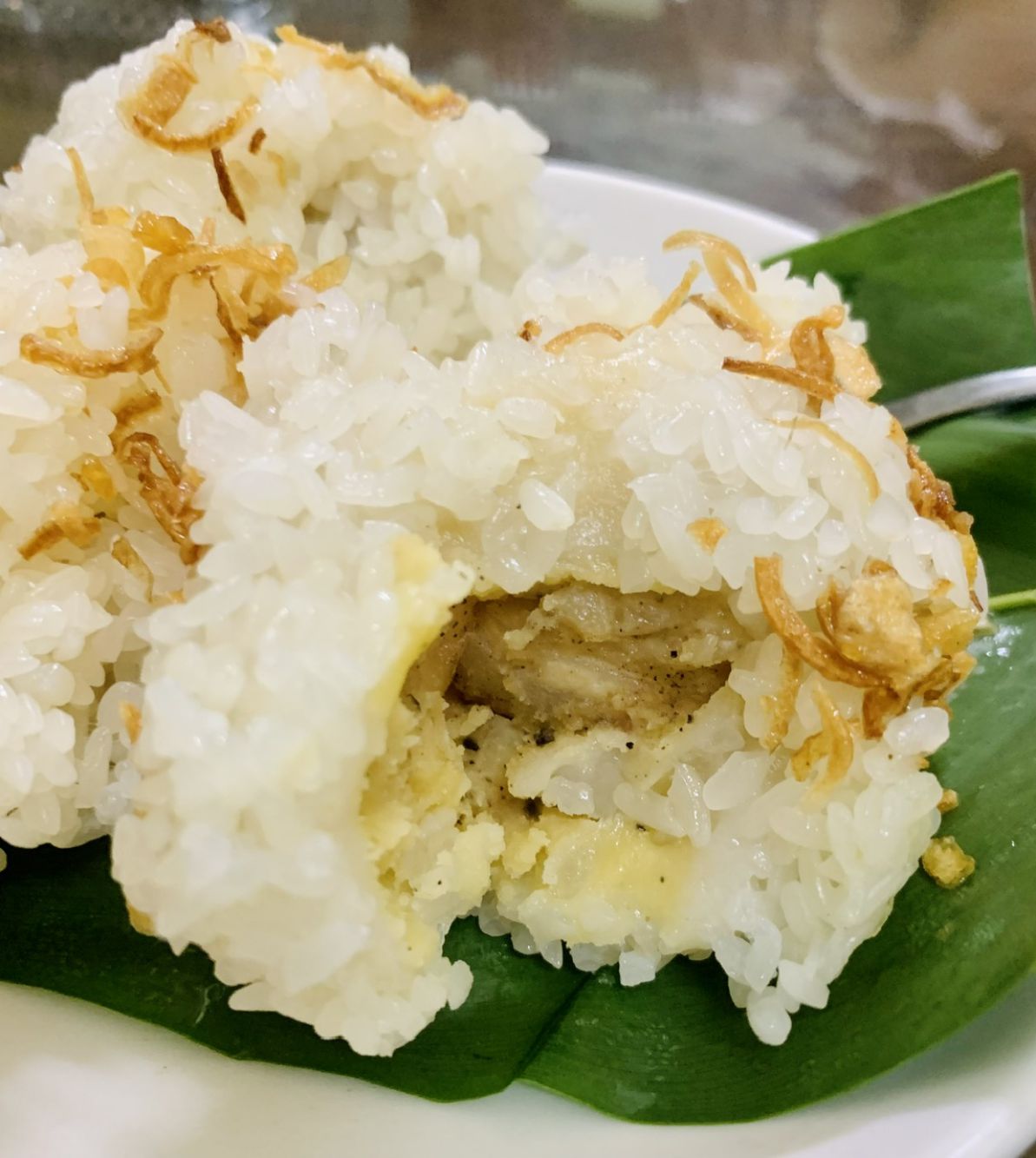
Looking at a bowl of banh khuc, it looks no different from a bowl of white sticky rice, however, just skillfully using chopsticks to pick each round banh khuc ball. The technique of picking banh khuc requires familiarity with the craft to separate each banh khuc ball without violating other balls.
Banh khuc can be eaten with sesame salt, pork floss or spring rolls, but perhaps it is most suitable to eat with nothing. Holding a package of banh khuc in your hand, biting a little bit and immediately touching the dough block because the layer of sticky rice wrapped on the outside is very thin. Immediately, a fragrant, greasy aroma of rau khuc rises all over your nose.
That is the strange aroma of herbs attached to the aroma of sticky rice, creating a unique flavor. The flexibility of the dough block is also different from the flexibility of sticky rice, making eating interesting because you can explore different levels in the same chewing piece.
Bite another piece, suddenly seeing the roots of the teeth suddenly soaked with a fatty liquid when the fat piece broke. Almost at the same time, the oral cavity was covered with the warmth of pepper, mixed with the fragrant and buttery taste of green beans. It can be called a bite that touches the paradise of beauty, causing gastric juice to pour out profusely to enjoy the delicious piece thoroughly.
Banh khuc is basically imagined like that, but in Son Nam Ha region of the old Nam Dinh countryside, banh khuc dish does not have "rau khuc". It is truly an incomprehensible mystery, because without "rau khuc" in January, it is still called "banh khuc". Nam Dinh banh khuc only consists of the skull wrapped in a layer of sticky rice, completely without the layer of sticky rice flour.
But that is still the delicious "banh khuc" cake, conquering every stomach in the locality as well as from all over the country. Anyway, that "banh khuc" cake lacks the romantic beauty of the scene of Spring going to pick "rau khuc" under drizzle, summer cycling through morning dew to pick "rau phi" (leeks) to make simple rustic dishes.
Anyway, that is just a variation of "banh khuc" in this place or that place. But now, when the first lunar month is just over, the second lunar month is just beginning, and "rau khuc" is booming, don't waste the opportunity to enjoy spring "banh khuc".


