
Keeping the fire of the craft from the hands of the craftsman
Chuong village (Thanh Oai commune, Hanoi) has long been considered the cradle of the conical hat making profession in the Northern Delta. Over many generations, the conical hat profession has not only brought livelihoods to people but also contributed to creating a unique identity of the countryside. Not only is it an item to shield from sun and rain, the conical hat also enters folk songs, festivals, associated with ao dai, with rural markets and simple memories of many generations.
If you want to eat white rice with catfish, if you want to wear a good hat, go to Chuong village", the folk song is proof of the long-standing strong vitality and fame of a village with conical hats.
Although the number of households engaged in the profession is no longer as large as before, in Chuong village, the conical hat making rhythm is still maintained in each roof. In artisan Ta Thu Huong's house, conical hats are still handmade according to traditional methods. From the stage of selecting palm leaves, drying, flatting to arranging molds, sewing conical hats, each stage requires meticulousness and experience accumulated over many years.
Fresh palm leaves have high moisture content, so before being put into production, the craftsman must dry them through about three large suns to reduce water content. Then, the leaves are further processed with a folk process called "spinning the leaves", which helps the leaves become drier and softer. Next, the leaves are dried and dried one last time to achieve the necessary flexibility. Through these steps, young palm leaves gradually turn bright, while old leaves turn yellow, ready for the conical making process.
To have a beautiful hat, the hat frame plays a key role. The frame is knitted from bamboo bars - a type of material available along the dikes of the Day River. The craftsman must create enough 16 rims, stacking layers from top to bottom according to standard size. When sewing the leaves into the frame and knitting, the craftsman's skills are most clearly shown in hiding the connections, so that each line appears neatly and steadily, creating a graceful look for the Chuong village hat.

I have over 50 years of experience in the profession, if you want to have a beautiful hat, a skilled craftsman must know how to choose raw materials and supplies: palm leaves are carefully selected, neither too young nor too old, to ensure flexibility and beautiful color. Next is the leaf folding stage - an important stage that determines the shape of the hat. Each leaf is carefully placed on the mold, arranged evenly so that when sewn, the hat is round, balanced and not exposed. A complete hat is not only beautiful in appearance, but also must be light, firm, comfortable to wear and durable over time" - Artisan Ta Thu Huong said.
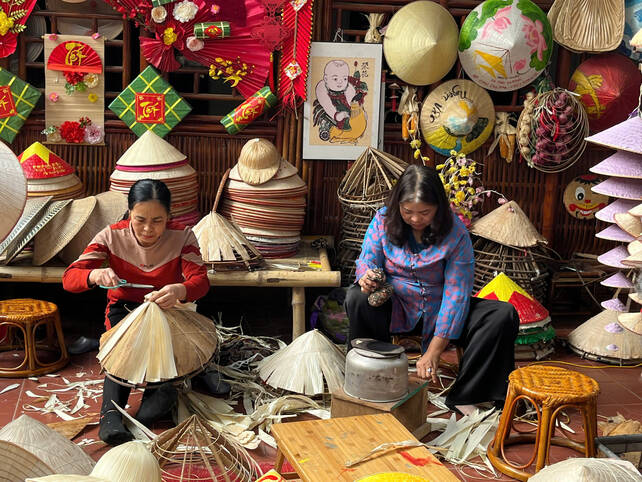
It is the persistence and love for the craft of the Chuong village artisans that has helped conical hats not only survive through the fluctuations of time, but also continue to exist as a familiar cultural value, associated with the lives and memories of many generations of Vietnamese people.
Developing the hat profession associated with tourism and cultural promotion
In the flow of the market economy, when fabric hats and industrial shields rose to prominence, conical hats once faced the risk of being forgotten. However, Chuong village has chosen a new direction: turning consumer products into cultural and tourism products.
In recent years, Chuong village has begun to become an attractive destination on the tourist map of Hanoi. Tourists, especially international visitors, come here not only to buy hats, but also to experience the hat making craft. The craft village space is opened to introduce the hat making process, allowing tourists to directly participate in some stages and listen to craft stories from the artisans themselves.
Experienced tours allow visitors to personally hold needles and try sewing hats under the guidance of artisans. The image of foreign tourists who are not proficient but are full of excitement next to the hat frame has become a great bridge for Vietnamese culture to spread.
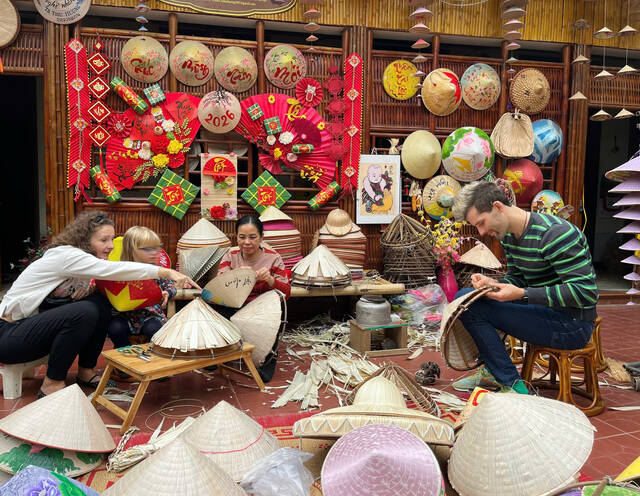
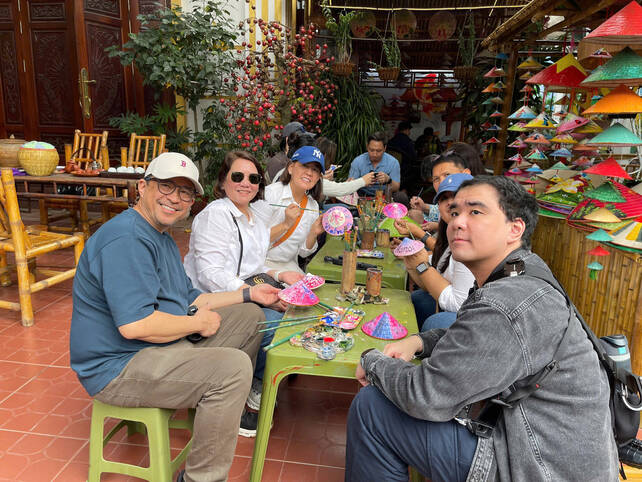
Artisans actively create tourism products such as decorative conical hats, souvenir conical hats, and handicrafts bearing cultural imprints. Combining production with experience helps the conical hat profession have more output, and at the same time contributes to promoting the image of the conical hat - a familiar symbol of Vietnamese culture.
In particular, the greatest pride of the facility is that the conical hat product has been honored to achieve OCOP certification - One Commune One Product Program. The OCOP star attached to the hat is not only a travel ticket affirming superior quality, safe production process, but also the most prestigious commitment.
In order to preserve and maximize the values of traditional craft villages, with the orientation of tourism as one of the key economic sectors, Thanh Oai Commune People's Committee always prioritizes and implements methodically and synchronously many solutions, such as: supporting craft villages, artisans, market development, strengthening promotion and promotion, improving the quality of human resources serving tourism...
In the midst of modern life, the conical hats of Chuong village still silently exist as part of a cultural memory that is not easily faded. From the hands of artisans diligently working by the conical hats to the transformations associated with tourism and cultural promotion, Chuong village is striving to preserve not only a traditional craft, but also the soul of Vietnamese villages.


