In the first National Treasure recognition in 2012, the bronze statue of two people carrying each other playing the khen was one of the typical artifacts of Dong Son culture, along with the Ngoc Lu bronze drum, Hoang Ha bronze drum and the kneeling-shaped lantern discovered in Lach Truong.
According to information from the National Museum of History, the statue was discovered in 1935 by Swedish archaeologist Olov Janse during excavations at the Han tomb area in Lach Truong (Thanh Hoa). This is an artifact belonging to Dong Son culture, about 2,500 - 2,000 years ago.
The statue is cast in brass, with a characteristic gold color, small in size, only 8.5 cm high and 9.5 cm wide. Despite its small size, the statue clearly shows two characters connected in a lively pose.
The bronze statue is cast solidly in a clay mold, without any signs of joining. Artisan Dong Son processed the statue structure according to the principle of three support points, which are the two legs of the carrying person and the extended shackle tail touching the ground, creating a three-legged shape that helps the statue stand firmly without needing a support.
The statue carves the carrier in a jumping posture, with uneven legs. Two arms wrapped backwards to support the person sitting on the back. The person sitting above hugs a khen, holding the khen in one hand, holding the blowpipe in the mouth, and the other hand leaning against the carrier's shoulder. Both are wearing scarves, large earrings, and a yoke, which are typical details of the costumes of Dong Son residents.
Unlike most Dong Son statues that are static decorations, this statue clearly shows a dynamic posture, with interaction between two characters. This highlight makes the statue considered the most vivid block of statues in the Dong Son statue collection currently available.
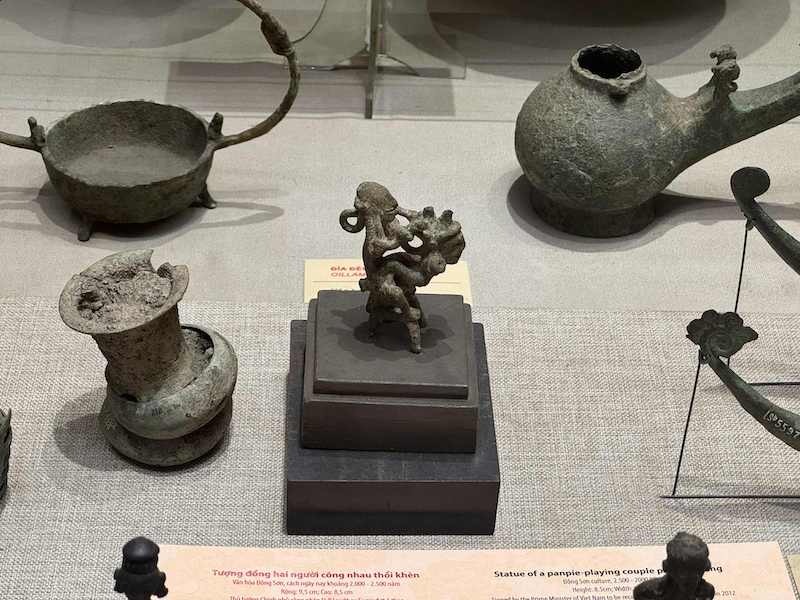
The statue of two people carrying each other blowing the khen shows the bronze casting skills of the Dong Son people. Creating a solid casting mold for a shape with many convex and complex movements requires sophisticated moldmaking techniques and the ability to control the temperature during the copper pouring process. The statue also has patterns engraved on hair and hands, reflecting the combination of shaping and writing techniques of Dong Son artisans.
The statue also reflects a visual mindset towards real life, not religious or mythological symbolism. The image of two people carrying each other blowing the khen may originate from the reality of festival, entertainment, and music activities of ancient Vietnamese residents.
The khen performed in the statue is a popular musical instrument of the Dong Son period. The khen once appeared on bronze drums, bronze axes, muôi handles... showing its important role in community activities. The khen belongs to the breathing system, combined with percussion systems such as drums, bells, gongs to create a typical instrumental form of the Dong Son residents.
To this day, khen is still an important musical instrument in the cultural life of many ethnic minorities in Vietnam such as H'Mong, Muong people or communities in the Central Highlands. This shows the inheritance and continuity in folk music traditions.
The statue also shows that Dong Son residents have dance activities, often associated with music and jewelry that create sounds. Archaeological artifacts show that Dong Son people wear copper tubes, earrings, and horizontal bars with musical beads attached. When they dance, these objects create a loud noise, which is part of traditional festival culture.
Although many Dong Son cultural sites have been excavated, the statue of two people carrying each other playing the khen is still the only artifact with such a vivid dance and music image. This is a precious work, with unique value, not duplicated with any other statue blocks in the same period even though hundreds of ancient villages and ancient tombs of Dong Son culture have been excavated.
The statue provides valuable data on costumes, musical instruments, bronze casting techniques, aesthetic thinking and spiritual life of Dong Son residents.
On October 1, 2012, the statue was recognized by the Prime Minister as a National Treasure under Decision No. 1426/QD-TTg.
Currently, the statue of two people carrying each other playing the khen is preserved and displayed at the National Museum of History, No. 1 Trang Tien (Hanoi), in a thematic exhibition space about Dong Son culture.