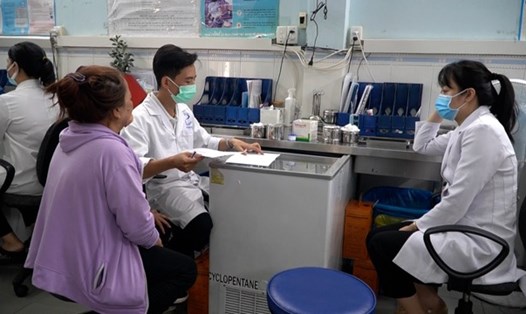
About 5 days before being admitted to the hospital, the child showed signs of fatigue, headache, poor appetite, then developed a sore throat, difficulty swallowing water, and high fever. After just one day, the condition becomes unusual: The child becomes angry, talking nonsense, afraid of water, afraid of the wind, slow to regain consciousness. At a lower-level hospital, doctors suspected the patient of rabies, took a brain drain and saliva for testing but there were no results yet. The patient was given sedatives, an endotracheal tube, mechanical ventilation, and vasopressors. However, the condition did not improve and he was transferred to the Central Hospital for Tropical Diseases.
Doctor Nguyen Thi Huan, Intensive Care Center, Central Hospital for Tropical Diseases, said: When admitted, the patient had to use a ventilator through an endotracheal tube, maintain 3 high-dose vasopressors, and slow-glare refractive errors, increased phlegm secretion in the throat. The patient was diagnosed with septic shock, encephalitis - meningitis. In particular, because the patient showed signs of fear of water and wind and had a history of raising dogs but died abnormally, the doctors thought a lot about rabies.
Test results later confirmed that the patient was positive for the rabies virus.
The family representative said: I don't know if my child was bitten by a dog or had direct contact, so I haven't been vaccinated.
After the results confirmed that the patient had rabies, the family asked to take the child back to take care of at home.
Dr. CKII Nguyen Nguyen Huyen - Director of the Center for Epidemic Prevention and Immunization, Central Hospital for Tropical Diseases - emphasized: Rabies almost always causes death after symptoms appear. There is currently no specific treatment, but it is completely achievable if vaccinated promptly after exposure".
Rabies virus exists in the saliva of sick animals such as dogs and cats and can be transmitted to humans through bites, scratches or when saliva comes into contact with open wounds and mucous membranes. When developing the disease, patients are often afraid of water, wind, convulsions, perception disorders and paralysis, with the risk of death almost certain if not prevented early.
Experts recommend: When bitten or scratched by a dog, cat or any animal, wash the wound with soap in running water for at least 15 minutes, do not apply leaves, do not self-treat, then go to a medical facility to get vaccinated and anti-rabies serum if necessary. Do not wait to monitor pets if you do not ensure strict supervision.