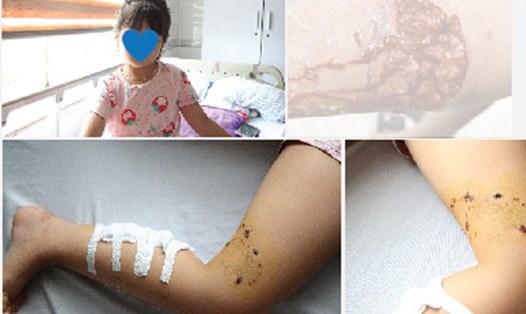
Patient N was transferred to the National Hospital for Tropical Diseases, a part of the patient's femur was seriously destroyed, the risk of disability and limb loss is always present.
According to his family, the patient was originally a dynamic boy, who loved sports, especially football. About two months ago, N began to experience continuous high fevers accompanied by chills, at times his body temperature reached 40 degrees Celsius.
Initially, N only complained of severe pain in both thighs. The family thought this was a sign of muscle fatigue due to excessive exercise, so they were not too worried. However, the pain quickly spread throughout the body, forcing the family to take her to a medical facility for examination.
The condition progressed very quickly. In just a short time, the child fell into acute respiratory failure, had to be supported with oxygen and transferred to a higher level for treatment. Here, doctors diagnosed the child with septic shock, sepsis due to Staphylococcus aureus - a dangerous form of blood infection that could be life-threatening.
The patient had to undergo 6 days of invasive ventilation and surgery to drain pus from both thigh muscles to control the infection site. Although the fever was cured after nearly a week of intensive treatment, N's legs were severely damaged. The child was almost unable to walk, the right thigh area was severely painful, and pus mixed with blood still continuously permeated the bandage.
Recognizing the risk of bone necrosis and disability, doctors transferred the patient to the National Hospital for Tropical Diseases for intensive treatment.
Upon admission, pediatricians recorded that the patient was in a state of malnutrition, with a thin and weak body. Both legs had many old surgical wounds still oozing fluid, mixed with blood and thin pus.
Test results showed that the CRP index - a marker reflecting inflammation in the body - increased to 194.9 mg/L, dozens of times higher than the normal threshold. The bacterial culture result identified the pathogen as Staphylococcus aureus.
Image diagnosis instruments showed particularly severe lesions. MRI and soft tissue ultrasound images recorded diffuse myelitis in the femur, with multiple abscesses in the bone, under the periosteum, and muscle masses in the pelvis, buttocks, and right thigh.
Notably, ultrasound revealed a pus bump of 12x15 mm in size located close to the femur pelvis, deeply encroaching into the bone tissue and forming a leak out of the skin. The entire soft tissue in the buttocks, thighs and calves on both sides was seriously swollen.
Doctors diagnosed the patient with septicemia due to Staphylococcus aureus accompanied by femoral fasciitis.
Faced with severe bone necrosis, pus continuing to leak and a very high risk of loss of motor function, doctors held an inter-specialty consultation and decided to perform surgery.
BS.CKII Hoang Manh Ha, Head of the Department of Orthopedic Trauma Surgery and Spinal Neurosurgery, who directly performed the surgery, said that Staphylococcus aureus bacteria had entered the body through the bloodstream, then localized in the bone cages and long bone marrow cavities.
Here, bacteria multiply strongly, causing inflammation, necrosis, destroying bone structure and forming a series of abscesses in bones as well as surrounding soft tissues," Dr. Ha said.
In more than an hour of surgery, the team maximized the dredging of abscesses, removing inflammatory tissue and necrotic tissue in bones as well as soft tissues. To thoroughly control the remaining infections that could not be observed with the naked eye, doctors used antibiotic cement to fill bone gaps.
According to doctors, antibiotic cement will slowly release the drug right at the site of the injury, helping to kill bacteria effectively. After about 3-6 weeks, when the inflammation is completely controlled, the patient will continue to undergo autologous bone graft or artificial bone surgery to regenerate the lost bone.
This is considered an effective treatment method today, helping to control osteomyelitis, preserve limbs and restore motor function for patients.