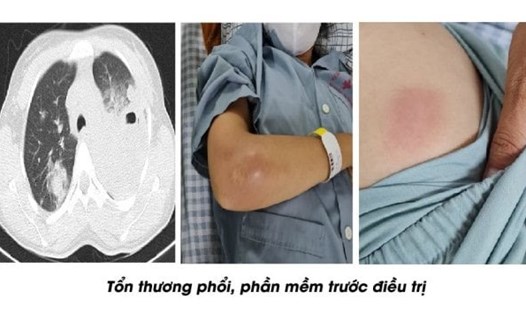
Male patient L.V.T, 35 years old in Nghe An, lives and works in Thailand - an area with high Whitmore disease. He has a history of diabetes that he was recently diagnosed with. About five weeks ago, when he returned to Vietnam, the patient had a continuous high fever, difficulty breathing, and was highly agitated, and had to be hospitalized at a medical facility in Thailand.
Here, the patient was placed in a mechanical ventilation room; the results of the blood culture determined to be infected with Burkholderia pseudomallei - the cause of Whitmore disease. Despite initial treatment, the condition continued to worsen, so the family asked to move back to Vietnam to continue treatment. But after only a few days, the patient fell into septic shock, multiple organ failure, continuous high fever, impaired consciousness and was urgently transferred to the Emergency Department - Central Hospital for Tropical Diseases.
Dr. Nguyen Kim Anh, Emergency Department, Central Hospital for Tropical Diseases, said: The time to receive the patient was a very stressful moment. The patient was in a deep coma, with a Glasgow scale of only 9, lost airway reflex, and depended entirely on the ventilator. Continuous temperature 4142°C with systemic trembling, suggesting a malevolent body temperature increase on the basis of acute sepsis.
Tests showed high liver enzymes and bilirubin, blood clotting disorder, createdinin increased rapidly with un much - manifestations of liver failure, advanced acute renal failure. The CK concentration exceeds 100,000 U/l, accompanied by muscle pain and dark urine, suitable for acute melasma. Inflammation indicators such as CRP and PCT have increased significantly, reflecting a severe state of infection - severe poisoning throughout the body. On that basis, there is uncontrolled diabetes and chronic hepatitis C, which further reduces the patient's body.
According to Dr. Kim Anh, this is one of the most severe forms of Whitmore - severe sepsis, multiple organ failure, deep metabolic disorders and a great risk of death in a very short time if not immediately activated.
After about three days of high resuscitation, the patient began to have a fever, inflammation index gradually decreased, blood pressure was more stable with reduced vasopressor demand, liver and kidney function improved, and perception gradually recovered. The patient was given a ventilator to open the tracheal tract, do natural breathing exercises and restore movement. During three weeks of intensive treatment in the Emergency Department, doctors continued to optimize antibiotics, strictly control blood sugar, support nutrition and recover function early.
Dr. Kim Anh recommends: Whitmore is a dangerous infectious disease that can cause multiple organ failure and rapid death, especially in people with underlying diseases such as diabetes, chronic liver disease or those who have worked for many years in soil and humid environments. The disease can kick off at an unusual time with symptoms such as prolonged fever, fatigue, headache, muscle pain, cough, weight loss or perception disorder, which are easy to miss. People with risk factors or symptoms of prolonged fever of unknown cause need to go to infectious facilities for timely testing, diagnosis and treatment, while fully complying with the long-term antibiotic regimen to avoid recurrence. This is a community warning against being subjective about prolonged fevers, especially in people with underlying health conditions and living and working in Whitmore's epidemic area.