
On December 23, information from Xuan Lien Nature Reserve (in Thuong Xuan district, Thanh Hoa province) said that in the primeval forest area (in Vin village, Bat Mot commune, Thuong Xuan district), a "strange" plant species with a transparent white color and no chlorophyll was recorded.
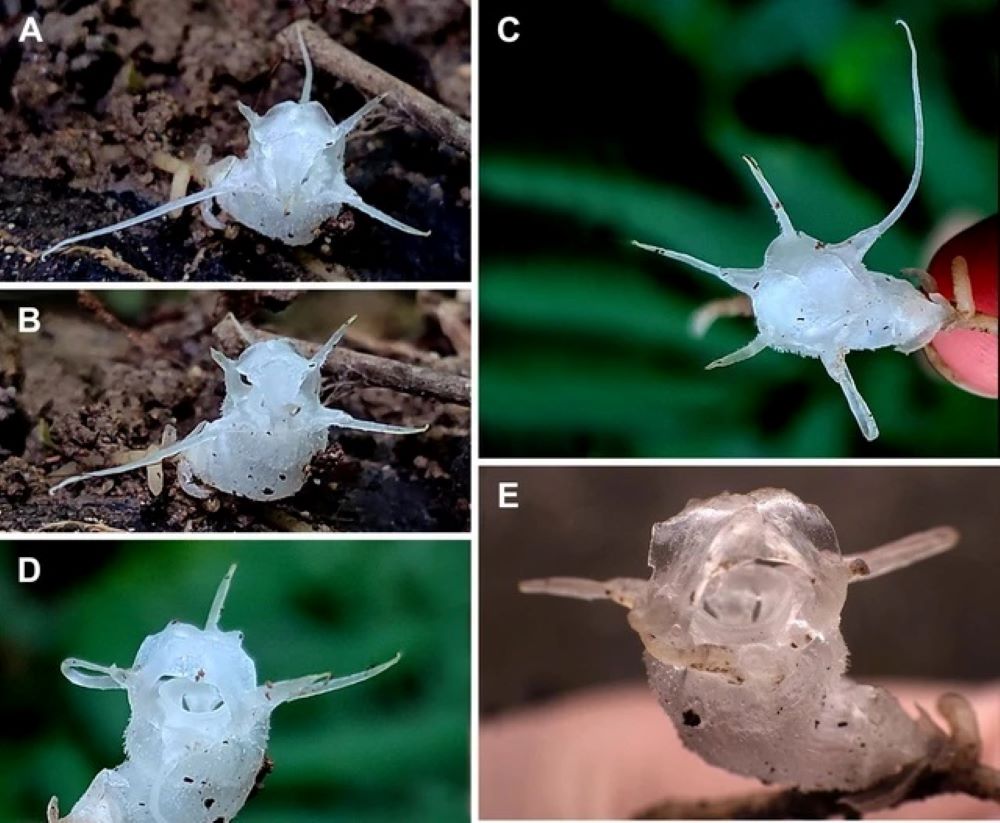
Previously, during an ecological and biodiversity survey trip, scientists from the Vietnam - Russia Joint Research Group (Vietnam - Russia Tropical Center and Moscow State University, Russia) together with scientific staff of Xuan Lien Nature Reserve discovered and recorded a new plant species.
The new species, scientifically named Thismia papillata, is the only chlorophyll-free plant discovered at an altitude of 800 m above sea level.
Scientists say that normally, plants with chlorophyll synthesize their own nutrition through photosynthesis. Most plants without chlorophyll must obtain nutrients through symbiosis with some fungi during growth and development, called heterotrophic plants (Mycoheterotrophic).
Thismia papillata species belongs to the genus Thismia, family Thismiaceae, is a very small herbaceous plant that lives in symbiosis with fungi, has slightly succulent stems, fibrous roots, lives on land and prefers moderate moisture.
The flowering branch is about 1 mm long, bearing a single flower at the terminal end surrounded by three bracts. The leaves are small, alternate or opposite, reduced to triangular or ovate scales, glabrous, 2 mm long and devoid of chlorophyll.
Flowers are bisexual, pale white, about 13 mm long, inverted cup-shaped, slightly inclined, with prominent papillae on the outside, curved about 90 degrees in the middle. The stamens are united into a curved tube shaped like a boot, the lower ovary has many cells.
The most distinctive feature of this species from other species in the genus Thismia is the morphology of the appendages of the outer and inner perianth. The inner perianths are fused into a cap.
To date, scientists have identified 109 species of the genus Tit Mi worldwide, most of which are distributed from tropical and subtropical Asia to temperate Australia and the Americas.
In Vietnam, scientists have also identified 6 species of the genus Thismia. Notably, all 6 species are distributed from Quang Tri onwards. Only one specimen of the Thismia papillata species in Xuan Lien was discovered, recorded for the first time to be distributed at the highest latitude in our country.


