
According to park officials and video recorded by witnesses, the hydrothermal explosion at Yellowstone National Park in the US on July 23 local time caused visitors to flee. Fortunately, no injuries were reported, according to Global News.
The US National Park Service (NPS) said the explosion occurred at about 10:20 local time near Sapphire Lake in the Biscuit Basin, located about 3.5 km northwest of the famous Old Faithful geyser. .
The entire Biscuit Basin area, including the parking lot and boardwalk, is closed until further notice for safety reasons.
Video of the explosion showed a huge column of gray smoke rising above the Biscuit Basin geothermal area, accompanied by hot water, debris and rocks thrown into the air. Tourists, including many children, scrambled to escape.
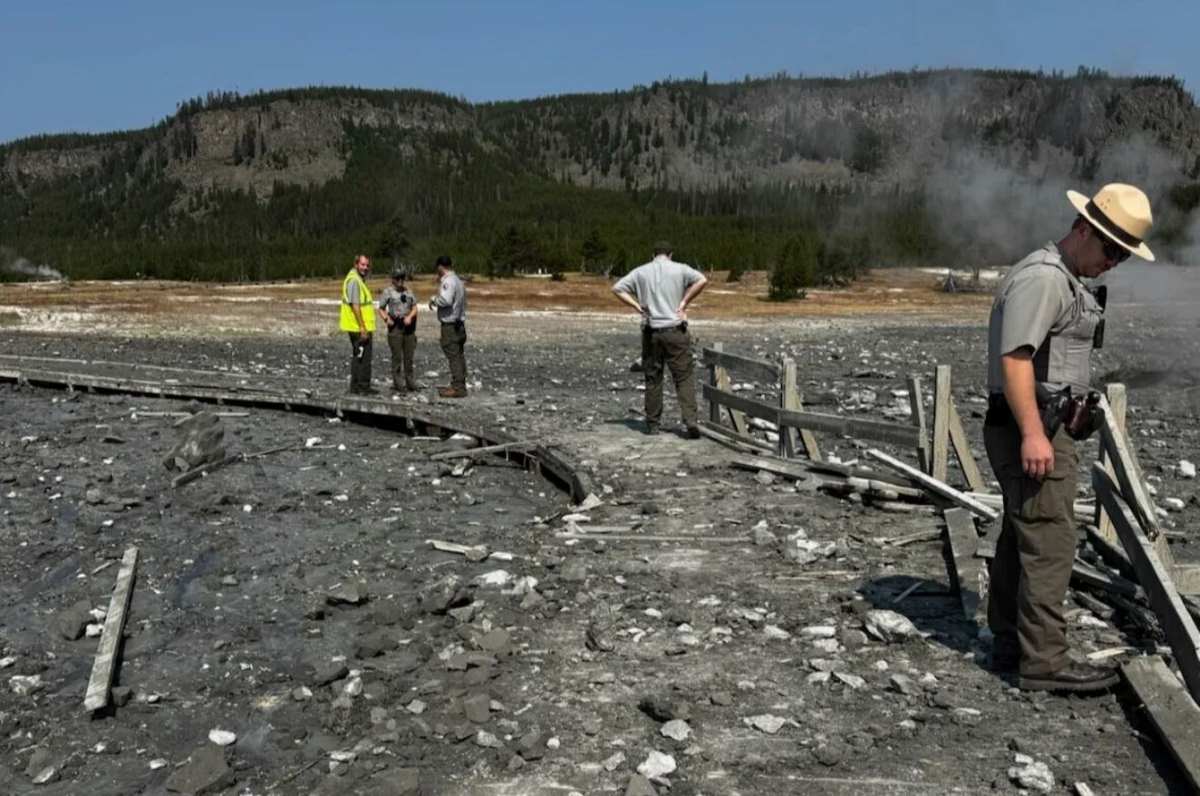
Officials said it is unclear at this time the extent of damage caused by the explosion. Photos of the aftermath show the Biscuit Basin boardwalk covered in black dust and debris, and some wooden railings severely damaged.
Vlada March was on a tour when the tour guide said something unusual was happening, so she started recording video.
“We saw more steam rising and within seconds it became this huge thing. It just exploded and became a black cloud covering the sun. I think our tour guide said 'Run,' and I just started running and kept filming what I could," March said.
According to a joint statement from NPS and the US Geological Survey (USGS), the explosion appeared to originate from Black Diamond Pool.
Black Diamond Pool is a large hot pool with blue water, formed from hydrothermal explosions. Black Diamond Pool erupted with murky black water after an earthquake in July 2006, with several explosive eruptions in the following days. Eruptions have been sporadic since then, the last eruption observed in 2016.
The water in Black Diamond Pool has an average temperature of 64.7 degrees Celsius, an average pH of 8.2 and an average conductivity of 2092 uS/cm.
Hydrothermal explosions occur when water suddenly turns into steam underground. Liquid water takes up much less volume than steam, so when this hot water evaporates, it quickly expands, causing an explosion.
“Hydrothermal explosions are violent and dramatic events that result in the rapid eruption of boiling water, steam, mud and rock fragments. Explosions can reach a height of 2 km and leave craters ranging from a few meters to more than 2 km in diameter," according to the USGS information page.
Scientist Mike Poland of the Yellowstone Volcanic Observatory estimated that the explosion pushed water and mud about 30 meters into the air.
“Hydrothermal explosions like today are not signs of impending volcanic eruptions, and they are not caused by magma rising to the surface,” NPS added.
Yellowstone National Park sits atop one of the world's largest supervolcanoes . Yellowstone's famous geysers and hot springs are heated by the volcano's underground magma.
Established in 1872, Yellowstone became the world's first national park and a symbol of North America's natural resources. By 1978, it was recognized as a world heritage site.


