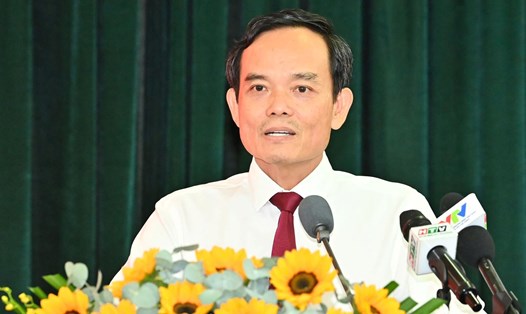
The above information was announced by Politburo Member, Secretary of the Ho Chi Minh City Party Committee Tran Luu Quang at a dialogue conference between the Standing Committee of the Ho Chi Minh City Party Committee and trainees of the training class, updating knowledge and skills for City Party Committee members; heads and deputy heads of agencies, departments, agencies, and branches of the city and the Standing Committee of the Party Committee directly under the Ho Chi Minh City Party Committee, on the afternoon of July 28.
According to Mr. Tran Luu Quang, there are currently 705 communes, wards, and special zones nationwide that do not fully meet the standards for population and area. Ho Chi Minh City alone has 54 units.
Among these, if considering the population criterion separately, Ho Chi Minh City has Con Dao Special Zone and Thanh An island commune that have not met the standards. However, these are two localities with special conditions in terms of geographical location, sea and island factors, national defense, and security, so it is difficult to implement the merger.
The remaining 52 communes and wards mainly do not meet the criteria for area after the process of arranging administrative units.
Ho Chi Minh City Party Secretary emphasized that area and population are only two of the many criteria for considering the arrangement of administrative units.
The adjustment of boundaries cannot be done mechanically but needs to be scientifically researched, cautiously, in accordance with actual conditions and create consensus among the people.
According to Mr. Tran Luu Quang, in addition to the criteria stipulated by the National Assembly, the review process must also assess many other factors such as development potential, geographical location, infrastructure conditions, national defense and security requirements, and the specific characteristics of each locality.
Therefore, whether to continue merging commune-level administrative units or not will be studied and proposed by Ho Chi Minh City and each locality based on practice.
The Standing Committee of the Ho Chi Minh City Party Committee has assigned communes, wards, and special zones to organize exchanges, reviews, and assess the needs for arrangement and report to the city. This process must be associated with collecting people's opinions to ensure consensus before implementation.
To ensure objectivity, the Standing Committee of the Ho Chi Minh City Party Committee also assigned the Ho Chi Minh City Development Research Board to conduct independent research, focusing on assessing factors of potential, development advantages, national defense, security and related conditions.
Based on proposals from localities and research results from specialized agencies, the Standing Committee of the Ho Chi Minh City Party Committee will consider and decide on each specific case.
Ho Chi Minh City Party Secretary said that localities and the Ho Chi Minh City Development Research Board must complete the review, research, and report to the Standing Committee of the City Party Committee before August 30.
After merging with Binh Duong and Ba Ria - Vung Tau, Ho Chi Minh City currently has 168 commune-level administrative units, including 113 wards, 54 communes and 1 special zone.
In parallel with reviewing units that have not met standards, Ho Chi Minh City is also implementing steps to transfer 29 eligible communes to wards.
The list of 29 communes being considered for conversion into wards includes: An Nhon Tay, Binh Hung, Binh Chanh, Ba Diem, Binh Loi, Binh My, Dong Thanh, Hoc Mon, Hung Long, Long Hai, Long Dien, Nha Be, Ho Tram, Ngai Giao, Tan An Hoi, Tan Nhut, Tan Vinh Loc, Vinh Loc, Xuan Thoi Son, Thai My, Cu Chi, Dat Do, Can Gio, Hiep Phuoc, Phu Hoa Dong, Chau Pha, Long Son, Bau Bang and Bac Tan Uyen.