
Some Wall Street experts are issuing negative warnings about gold prices this week, saying that the precious metal may continue to be under downward pressure in the context of the market being dominated by interest rates, the USD, oil prices and geopolitical tensions.
Rich Checkan - chairman and CEO of Asset Strategies International - predicts gold prices will fall. According to him, the market is reacting in an "unreasonable" way to tensions between the US and Iran.
Usually, geopolitical instability will support gold, but in the current conflict, escalating tensions will cause gold prices to fall, and when tensions cool down, gold prices will increase again.
Another factor putting pressure on gold is the meeting of the US Federal Open Market Committee (FOMC). Checkan said the market is almost certain that the Fed will keep interest rates unchanged. Investors are believing that gold will be disadvantaged if interest rates are not lowered.
However, this expert believes that argument is not convincing. He cited official inflation being close to 3%, while interest rates are at 3.5%. With a real yield of only about 0.5 percentage points, Checkan believes that this level is not attractive enough to make investors give up gold. However, he still believes that gold prices may fall this week.

Sean Lusk - co-director of trade hedging at Walsh Trading - also leans towards the scenario of gold prices falling. According to him, gold is still trading in the opposite direction to energy. As oil prices rise due to risks related to Iran and the Strait of Hormuz, the precious metal is under pressure again.
Lusk believes that investors are currently looking for a new bottom for gold and silver. He said the "easiest direction" for the market in the short term is to decrease. With gold, the more attractive price to return to buying may be around 4,300-4,400 USD/ounce, significantly lower than the current range.
Walsh Trading experts warn that if the Strait of Hormuz continues to be closed for about another month, commodity prices may be strongly affected. At that time, Brent oil could rise to 135-140 USD/barrel, while WTI oil could rise to 120 USD/barrel. According to Lusk, this development is not beneficial for gold and silver.
In addition to oil prices, Lusk also pointed out another unfavorable factor that the USD is still supported. He believes that the Fed is unlikely to cut interest rates soon, even if Kevin Warsh takes over as Fed Chairman, because economic data does not support this move. Meanwhile, US stocks are rising sharply, causing cash flow to prioritize stocks over precious metals.
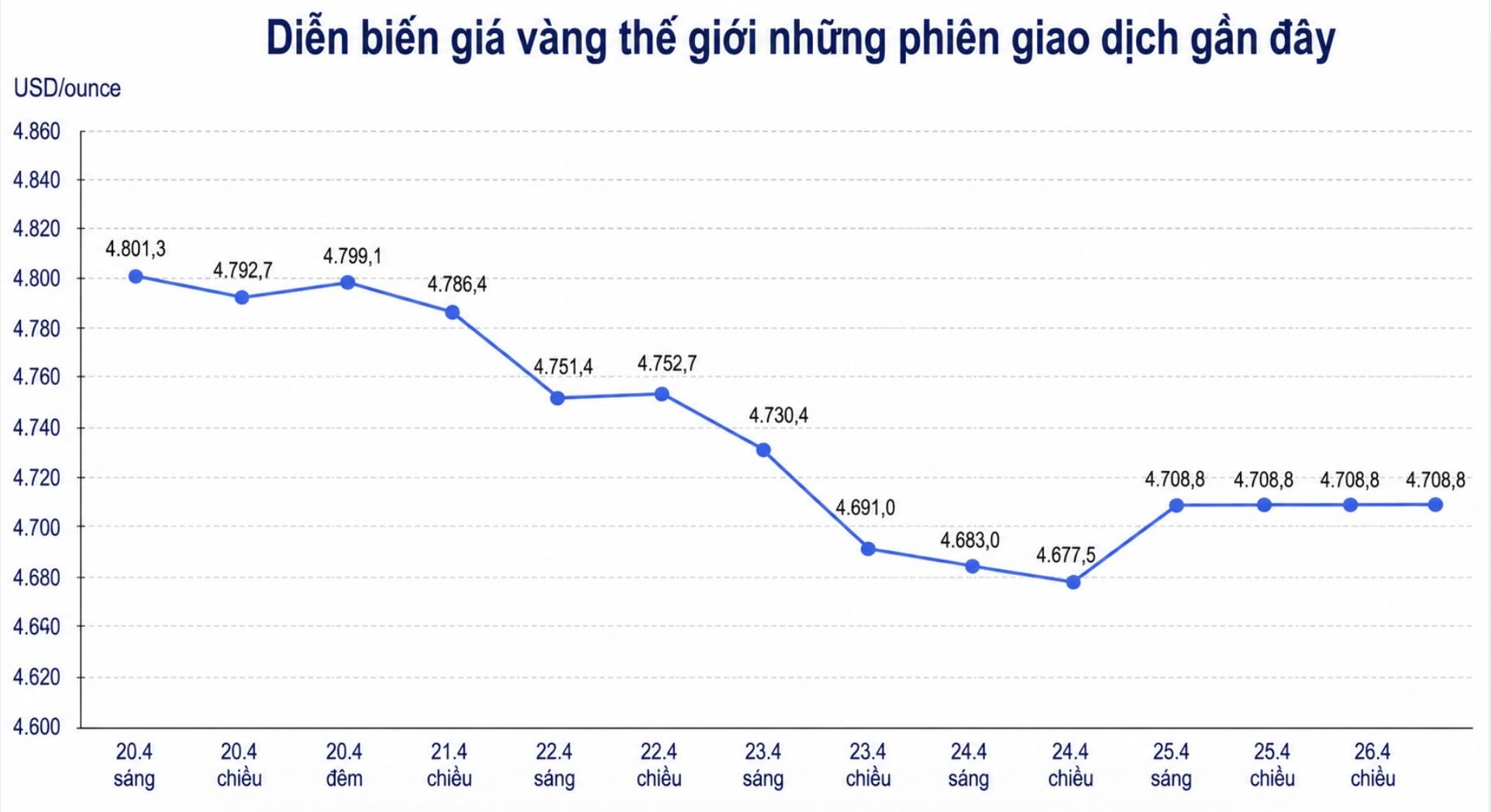
Alex Kuptsikevich - senior market analyst at FxPro - issued a clearer warning about the risk of a deep drop in gold. According to him, gold prices lost about 2.5% in the past week, at times falling below 4,660 USD/ounce before recovering to 4,700 USD/ounce.
Technically, Kuptsikevich said selling pressure is increasing after gold broke the upward channel formed from the end of March. The fact that the price cannot surpass the 50-day moving average is also a downward signal, making selling pressure stronger.
Regarding fundamental factors, FxPro experts believe that the recovery of oil prices and the USD, along with developments around Iran, are pulling gold down. In addition, the US stock market and some other countries are continuously setting new peaks, increasing expectations that monetary policy will maintain a tight state in the coming months.
Kuptsikevich believes that the series of meetings of central banks this week may make market sentiment more tense. Although Japan, the US, Canada, the UK and the euro zone are not expected to change interest rates, policy statements may be more tough.
In the base scenario, FxPro experts predict that gold prices may fall to 4,500 USD/ounce, or even slip to 4,400 USD/ounce. This is one of the most negative forecasts, showing that the risk of a sharp drop in gold prices is still present in the short term.


