
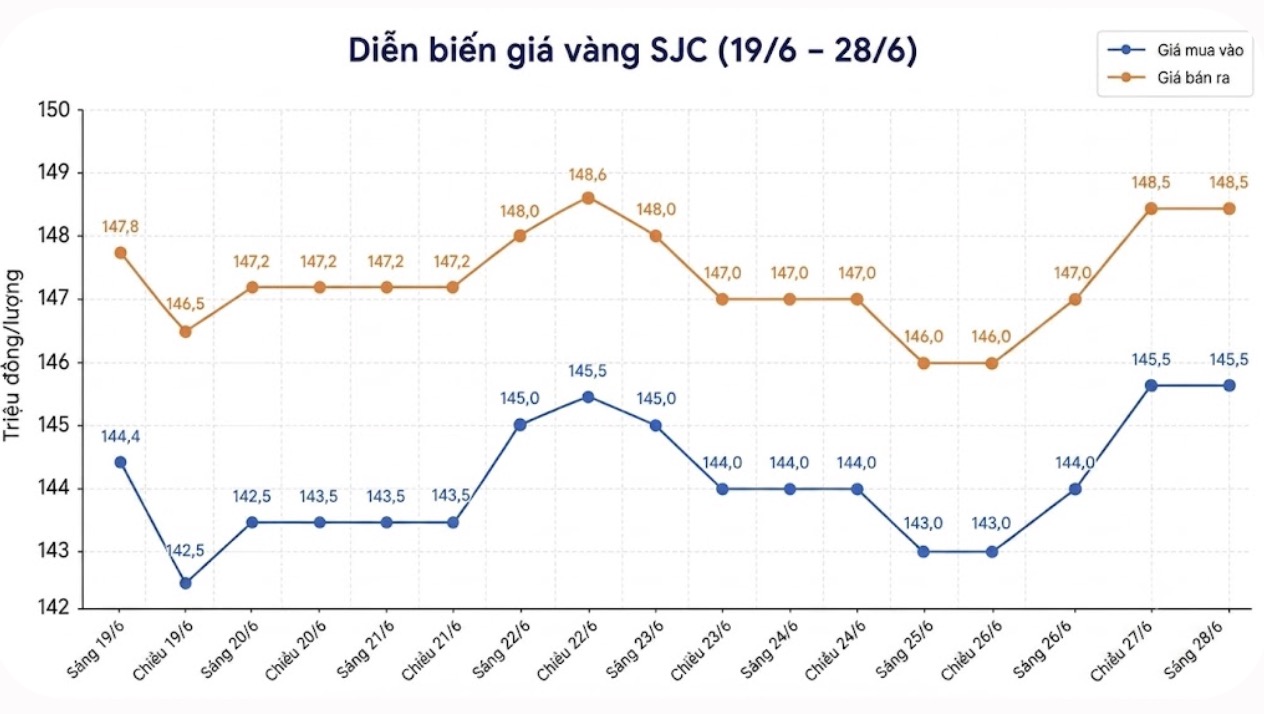
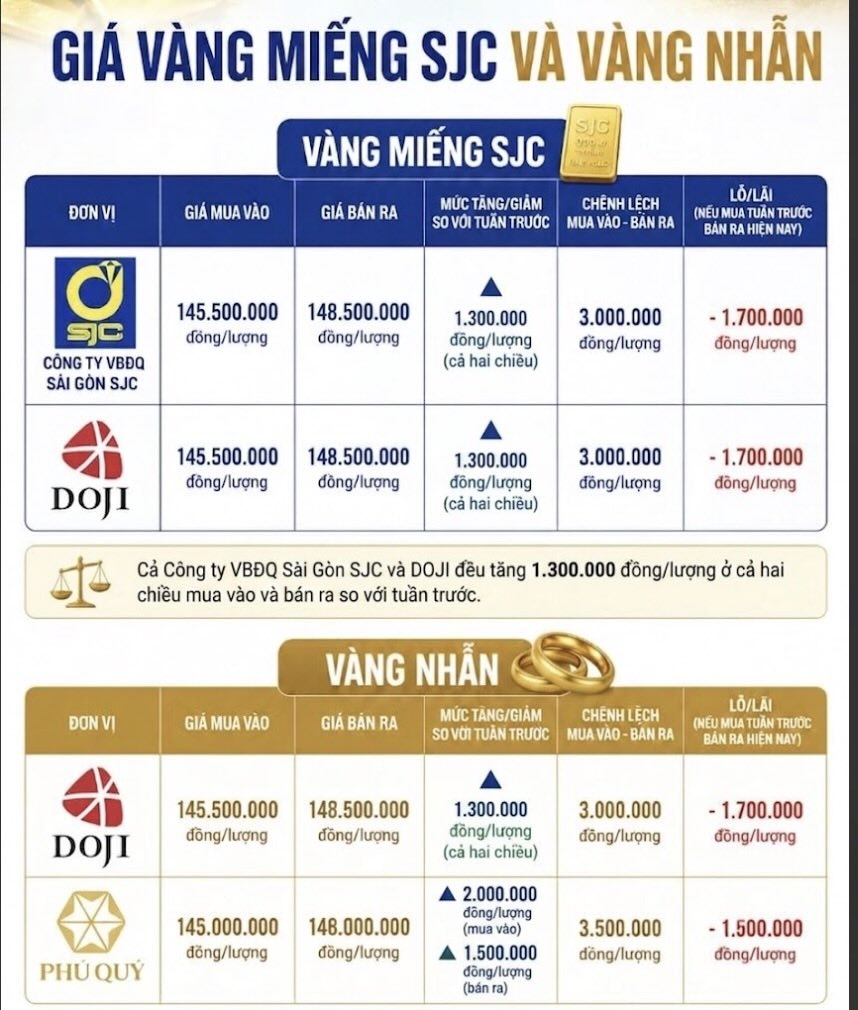
The domestic gold market has just experienced a volatile trading week but brought a paradoxical ending. Recorded at the weekly closing session on June 28, Saigon SJC Jewelry Company and DOJI Group simultaneously listed SJC gold bar prices at 145.5 million VND/tael for buying and 148.5 million VND/tael for selling.
Compared to the closing session of the previous week (June 21), the price of SJC gold bars in both of these units has increased by 1.3 million VND/tael in both buying and selling directions.
However, the increase in gold prices did not bring joy to individual investors. If a person buys SJC gold bars on June 21st at the selling price of businesses and decides to resell them on today's session (June 28th) at the purchase price, they will have to sadly suffer a loss of up to 1.7 million VND/tael.
A similar situation also occurred for 9999 plain gold rings. At DOJI Group, the price of gold rings was listed equal to gold bars at 145.5 - 148.5 million VND/tael (buying - selling), an increase of 1.3 million VND/tael after a week, but buyers still recorded a loss of 1.7 million VND/tael.
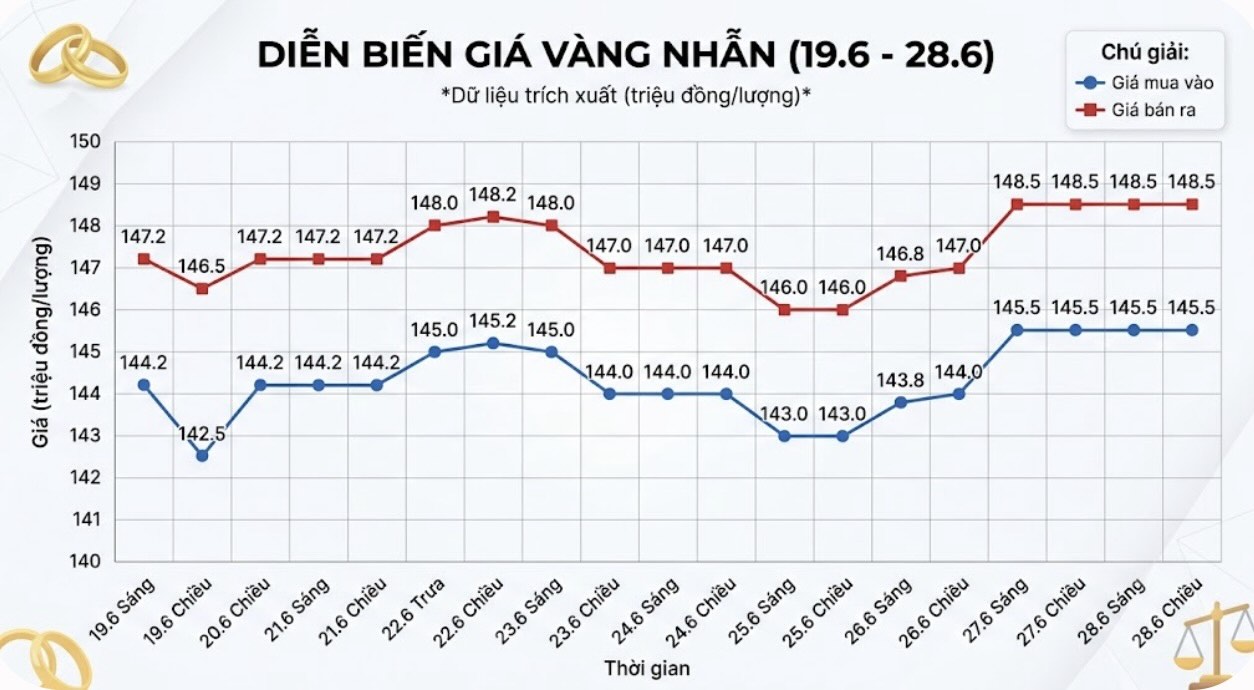
At Phu Quy Jewelry Group, although the price of gold rings was adjusted to increase more sharply to anchor at 145 - 148 million VND/tael, buyers here still suffered a loss of 1.5 million VND/tael after a week of trading.
The buying-selling difference widened to 3 million VND/tael. The main reason leading to the paradox "gold prices increase, buyers suffer heavy losses" lies in the gap between buying and selling prices being stretched too wide by precious metal businesses. According to surveys, all large units such as SJC, DOJI and Phu Quy are maintaining the buying-selling difference at an extremely risky level: 3 million VND/tael.
In the context of market fluctuations, the fact that business units are expanding the buying - selling range is a move that pushes risks towards customers. When this gap reaches 3 million VND/tael, the selling price of the market must increase by at least more than 3 million VND for investors to start making profits. If the increase is lower than last week, investors will definitely bear losses when settling short-term debts.
In stark contrast to the somewhat forced upward momentum of the domestic market, world gold prices have just experienced a week of decline. Closing the weekly trading session, world gold prices were listed at 4,088.6 USD/ounce, down 66.1 USD/ounce compared to a week earlier. The global gold market is entering a period of fierce tug-of-war around the important psychological support level of 4,000 USD/ounce.
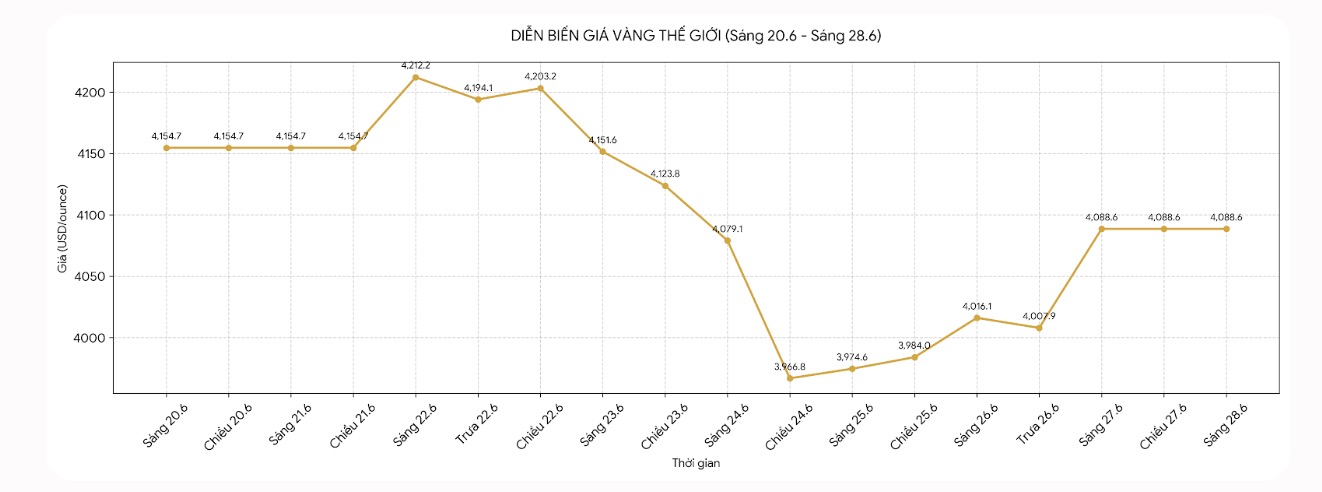
The biggest pressure on the precious metal currently comes from the strong "hawkish" move of the US Federal Reserve (Fed). Investors increasingly believing in the possibility that the Fed will implement an interest rate hike from now until the end of the year is adding strength to the USD, directly blurring the attractiveness of gold.
The sharp drop in world gold prices is creating great pressure on the domestic gold market. Historical reality has proven that domestic gold prices, although with a certain delay, can never go completely against the general trend of the global economy in the long term.
When world prices fluctuate strongly, gold buyers at this time need to be especially alert, continuously update and closely follow indicators from the international market to avoid making wrong disbursement decisions.
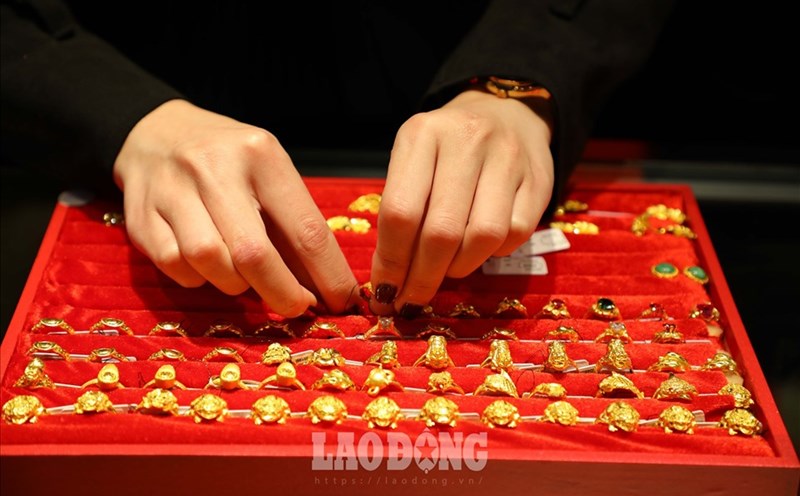
The fact that businesses are widening the buying-selling price difference to a record level of 3 million VND/tael is putting risks on consumers, creating a risk of losses waiting right after completing transactions.
In this context, investors should not be afraid of missing opportunities (FOMO), avoiding the situation of following the crowd to chase prices at all costs in abnormally hot domestic market sessions. In particular, using financial leverage or borrowing money to surf short-term gold waves is considered an extremely dangerous "catching a falling knife" action.


