
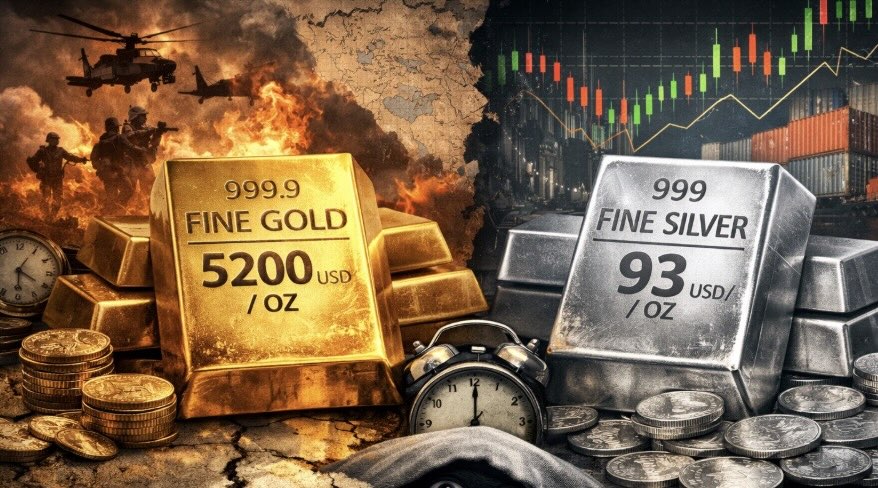
According to Kitco, as the market is concerned about escalating conflict in the Middle East, gold prices have returned above the 5,200 USD/ounce mark before entering the end of the week.
This development shows that many investors are willing to pay more to "buy insurance", instead of anxiously waiting for the futures contract opening session on Sunday evening.
Meanwhile, silver is playing a role as a more volatile "brother" of gold, when vibrant, sometimes dramatic, but still within the general safe-haven trend. Silver prices are currently maintaining above 93 USD/ounce, maintaining their upward momentum even though market momentum has somewhat cooled down.
Both precious metals closed the month near record highs - an impressive reversal if looking back at the beginning of February. At that time, gold prices once fell deeply before buying power returned strongly; while silver witnessed even more violent fluctuations.
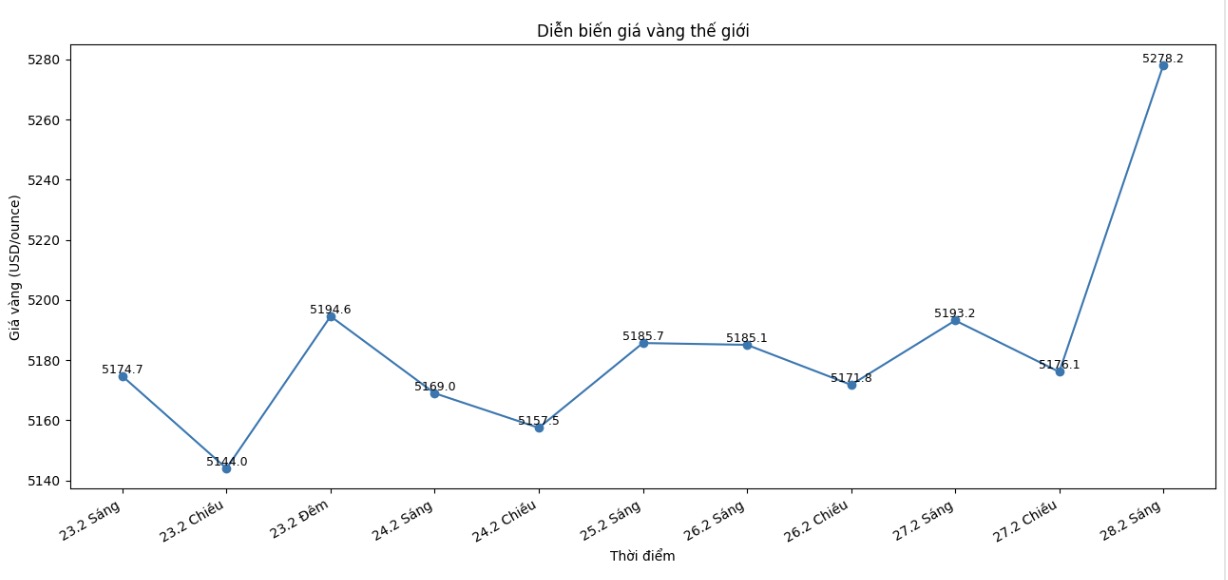
Since the bottom of nearly 4,400 USD/ounce, gold prices have increased by about 19%. Silver even increased by more than 45% from the bottom around 64 USD/ounce. Despite fluctuations and strong selling pressure at the beginning of the month, the long-term uptrend is still maintained.
Not only geopolitical factors support the upward momentum. Increased global public debt, prolonged budget deficits and re-export trade tensions continue to strengthen the strategic role of gold in the investment portfolio.
Bank of America believes that even though gold prices are accumulating below the 5,200 USD mark, this precious metal may still reach 6,000 USD. MKS PAMP Group believes that the upward price market is currently only in the middle of the cycle, with the possibility of gold prices reaching 6,750 USD when the political context in the US enters a peak period. In other words, the increase may be temporarily "recovering strength", but the road ahead has not stopped.
However, the upward momentum never goes straight. After historical increases, many experts believe that market adjustment and further accumulation are necessary. Markets that increase too quickly often also adjust strongly no less.
Even "loyal" investors to gold admit that adjustment phases will help create a more sustainable foundation. With silver - which is sensitive to industrial demand - volatility may remain strong if economic growth prospects change according to information on tariffs and global trade.
In the near future, one of the major obstacles may come from US monetary policy. A report by the US Department of Labor released on Friday showed that wholesale inflation increased by 2.9% in the past 12 months, higher than experts' forecast of 2.6%.
Persistent inflationary pressure may force the US Federal Reserve (Fed) to maintain a neutral policy stance longer than expected, thereby reducing expectations of interest rate cuts - a factor that may somewhat curb gold's upward momentum.
However, at the present time, the precious metal market is still supported by a clear reality: instability is present on many fronts, global debt continues to expand and policymakers have to fend for themselves in an increasingly complex geopolitical context. In that environment, investors do not abandon gold and silver - they take advantage of buying more when prices adjust.
The question at this time is no longer whether gold and silver are worthy in the investment portfolio or not. The issue is how much "safety" is needed when the world is still volatile. And through the latest price movements, it can be seen that many investors choose to hold a little more - in case another surprise appears before Monday morning at the end of the week.
See more news related to gold prices HERE...


