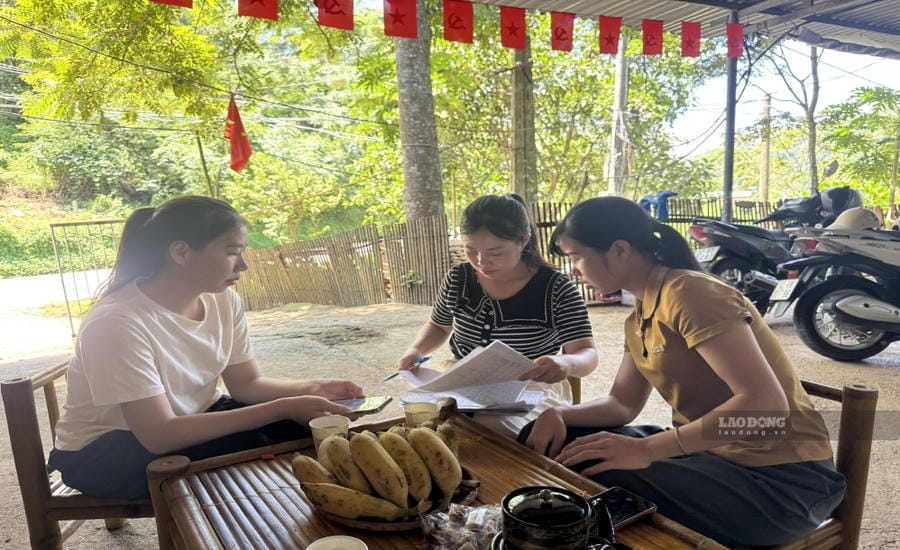
Zalo group and trips to each house
At nearly 11 pm, Mr. Hoang Van Thuc received news of a collision at a shop in the area, and immediately went to the scene to coordinate in handling it. This is one of many overtime calls since he became Village Head of Hop Nhat, Thanh Thinh commune, Thai Nguyen province. The village was merged from four old villages, with 216 households with 570 people. The area is large, without the deputy village head, so most of the work is directly undertaken by Mr. Thuc.
Having worked as Secretary of the Youth Union branch, selling goods online and regularly using social networks, Mr. Thuc was trusted by the local authorities to assign tasks thanks to his ability to apply technology.
Although initially under pressure because he was young and had little experience in mass mobilization, he established three Zalo groups according to residential clusters to quickly update notifications, meeting schedules and new policies.
The liaison group has a rule not to post sales, incitement, offensive information or unverified documents. According to Thuc, the village's cyberspace must serve common work, avoiding becoming a place to spread rumors.
However, not every household has a smartphone. Some elderly people, poor households or families living far from residential areas do not use Zalo. In these cases, Thuc asks neighbors to notify or directly come to his house. "Technology helps work faster, but cannot replace meeting and listening to people" - he said.
From online sales experience, Mr. Thuc makes a video "village head's diary" recording daily work in a close way, but always considers protecting private information and avoiding posting unverified events.
Social networks also help him connect resources to support people in difficult circumstances. Through a call, a poor household was given a refrigerator and many essential foods. However, with issues such as compensation, resettlement and livelihoods, technology cannot replace direct dialogue. "Many things are not under the authority of the village head, he can only listen to, summarize petitions and act as a bridge with the government" - Mr. Thuc said.
Bringing screens into meetings, technology to the fields
In Na Sam commune, Lang Son province, Ms. Lang Thi Tho, born in 1993, Head of Doan Ket village, is also looking for ways to bring technology into operation and economic development.
Graduating with a major in Social Work from the University of Science, Thai Nguyen University, she worked for more than 7 years at the Commune People's Committee before retiring to start a business, produce and do business.
Doan Ket village has about 208 households, a large area and no common cultural house. Meetings still have to be organized by area, causing the same content to be implemented many times.
Ms. Tho plans to use computers, projection screens, images and video illustrations in meetings. Instead of just reading documents, policies, guidelines or production models will be visually displayed for people to easily understand and remember.
According to her, applying technology must go hand in hand with the responsibility of verification. In a post-disaster damage review, a household reported that about 200 eucalyptus trees were broken. When the inspection team arrived at the scene, in fact only 6 trees were affected.
From this incident, she reminded people to provide truthful information, and at the same time learn from experience not to forward feedback without inspection.
The female village head also cherishes building a digital agricultural model. She plans to test new crops on her family's area, recording the process from variety selection, care to harvesting with images and videos, and then promoting products on social networks. "I have to be able to do it to be able to convince people. When people see products sold and bring real income, the campaign has weight" - Ms. Tho said.
If the model is effective, she will mobilize 10-15 households to participate, prioritizing young people, women raising young children and families with fields and gardens but unstable jobs. These approaches are still at the initial stage, but show that technology is gradually changing the way it operates at the grassroots level, while opening up more opportunities for young people to contribute to their homeland.