
The FIFA World Cup championship trophy, the most noble symbol of world football, was created by Italian sculptor Silvio Gazzaniga with the ambition of encapsulating the spirit of the king sport in a single work.
His design combines images of the persistent battle of players, the joy of fans and the moment of ultimate victory into a vibrant spiral shape. More than half a century later, this is still one of the most recognizable symbols of global sports.
When Spain and Argentina enter the 2026 World Cup final, the captain of the champion will once again lift this prestigious cup. However, few people know the special story behind its birth.
The origin of the cup originated from a design workshop in Brera (Milan, Italy), where Silvio Gazzaniga participated in a competition organized by FIFA to find a new cup design.
In 1970, Brazil became the first team to win the World Cup three times and according to regulations at that time, the Jules Rimet cup was kept permanently. This forced FIFA to create a new symbol for the next World Cups.
Among more than 50 entries, Gazzaniga's design stands out because he is the only one presenting a complete three-dimensional model, helping the judges fully visualize both the shape and the idea of the work.
The trophy depicts two healthy figures rising from the base, supporting the globe above. According to Giorgio Gazzaniga, the designer's son, his father sketched many drawings before completing the idea.
Silvio Gazzaniga, who passed away in 2016, used to work for GDE Bertoni and was also the author of many other famous titles such as the UEFA Cup and the European Super Cup.
According to Giorgio Gazzaniga, the work is not just a cup but also tells a story about the journey to conquer glory.
The globe symbolizes the world, while the two human figures below represent the efforts, strength and fighting spirit of the players. The reaching arms are like the wings of the Goddess of Victory, symbolizing the joy of both the winner and the fans.
The Jules Rimet cup previously also had a special history when it was stolen twice.
The first time occurred in England in 1966, when the trophy disappeared while being publicly displayed. After many days of searching, it was discovered by a dog named Pickles under a fence in south London.
In 1983, after Brazil permanently owned the cup, Jules Rimet continued to be stolen from the headquarters of the Brazilian Football Confederation. This time, the cup was never found and was said to have been melted.
That disappearance further made the cup designed by Gazzaniga become an immortal symbol of the World Cup.
The current FIFA World Cup trophy is 36cm high, made of 18-carat gold and has a blue malachite base.
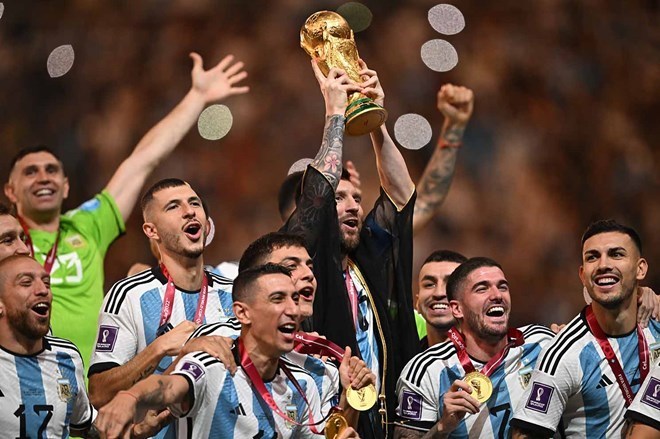
Despite its very symbolic value, the champion team is not allowed to permanently own the original trophy. After the coronation ceremony, the trophy will be returned to FIFA headquarters in Switzerland for preservation, while the champion only receives a gold-plated replica.
Even if a team wins three World Cup titles, FIFA no longer grants permanent ownership of the original cup as before.
Since its first appearance at the 1974 World Cup, the cup designed by Silvio Gazzaniga has accompanied 14 World Cups and become an immutable symbol of the tournament.
FIFA confirmed that this trophy will continue to be used at least until the 2038 World Cup.


