The word in the thousands
When darkness had just reached the small low-lying houses in the middle of Kim Phu valley (Quang Tri province), the flashing flashing flashing lights on the head of the Ruc people overtook the mountain.
Adults in the village steal books, say phrases every time they say, urging each other to quickly get to class. In the cold windy forest, their evenings do not end with rest, but start with the path to find the words.
In the classroom right at the On village cultural house, the sound of a broken heart resounded evenly. I work tired all day, but I want to go to school every night, said Ms. Cao Thi Nga, feeling sweat after returning from work.
At the age of over 40, Ms. Nga once thought that knowing how to read and write was too far away. Her childhood was spent in the fields, between trips with her parents to the forest, digging roots, and earning food.
In the past, the school was a few mountains away from the village, so children who wanted to go to class had to cross a deep stream and climb a rock slope. Poverty forces many children of the Ruc people to put aside their dreams of studying. Literally becoming a "luxury" that few people in the village touch.
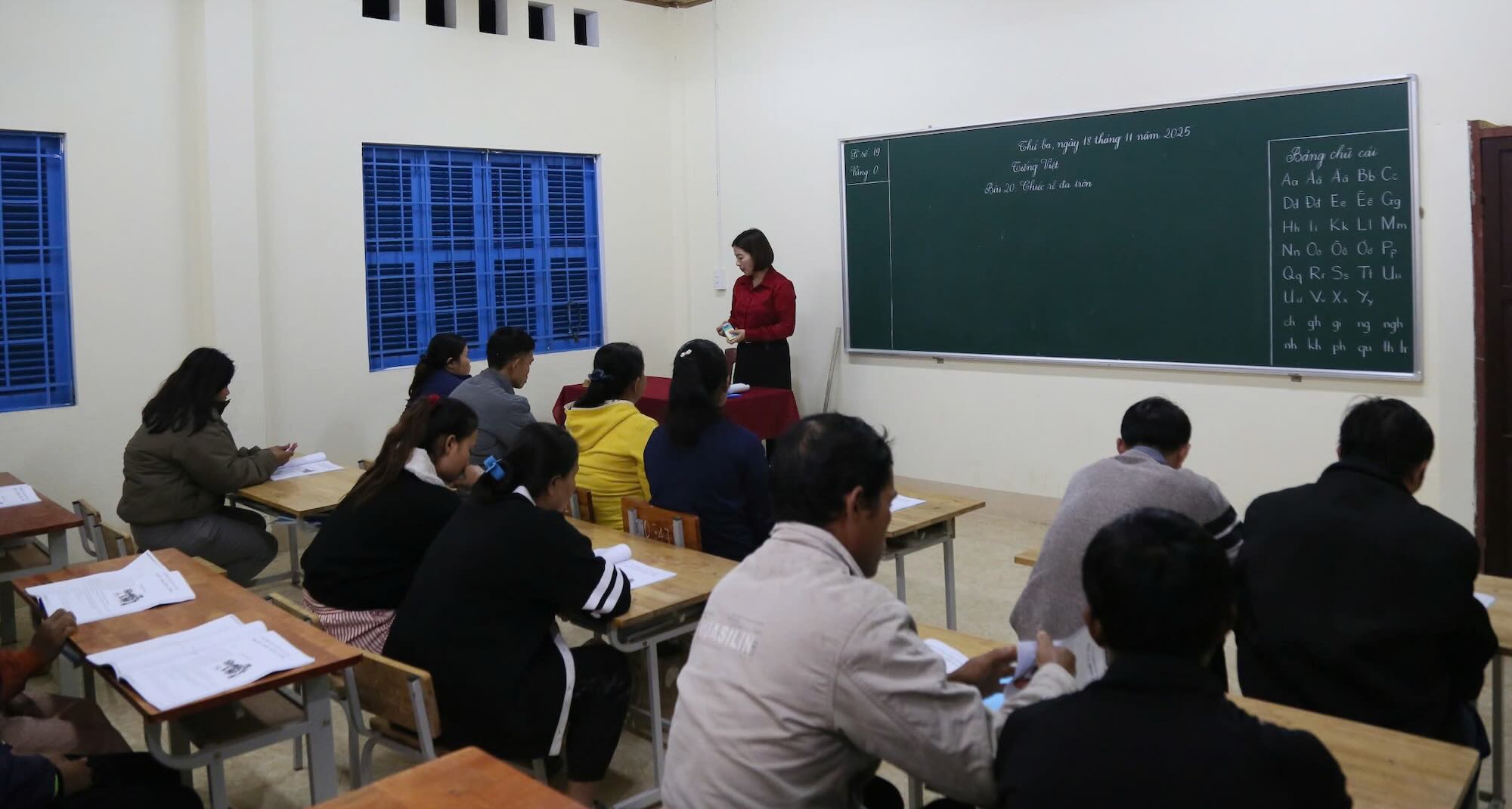
But today, when the illiteracy class was opened right in the middle of the village, Ms. Nga was so happy that she "not missed a single session".
In the same class as her was Cao Xuan Tam, a man with a hand in a hotel for all his life holding a hood and a spear. "I don't know how to spell. No matter the procedure, you have to point. It's very strange," said Mr. Tam and carefully wrote his name on the cover.
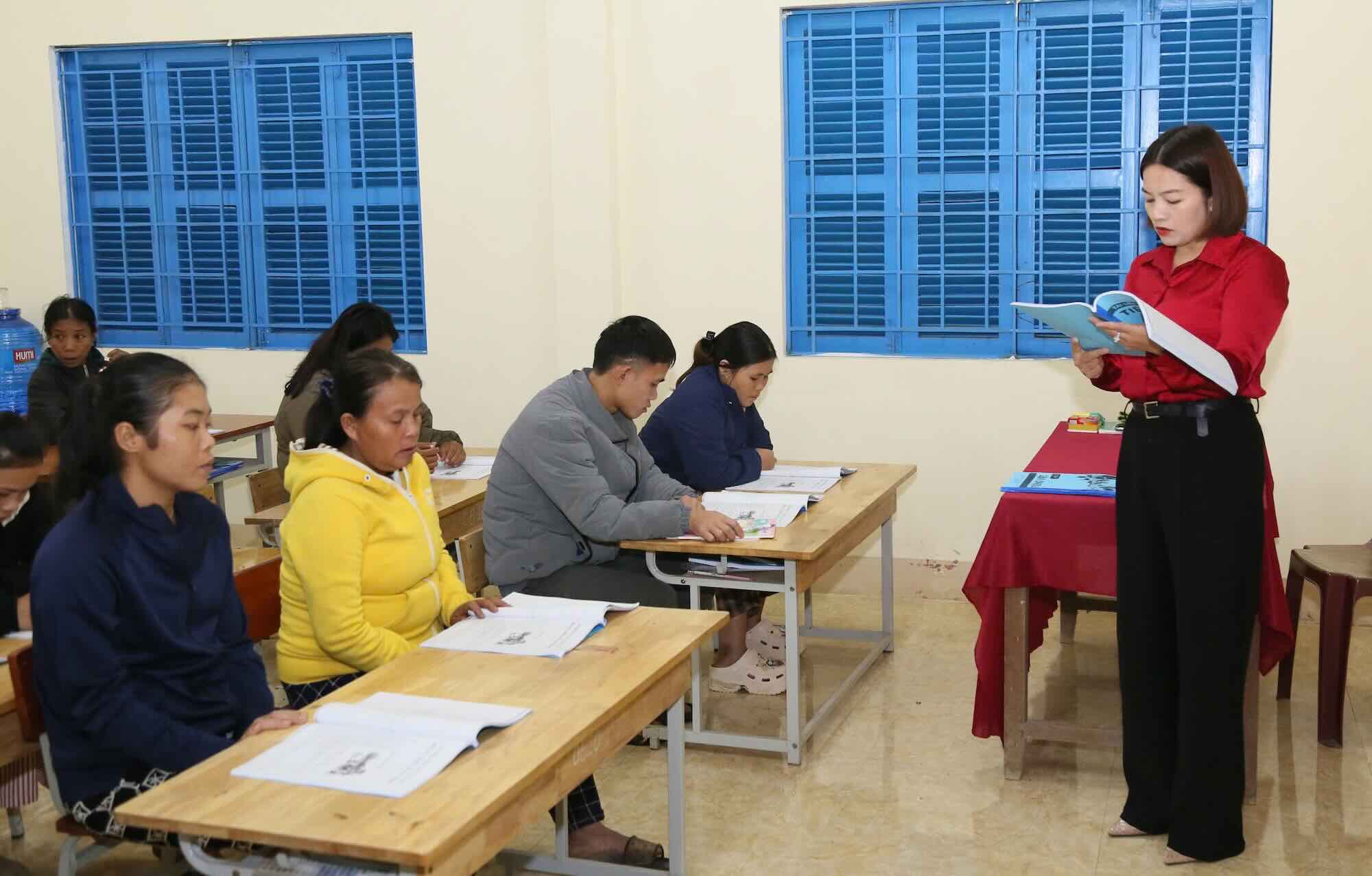
The Ruc people's illiteracy class only really " cake up" in the evening. From 6 hours onwards, groups of people followed the dirt road to the classroom. In the small room, teacher Dinh Thi Chinh persistently wrote each letter on the board, read the sample, spelled, and then held each student's hand to shape each letter.
During the day, Ms. Chinh teaches children of the Ruc people. At night, she teaches their parents. "Seeing their desire to learn, I feel sorry for them. So no matter how hard it is, I can't take any days off," she said.
Changes in letter color
The class opened in May 2025 with 19 students. There are young people, people over 50 years old. All school is from Monday to Friday, regardless of rain, wind, or cold. Sometimes people have to take a long break due to the busy crop season, so the school has to send teachers to each house to mobilize, even using a car to take them to class in time for class.
Mr. Phan The Dung - Principal of Thuong Hoa Primary and Secondary School said that the goal is that by April 2027, students will grasp knowledge equivalent to grades 3 to 5.
For the Ruc people, the word itself is the key to opening the door to integration. After 65 years of leaving the cave, their lives have changed, but the gap in knowledge is still a difficult problem. Therefore, night classes not only teach literacy but also teach confidence, teach the right to know and understand each person.
Mr. Hoang Tu Quoc Hung - Chairman of Kim Phu Commune People's Committee said that the light from the night classroom is "the light of knowledge in the midst of a thousand". That is the result of mobilizing the entire political system to participate: supporting books, improving facilities, encouraging and retaining teachers to stay in the village.
During quiet nights, standing at the head of the village looking down, the light of the classroom erases illiteracy like a warm sparkling fire penetrating under the forest canopy. The sound of learning words blends with the sounds of insects, like a fragile but hopeful song.
The Ruc people still go to the fields every morning, crossing the forest to find food, but when the evening comes, they come to class with the excitement of children. The words seem to have called them, urged them, helping them believe that life can change, even with just the first thought on the page.
In the midst of the great Truong Son, that light has not been turned off once.