
In the traditional cultural space of the Thai ethnic people, tó má lẹ has long become a familiar folk game, associated with holidays, Tet, celebrating new houses, weddings or leisurely farming times.
"To má lẹ" is loved by many people, especially women. The main tool of the game is a "mã lẹ" ball with a flat round shape, about 1cm thick, 4 - 6cm in diameter.
Brackets are usually made from the stem of a type of vine in the old forest, so they are firm and durable. With a not too complicated gameplay, the game is suitable for many ages, from young children to adults can participate.
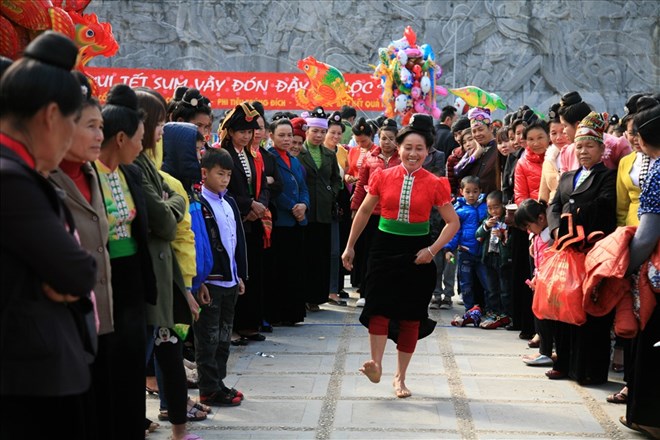
The To Ma Le playing space is quite simple, just a flat piece of land in front of the yard, under the floor or at the village cultural house. Players are divided into two teams, each team with a maximum of 7 people.
On the field, 3 lines will be drawn according to regulations to serve the competitions. Although not requiring elaborate fields, the game requires concentration, dexterity and very high team spirit.
To má lẹ consists of 4 main parts. In the first part, players stand at the starting line, place the má lẹ on their knees and then use their thumbs to pop the má lẹ to hit the target and fly over the finish line.
Team members take turns playing their turns. Whoever misses will not be counted. The team with more accurate turns will gain an advantage.
During the competition, if the last player does not perform successfully, the team can send other members to support. This creates a spirit of solidarity and mutual support in the game.
In the second part, players throw the cheek towards the opponent's cheek row to determine the hitting position. In the third part, players place the cheek on the back of their feet and run while using their feet to control the cheek to hit the opponent's target.
The final part requires higher accuracy when the player uses the thumb to pop the cheek from the ground to hit the opponent's cheek.
After 4 rounds of competition, the total scores of the teams will be added to determine the winning team. To win the overall prize, all members of the team must overcome the challenges.
If someone has not completed the game, teammates will find a way to save them by hitting instead. It is this element of coordination and support that has made "to ma le" not only a physical game but also a symbol of the community spirit of the Thai people.
The cheers and drumbeats in each game created a joyful and exciting atmosphere in the villages. "To má lẹ" requires participants to be flexible, agile, meticulous and especially the ability to accurately adjust each shot.
Today, along with the attention of the locality and the cultural sector, the "to ma le" game continues to be preserved and promoted in community life.
This is also one of the sports that regularly appears at cultural festivals of the Thai ethnic people. The fact that young people continue to love and participate in games has contributed to preserving traditional cultural values, helping to má lẹ become a unique beauty in the treasure of Thai folk culture.


