
Hidden in the isolated valley of Binh Chuan commune, Nghe An province, the ancient stilt houses of the Thai people in Xieng, Dinh, Na Co, Met villages... still retain almost their original traditional appearance through many generations. Not only a place to live, the stilt houses also deeply preserve the cultural and spiritual life of the people of the mountainous region of Nghe, according to VNA.
Looking from the top of Pu Huot slope, the stilt house complex stands out in the valley with layered roofs. Houses are often erected from 1.6m to more than 2m above the ground with a large wooden column system, creating stability but still graceful.
Mr. Kha Van Khay (Na Co village, Binh Chuan commune) said that the Thai people believe that stilt houses are places that connect people with nature, so the architecture is designed to suit the mountainous terrain.
The floor is made high to avoid humidity, wild animals, snakes, floods and landslides. The basement is used for agricultural tools and firewood; all activities take place on the upper floor with a reception room, resting place and kitchen located at the gable.
According to Mr. Lo Van Man - a resident of Na Co village, the house pillars are usually made from durable woods such as lim, sen, tau, doi, trai... The Thai people often go into the forest to choose wood in the dry season to limit termites. The chosen tree must have straight trunks, no worms, no cut tops.
Mr. Lang Van Tuat - a resident of Na Co village - said that the entire wooden frame system of the stilt house is linked by traditional pin and bolt technique instead of using iron nails. Accurate joints help the project be solid but still retain its softness and elegance.
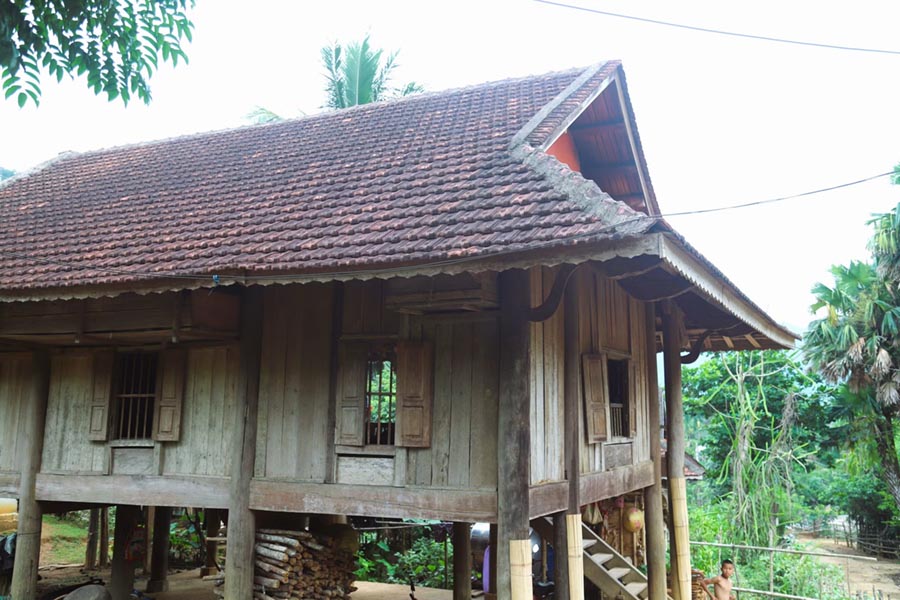
Thai stilt houses in Binh Chuan have four flat roofs spread out to shelter from rain and sun, not decorated with "khau cut" like many Northwest regions. Unlike black Thai and white Thai stilt houses with two separate stairs for men and women, Thai thanh stilt houses in Binh Chuan only have one shared staircase.
The Thai people here also value the feng shui element. Houses are often built in the style of 3 compartments, 2 porches or 5 compartments, 2 porches; the number of main doors and windows are all odd numbers with the belief of bringing good luck and prosperity.
Many houses are also prominent with dragon heads carved at both ends of the stairs. The railings and porches are decorated with sawtooth patterns, five-pointed stars, hearts... both creating aesthetic highlights and helping to circulate air and limit rain.
The stilt house space is also associated with traditional rituals such as weddings, rituals, tying wrist strings or welcoming distinguished guests. During holidays, Tet, and welcoming new houses, under the floor becomes a place for villagers to gather to dance xoe, row dancing, gong playing, and drinking can wine.
Mr. Lo Van Ly - Chairman of Binh Chuan Commune People's Committee - said that the whole commune has 7 Thai villages located along the valley, in which the density of traditional stilt houses is concentrated in Dinh, Na Co, and Xieng villages. In recent years, the locality has promoted propaganda and encouraged people to preserve the original state of stilt house architecture and orient community tourism development associated with preserving national cultural identity.


