
Under the early summer sun on the rocky plateau, llant fields in Nhèo Lủng village, Đồng Văn commune (Tuyên Quang province) are entering their growing period. From a plant that has been associated with the Mong people for a long time, llant is opening up a new direction of development as the locality implements a production model associated with product consumption.
Lence has long played an important role in the life of the Mong people, being both a raw material for weaving traditional costumes and carrying cultural and spiritual values. However, for many years, lence production has been small-scale, lacking output linkages, so the economic efficiency has not been commensurate.
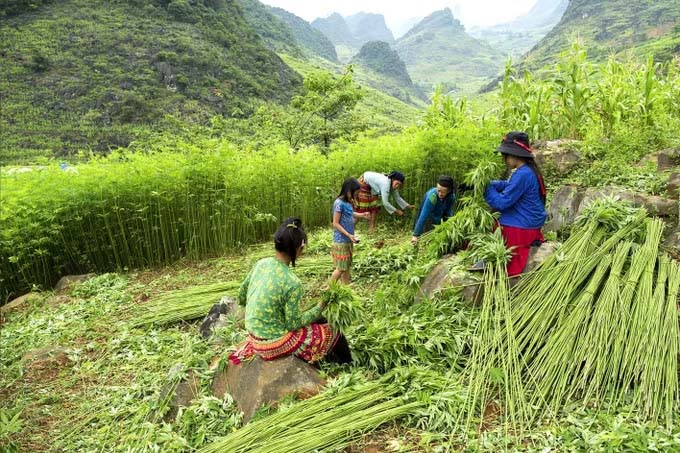
The implementation of the product consumption guarantee model is considered a remarkable shift. For the first time, llant growers have a stable output, creating motivation to expand the area, improve quality and aim for sustainable commodity production, according to VNA.
Currently, each hectare of linen brings in an income of 200 to 300 million VND, much higher than corn. This result shows the potential for crop restructuring in highland areas, especially in harsh cat ear rock terrain conditions, where linen adapts well and grows sustainably.
Not only creating economic value, the fig tree also opens up a direction for experiential tourism development. From peeling, spinning, weaving to indigo dyeing, beeswax painting, handicrafts create products imbued with cultural imprints, becoming "soft resources" to attract tourists.
In the linkage chain, young people like Vang Thi De play a connecting role. Born in Nheo Lung village, Vang Thi De built a project to bring linen products to the market, and at the same time linked people to develop raw material areas. She and the people completed the production process, gradually forming a value chain from linen cultivation to product processing. Thanks to that, many Mong women have stable jobs right in the locality, both maintaining traditional crafts and increasing income.
Mr. Pham Duc Nam, Chairman of Dong Van Commune People's Committee (Tuyen Quang province), said: "The launch of the production model and signing of consumption contracts for products from flax trees not only helps increase income for people, but also contributes to preserving and promoting the traditional craft of the Mong people." He emphasized that flax trees will be the main crop, associated with the development of unique tourism products.
In the coming time, the locality will continue to mobilize to expand the area for growing linen, improve product quality, build brands and promote linking production with experiential tourism. Reality in some places in the province shows that this model has created stable jobs and attracted tourists.
The formation of a linkage chain from cultivation to consumption helps people feel secure in investing and increasing the value of flax trees. Through this, not only creating livelihoods, the model also contributes to preserving cultural identity and opening up sustainable development directions for Dong Van.


