
Tram Gian Pagoda, in Quang Nghiem Tu script, is located on So mountain in Chuong My ward, Hanoi city. This is one of the large-scale ancient pagodas of the North and is classified as "Four Great Scenic Spots of Xu Doai", along with Thay Pagoda, Tram Pagoda and Tay Phuong Pagoda.
According to folk documents, the pagoda was started in 1185 under the reign of King Ly Cao Tong. Local people also call this place So Pagoda, Nui Pagoda or Tien Lu Pagoda. Not only is it a long-standing Buddhist center, Tram Gian Pagoda is also associated with the legend of Saint Boi - a Zen master with the vulgar name Nguyen Binh An, from Boi Khe village.
Legend has it that after practicing at So Mountain, Saint Boi became enlightened and was respected by the people as a saint. Folk tales have been passed down about him, including using a pot of rice and a little pickled eggplant to feed hundreds of workers but still not empty.
When he passed away at the age of 95, his body was kept in the tower and people revered him as "Great Saint Khai Son Binh Dang Hanh Nghia Tin Bo Tat". To commemorate the merits of Saint Boi, every year from the 4th to the 6th day of the first lunar month, Tram Gian Pagoda organizes a traditional festival with many solemn rituals such as palanquin procession, worship and unique folk cultural activities.
Prominent among them are vegetarian feast competitions, dry puppetry performances and exchanges between people and delegations from Boi Khe village, the hometown of Saint Boi.
Located on a high hill amidst green natural scenery, Tram Gian Pagoda owns an architectural complex of 104 large and small compartments. The main items are arranged into three areas including Tam Quan, bell tower and main pagoda area, creating a harmonious and majestic overall.
From Tam Quan, visitors pass through a wide brick yard and then follow the chi-shaped brick road leading to the top of the hill. On both sides are rows of ancient pine trees creating a peaceful and ancient space. On the way to the pagoda, there are also a stele house, a semi-circular lake and many auxiliary works bearing the imprint of traditional architecture.
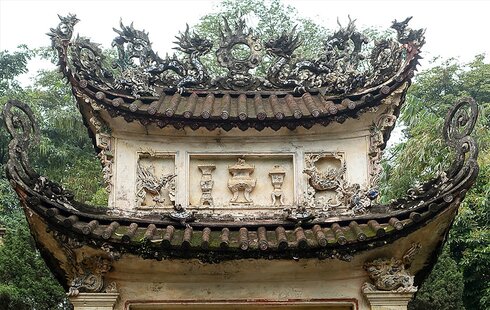
The highlight of the complex is the ancient bell tower built from the late 17th century. The building has a two-story eight-roof architecture, a solid ironwood structure with delicate dragon and fire cloud carvings. Inside, a bronze bell cast in 1794 is still preserved, and on the body of the bell is also engraved the "bài minh" of danh sĩ Pham Huy Ich.
The Tam Bao area is designed in the form of the word "cong", combined with rows of corridors to form a characteristic "quoc" architecture in Vietnamese Buddhist architecture. The works in the campus are closely linked to each other, both ensuring worship function and creating a harmonious beauty between architecture and landscape.
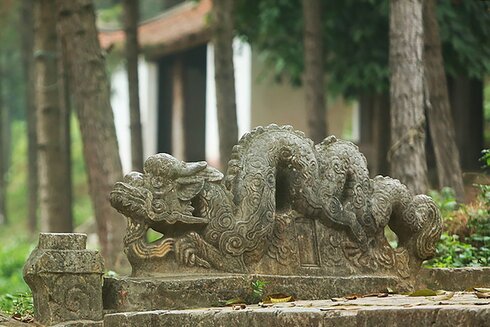
Tram Gian Pagoda still preserves many precious artifacts. Typical are the pair of Tran Dynasty stone dragons, a system of 153 ancient wooden and terracotta statues, Tuyet Son statues, Quan The Am Bodhisattva statues, and many La Han and Thap Dien reliefs of high artistic value.
In particular, the statue of Admiral Dang Tien Dong - a famous general of the Tay Son Dynasty, is considered a rare historical artifact still preserved at the pagoda.
With outstanding values in history, art and Buddhist architecture, the pagoda has been ranked as a national historical and cultural relic since 1962, becoming a precious heritage of Xu Doai land.


