
Located in Tam Hung commune, Hanoi city, Boi Khe Pagoda is one of the oldest ancient pagodas in the Northern Delta region.
Through hundreds of years of existence, the pagoda preserves unique architectural and artistic values, and is associated with many historical, cultural and revolutionary imprints.
Boi Khe Pagoda has the initial name Dai Bi Tu, formerly belonging to Boi Khe land of Son Nam Thuong town. According to legend, the pagoda was built around the 14th century under the Tran Dynasty. Through many restorations, this place still preserves many architectural traces from the Tran, Le So, Mac and Nguyen dynasties.
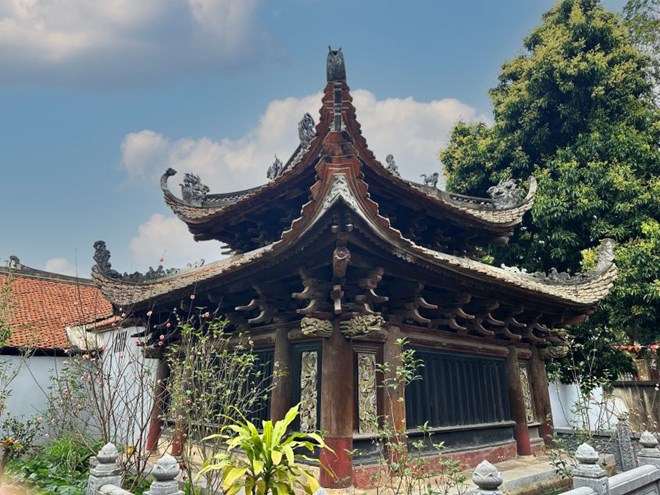
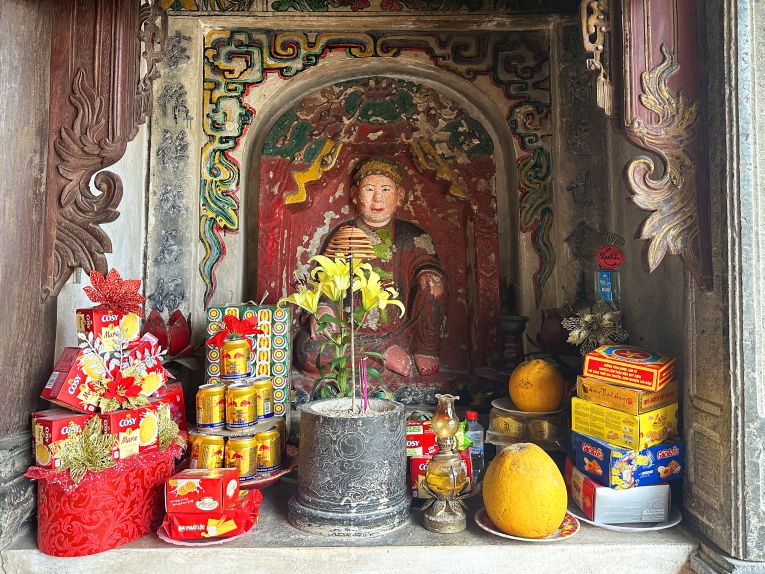
Not only is it a place to worship Buddha, the pagoda also worships Saint Boi - a famous Zen master of Boi Khe land. According to folk legend, his real name is Nguyen Binh An, orphaned from a young age, early ordained to practice at Tien Lu Institute (Tram Gian Pagoda).
Later, his reputation spread far throughout the region, and he was appointed Chan Nhan by King Tran. Legend has it that when the Ming army invaded and insulted the pagoda scene, he caused a "rain of blood" causing the enemy to retreat.
The space of Boi Khe Pagoda is more than 8,000m2 wide, built along a vertical axis facing the West - towards the Buddha entering Nirvana. Right from the entrance gate, visitors can feel the ancient beauty with the tomb tower system, Ngu Mon gate, brick bridge spanning Do Dong Giang and 2 heritage trees hundreds of years old.
The highlight of the pagoda is the "Nội công ngoại quốc" architecture and the "Tiền Phật hậu Thánh" arrangement. The three-entrance gate is also a bell tower, currently hanging a large red flag cast from 1844. In front of the Three Jewels area is a large courtyard with monolithic stone slabs, stone elephant statues and many valuable ancient artifacts.
The Tien Duong tower consists of 7 large compartments, on the steps of the foundation are still preserved many Mac Dynasty bricks with unique patterns. Two rows of corridors running along both sides place 18 La Han statues made of terracotta lacquered in gold.
Behind is the Holy palace built in the style of a bed of matches with 2 floors and 8 roofs, creating a majestic and ancient look for the entire project.
One of the most precious artifacts of the pagoda is the "Buddha Stone Table" lotus stone pedestal dating back to 1382 during the reign of Emperor Tran Phe De. The pedestal is exquisitely carved with images of dragons, divine birds, flowers and leaves and lotus pedestals, clearly reflecting the art of Tran Dynasty sculpture.
In addition to its cultural and architectural value, Boi Khe Pagoda is also an important revolutionary activity site during the resistance war against France. The secret tunnel system excavated in 1948 was once a place of shelter, communication and combat for local guerrilla forces. Currently, a part of the tunnel is still preserved within the pagoda's premises.
With special historical, cultural and artistic values, Boi Khe Pagoda has been recognized as a National-level architectural and artistic relic since 1979. In early 2025, the pagoda continued to be recognized as a Special National Relic, affirming the position of a typical ancient pagoda in ancient Thang Long land.


