
Tien Le communal house is one of the typical ancient relics of Hanoi, and also the early communal house to apply 3D technology and publicize it for free on cyberspace, helping the community easily access and learn about heritage values.
Currently, the communal house is located on a land area of more than 5,300m2 in Son Dong commune, Hoai Duc. According to old history, under Le Trung Hung (XVII century), the communal house belonged to Tien Le commune, Dan Phuong district, Quoc Oai prefecture.
The communal house is built facing West, facing the river in front, leaning behind the Day River dike, an important trade route in the past, contributing to the prosperity of the land bordering Thang Long capital.
Based on stele texts and architectural traces, Tien Le communal house dates back to before 1670 (Canh Tri 8th year). After more than 350 years of existence, the ancient communal house has been repaired many times, including a restoration under King Bao Dai that is still recorded in the royal altars.
In recent years, in the face of degradation, the government and local people have actively preserved and restored the project.
The Tien Le communal house complex includes many architectural items, notably the Nghi Mon gate on the west side built in a trụ biểu style with one main door and two auxiliary doors. From here, it leads to a large yard, with Ta mac and Huu mac on both sides serving rituals.
The center is the large communal house located next to the Day River dike, built in the style of the "Dinh" character, including the Dai Bai house and the Hau Cung house. Dai Bai has 5 compartments, 2 compartments, about 22m long, nearly 14m wide roof; 3 middle compartments are equally wide, 2 adjacent compartments are smaller. Following behind are 2 Hau Cung compartments - where the village tutelary god is worshiped.
The project impresses with its large scale, including 46 wooden columns, a system of truss structures, and horizontal bars connected by sturdy bolts. The communal house roof is tiled with "nói hài" tiles, including 2 main roofs and 2 auxiliary roofs intersecting, creating 4 soft curved ends; on the roof ridge is the image of "Two dragons worshiping the sun", and the ribbon banks are decorated with lively spirit animals.
The rear of the Imperial Palace stands out with a tiger cone holding the word "Phuc", above is the stylized word "Tho". Wooden components such as lines, eaves, and the first sentences are all exquisitely carved with the themes of "dragon clouds", "waves" using bong carving technique.
Along the spiritual axis are steps, on both sides there are stone railings carved with dragons; a pair of stone dragons are carved from blue stone, with soft curved bodies, combined with cloud patterns to create a lively feeling.
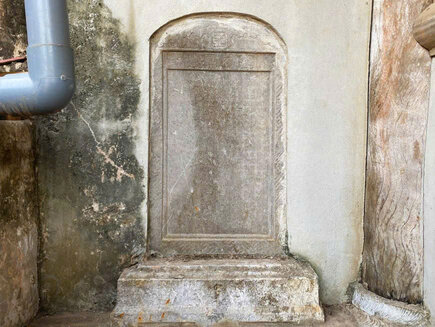
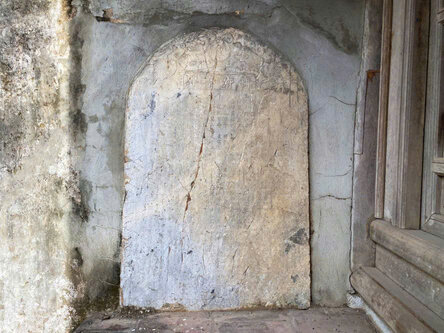
Tien Le communal house currently preserves 2 ancient stone steles reflecting the ancient community life. The stele "Khai phu dinh bi - Luu truyen van dai" (1682) states that the act of singing at the communal house door has appeared since 1670, while the stele "Tao thach bi ky" (18th century) records the erection of the stele during the Canh Hung period.
Both are exquisitely carved with motifs that symbolize Phuc - Loc - Tho. In the communal house, there is also a horizontal lacquered board "Thanh cung van tue", worshiping Nhu Hoa Vuong and coordinating the worship of Ly Phuc Man, a famous general of the Ly Nam De dynasty.
For centuries, the communal house has been the center of cultural and religious activities of local residents. Every year, on the 12th day of the 3rd lunar month, the communal house festival is held to commemorate the predecessors.
With the typical historical and artistic values of Le Trung Hung - Nguyen architecture, Tien Le communal house has been recognized as a national-level architectural and artistic relic since 2011; today, along with 3D digitization, the ancient communal house continues to be preserved and widely spread in the digital space.


