
As a border mountainous province with more than 80% of the population being ethnic minorities, Dien Bien is making efforts to push back early marriage and consanguineous marriage. At educational institutions, students are being gradually protected through field trips.
According to statistics from 2015 to now, Dien Bien province has over 42,000 married couples. Among them, there are up to 6,176 early marriages (accounting for about 14.7%) and 51 consanguineous marriages. This situation is mainly concentrated in the H'Mong ethnic group, with the common marriage age being only from 15-17 years old for women and 16-19 years old for men.
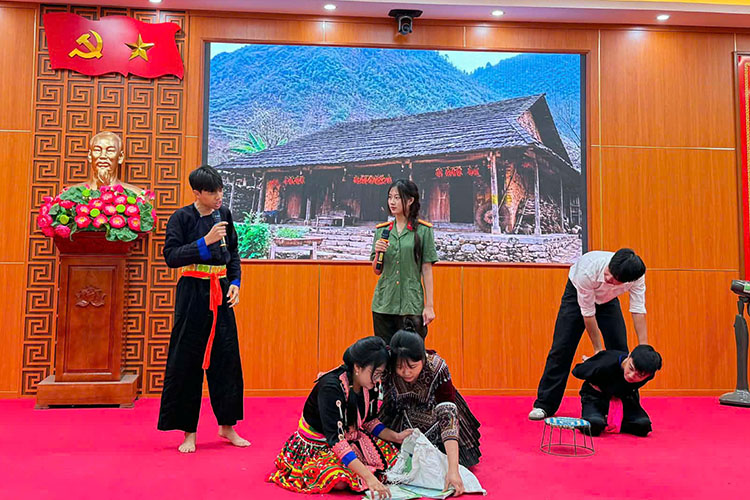
The consequences of early marriage and consanguineous marriage not only take away the opportunity to go to school for thousands of children, but also increase the risk of malnutrition, seriously affecting the health of teenage mothers.
Many families, due to early marriage, lack of knowledge and livelihoods, have continued to fall into the vicious circle of poverty, directly reducing the quality of the local population.
In the context of digital technology development, social networks are unintentionally becoming a negative "catalyst". Many highland youths get acquainted and fall in love online and then voluntarily drop out of school and move in together when they are not old enough.
In order to improve the capacity of grassroots officials and change community thinking, many schools in the province have been and are having effective propaganda methods.
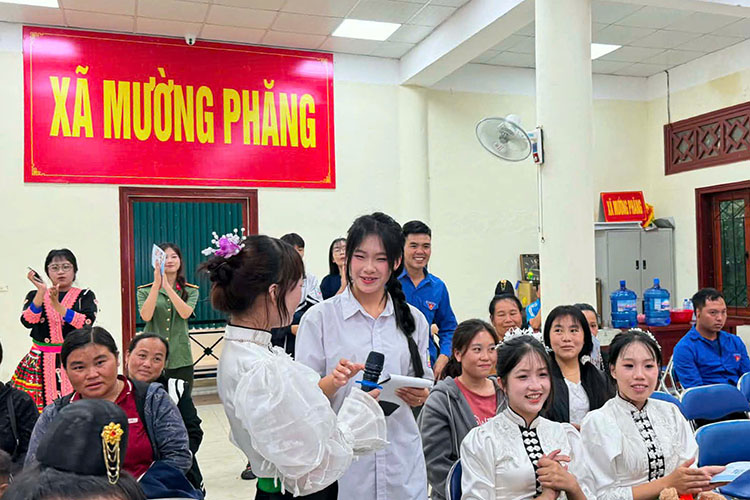
Recently, on May 30, Le Quy Don High School for the Gifted, Dien Bien province, in coordination with Muong Phang commune, organized a direct legal propaganda program to raise awareness for people and students about preventing and combating early marriage and consanguineous marriage.
Here, students organized lively extracurricular forums, disseminating knowledge about juvenile reproductive health, gender equality and analyzing the consequences of early marriage.
Through the form of direct, close, and lively exchange, the program has attracted the attention of a large number of people and students, contributing to raising awareness and responsibility of families, schools and society in joining hands to prevent and minimize early marriage and consanguineous marriage.
In parallel with educational activities, the school also presented 30 gifts worth nearly 20 million VND to students in difficult circumstances in Muong Phang commune, helping students have more motivation to stick to class, stick to school, and rise up through learning.
According to Ms. Hoang Tuyet Ban - Director of the Department of Education and Training of Dien Bien province, to minimize early marriage and consanguineous marriage in educational institutions, the Department strives that by 2030, 100% of educational institutions in the province must organize propaganda activities.
Schools are also encouraged to maintain and replicate communication models such as: "Schools without child marriage", "Students say no to child marriage", or "Student forum on teenage reproductive health".
In particular, the results of communication work on preventing and combating early marriage and consanguineous marriage are one of the contents to consider and evaluate the level of task completion, emulation and commendation work.
If an educational institution has cases of early marriage or consanguineous marriage occurring in the unit, the head of the unit must be responsible to the directly superiors. The implementation of this task will be used as one of the criteria for evaluating and ranking collectives of cadres, civil servants, public employees and implementing planning and appointment of cadres.


