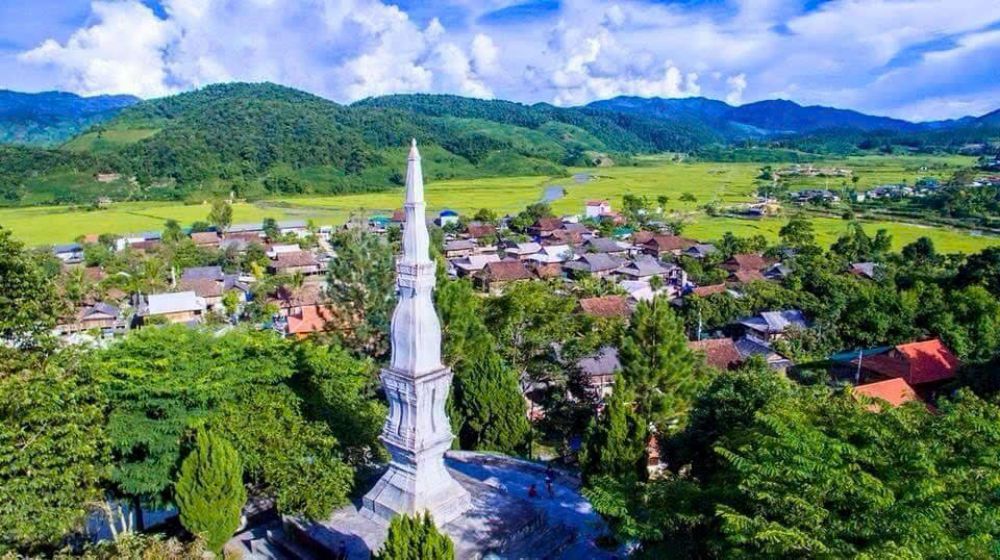
Standing majestically on an artificial hill in the center of Muong Va village (Sop Cop commune, Son La), the ancient Muong Va tower has existed for more than 400 years, becoming a sacred symbol and a testament to the strong bond between ethnic communities in the Vietnam-Laos border region.
According to documents and folk legends, from the 17th century, Lao people migrated to settle in this fertile land. Recognizing the "back leaning against the mountain, face facing the plains" terrain, a geomancer proposed building a pagoda and tower as a religious center.
People in the area together built hills and towers, and the land taken away formed ponds and lakes with traces to this day. Over time and war, the wooden pagoda is gone, only the tower stands firm as a historical witness. In 1998, the project was ranked as a National-level architectural and artistic relic by the Ministry of Culture, Sports and Tourism.
The tower is about 13m high, consisting of 5 floors, built of red brick, attached with lime, sand and honey. The structure has no doors, divided equally on 4 sides, with the shape of a tower pen reaching high, both elegant and solid. Decorative details bear the strong imprint of Lao Buddhism: spiral patterns, images of elephants climbing mountains symbolizing strength, and the top of the tower creates a lotus bud shape expressing enlightenment and purity.
Not only has architectural value, Muong Va tower is also the cultural activity center of the Lao ethnic community. This place hosts Khau Ho Tet - a new rice celebration on the 15th day of the 8th lunar month, with rituals of worshiping ancestors, praying for harvests and Xoe dance activities, folk games.
Today, along with preserving relics, the locality is gradually developing community tourism. Tourists come here not only to visit the tower but also to experience brocade weaving, enjoy cuisine and immerse themselves in local life. For more than 4 centuries, Muong Va tower has quietly extended the cultural flow, becoming a spiritual support and pride of the Northwest border region.