
To become a Tao Master, learners must go through a meticulous and rigorous training process. They are taught how to read Han script and Tay Nom script, memorize many prayers and traditional ritual procedures.
Learning is mainly in the form of oral transmission, combined with ancient books handwritten through many generations. Not only needing knowledge, practitioners also have to maintain virtue and respect for ancestors and gods because this is a job closely linked to community religious life.
Among the important rituals of the Tay and Nung people such as the peace prayer ceremony, the soul calling ceremony, the new house worshiping ceremony, the initiation ceremony or funerals, the image of Master Tao is always present. Each ritual is a harmony between prayers, music, dances, costumes and props, creating a spiritual cultural space rich in identity.
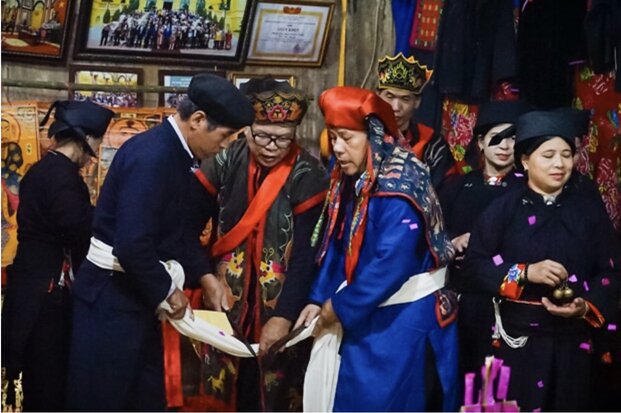
Especially in funerals - important rituals of the life cycle, Master Tao takes on the role of leading the soul of the deceased back to their ancestors. Each ritual and prayer expresses the belief in the connection between humans and the yin and yang world.
Not only practicing rituals, Master Tao is also a person who preserves many traditional cultural values of the community. They preserve ancient books, prayers, ancient stories and many folk knowledge passed down through many generations. Through the sound of drums, chants or ritual music, listeners can feel the worldview and philosophy of life of the Tay and Nung people.
Currently, the Tay Tao profession is facing many challenges as young people are increasingly less attached to traditional beliefs, and the number of people who can read Tay Nom script or practice formal rituals is also gradually narrowing. Preserving ancient knowledge and rituals is becoming an issue that needs to be concerned about.
In recent years, some localities such as Lang Son and Cao Bang have initially deployed surveying, restoring and preserving rituals related to Thay Tao. Some typical rituals are recorded and put into folk cultural education activities to help the community, especially young people, better understand traditional cultural values.
In the midst of modern life, Thay Tao is still considered the spiritual firekeeper of the village, contributing to preserving cultural memories and connecting generations in the Tay and Nung communities.


