
According to the Joint Typhoon Warning Center (JTWC), tropical depression Higos has strengthened into a tropical storm, becoming storm number 8 of the 2026 storm season in the Northwest Pacific region.
As of the morning of June 23, the center of Typhoon Higos is located about 33km south of Tinian Island. In the past 6 hours, the typhoon has been moving in the Northwest direction at a speed of about 17km/h. The maximum sea wave near the center of the typhoon is about 4.3m high.
In the next 24 hours, Typhoon Higos is forecast to strengthen only slowly due to still being affected by the Southeast wind fault and the typhoon's structure is still asymmetry. However, from the next 1-2 days, the environment will become more favorable, creating conditions for the typhoon to continue to intensify.
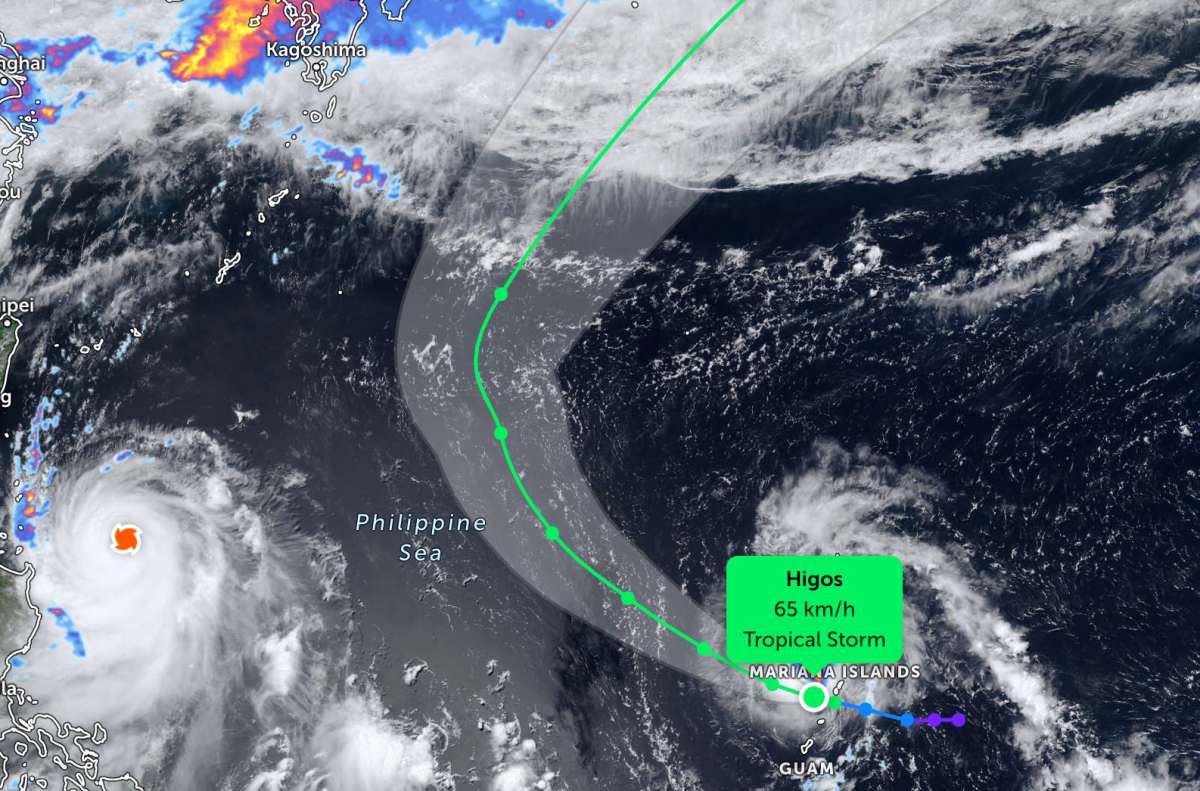
Forecast intensity models all show that Typhoon Higos will strengthen in the next 2-3 days before reaching its maximum. Some models such as Google DeepMind and COAMPS-TC forecast that the storm may reach winds of about 100km/h, while HAFS-A forecasts about 95km/h and GFS model forecasts about 85km/h. JTWC currently leans towards the intensity scenario in the high group of forecasts.
In terms of trajectory, Typhoon Higos is being affected by a low-level subtropical high pressure and will continue to move northwest in the next 36 hours. After that, the typhoon approaches the weakening zone of the subtropical high pressure, slows down and begins to change direction.
After about 60 hours, Typhoon Higos is forecast to change direction to the Northeast when it is drawn into the mid-latitude West wind zone. From here, the typhoon will gradually weaken into a tropical depression.
One of the factors that makes Typhoon Higos' forecast still uncertain is the interaction with Typhoon Mekkhala, which is operating in the North. Previously, some Typhoon Mekkhala forecast models may completely absorb Typhoon Higos after about 3 days. However, JTWC believes that this scenario is now less likely to occur than previous forecasts.
According to current forecasts, Typhoon Higos is unlikely to make landfall in the East Sea area. The main orbital models all show that the typhoon will change direction to the Northeast towards Japan and the North Pacific region, with no signs of moving into the East Sea in the coming days. Therefore, this typhoon is not yet capable of directly affecting the mainland of Vietnam.


