
According to the latest storm news from the Philippine Atmospheric, Geophysical and Astronomical Services Administration (PAGASA), Typhoon Nokaen is intensifying.
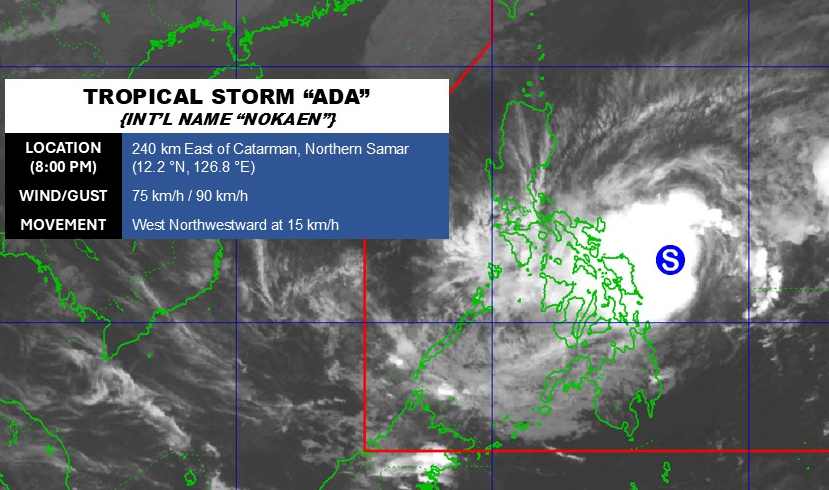
As of 8 pm on January 16 (local time), the storm's center was located at about 12.2 degrees North latitude - 126.8 degrees East longitude, 240 km east of Catarman, North Samar.
The strongest wind near the storm center reaches 75 km/h, gusting at 90 km/h. The storm moves in a Northwest direction at a speed of about 15 km/h.
PAGASA forecasts that the storm will move in a Northwest direction before slowly changing direction to the North - Northwest and then to the Northeast direction tomorrow, January 18.
Early next week, Typhoon Nokaen is forecast to move southeast as it passes through the sea east of the Bicol region.
The storm moving further west may lead to the possibility of making landfall in the Eastern Visayas and Bicol regions," PAGASA added, noting that forecasts may still change.
PAGASA said 14 areas are in Category 1 storm warning, including the south of Quezon province, the provinces of Camarines Norte, Camarines Sur, Catanduanes, Albay, Sorsogon, Masbate, Northern Samar, Samar, Eastern Samar, Biliran, Leyte, Southern Leyte; the north of Cebu province (including the Camotes and Bantayan archipelagos) and the Dinagat, Siargao and Bucas Grande archipelagos.
Waves can reach up to 4 m high in the northern and eastern waters of Catanduanes and North Samar, the eastern waters of Albay, Sorsogon and East Samar, the northern waters of Camarines Sur and the waters of Camarines Norte.
The Philippine Coast Guard said that as of 8 am on January 16 (local time), a total of 5,376 passengers, 2,191 cargo and 21 ships were stranded, while 11 other ships are seeking shelter due to Typhoon Nokaen.
The Civil Defense Bureau has also activated preparation measures to cope with the impact of the tropical storm.
Faced with the situation that Mayon volcano in Albay is still operating unstablely, further measures are needed, as the storm could exacerbate the emergency situation in the province," the Crisis Prevention and Control (OCD) agency said in a statement on January 15.
Local authorities and disaster response officials in Albay have also strengthened prevention measures against the risk of mud and rocks in the area near the volcano due to the impact of heavy rain from the storm.
Tourists planning to go to areas affected by the storm should pay attention to weather forecasts. Check flight schedules and follow local instructions to ensure safety.


