
Recently, the National Center for Hydro-Meteorological Forecasting issued a weather trend forecast for the season from May to October 2026. In which, noteworthy is the forecast for ENSO (natural climate change phenomenon in the equatorial Pacific region) and the activity of storms and tropical depressions in the first months of the season.
Accordingly, ENSO is currently in a neutral state. In the next three months, ENSO is likely to maintain a neutral state with a low probability and increase the possibility of transitioning to El Nino state.
It is forecasted that in the period from August to October 2026, ENSO tends to maintain El Nino status with a probability of about 80 - 90%, while the possibility of maintaining neutral status is only about 10 - 20%.
ENSO is one of the important bases in forecasting climate trends, especially the storm and flood season globally and in Vietnam.
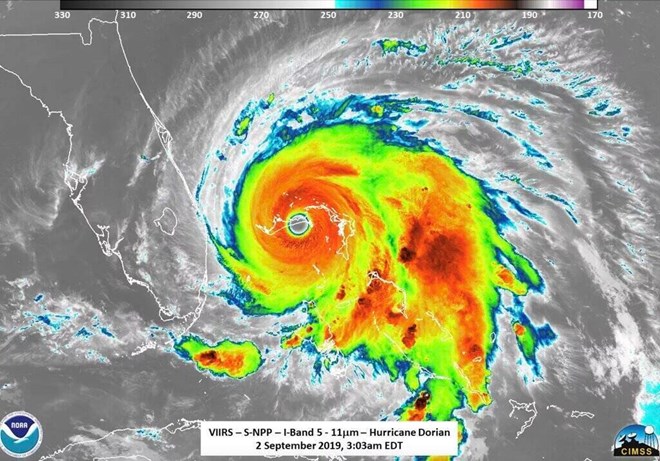
The meteorological agency predicts that from May to July 2026, storms and tropical depressions will operate in the East Sea area and directly affect the mainland at a higher level than the multi-year average. According to multi-year average data, during this period, about 3.2 storms or tropical depressions will appear in the East Sea, of which about 1.2 storms will make landfall.
From August to October 2026, storms and tropical depressions in the East Sea and direct impacts on land are forecast to be lower than the multi-year average. According to statistics, the multi-year average in this period is about 6.8 storms or tropical depressions operating in the East Sea, of which about 2.8 storms make landfall.
Regarding the overall storm season in 2026, the meteorological agency said that the number of storms and tropical depressions in the East Sea tends to be lower than in 2025, approximately or lower than the multi-year average. The multi-year average in the East Sea is about 12.7 storms, of which about 5.1 storms make landfall.
According to the National Center for Hydro-Meteorological Forecasting, in 2026, special attention should be paid to the risk of strong, even very strong storms, rapidly intensifying, and potentially super typhoons with complex trajectories and operating times, difficult to forecast.
The meteorological agency assesses that in the context of climate change, weather and climate are increasingly complicated with many extreme phenomena such as localized heavy rains, flash floods, landslides....
People and tourists need to regularly update short-term forecast bulletins to proactively plan responses, ensure safety and prevent storms from affecting their journey.


