
The holiday lasting from April 25 to May 3, 2026 has created a major boost for the country's tourism industry, with about 12 million visitors, an increase of more than 14% compared to the same period. In that growth picture, Ho Chi Minh City, Da Nang and Hanoi are the three leading localities in terms of tourism revenue.
Accordingly, Ho Chi Minh City ranked first with about 8.7 trillion VND from 1.69 million visitors; Da Nang ranked second with 5.727 billion VND and 1.46 million visitors; Hanoi reached more than 5,000 billion VND with 1.35 million visitors. It is noteworthy that the revenue ranking is not completely proportional to the number of visitors, but clearly reflects the "money-holding" capacity of each destination.
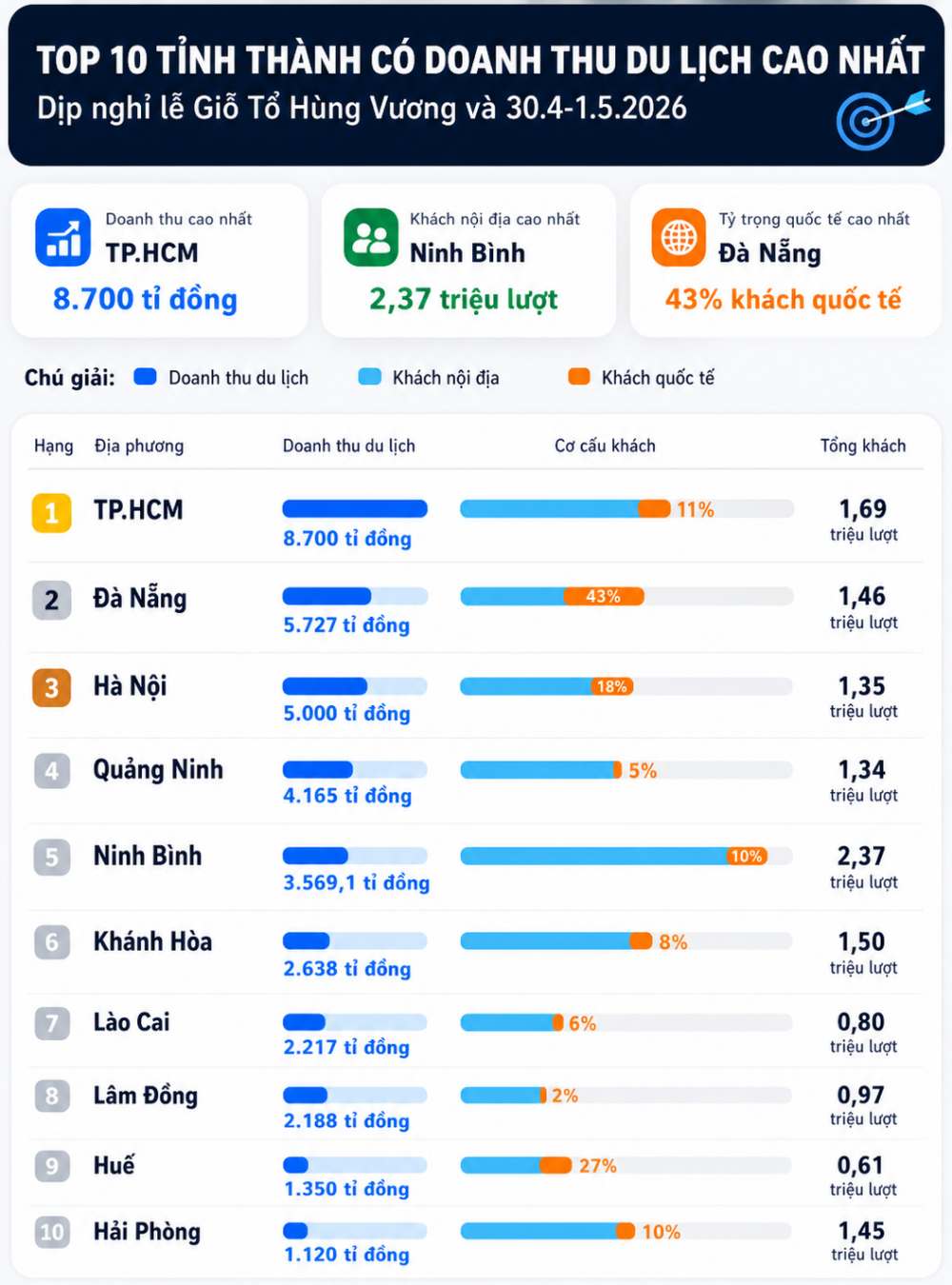
First of all, the most important factor helping these three major cities lead is the visitor structure, especially the proportion of international visitors. Da Nang has about 43% of international visitors, equivalent to more than 621,000 visitors; Hanoi welcomes 248,000 international visitors; Ho Chi Minh City about 19,000 visitors.
This is a group of customers with high spending, longer stays and using many high-end services such as 4-5 star hotels, cuisine, entertainment, shopping..., so they contribute greatly to total revenue. Reality shows that although Ho Chi Minh City does not have a high proportion of international visitors like Da Nang, it still leads thanks to its large market size and diverse spending exploitation capabilities.
In addition, a rich and constantly innovating tourism product ecosystem is also a key factor. Ho Chi Minh City launched nearly 1,000 products, from cultural and historical tours such as "Saigon Commando", Cho Lon experience, to high-end products such as yachts, helicopters, waterway tourism, night tours...
Hanoi is promoting its cultural and heritage strengths with exhibitions, traditional craft experiences, large-scale art programs, and expanding tourism space to the suburbs such as Ba Vi, Soc Son... Da Nang is building a methodical festival and event ecosystem, from fireworks, sea sports to coastal entertainment activities, combined with the regional linkage advantage with Hoi An, My Son.
Another common point is the ability to organize the market and effective stimulus strategies. Localities and businesses simultaneously launched incentive programs, travel comboes, new products... helping to increase the number of customers but still ensure revenue thanks to selling with services.
Ho Chi Minh City applies many stimulus packages reduced by more than 40% but accompanied by diverse experiences; Da Nang invests heavily in media and events to create "reasons to come"; Hanoi focuses on improving the quality of accommodation services and cultural experiences, reflected in the capacity of 4-5 star hotel rooms being almost fully booked during peak seasons.

Transportation infrastructure and connectivity also play an important role.
Major cities are international aviation hubs, supplemented with hundreds of thousands of flight seats during holidays, with high occupancy rates.
This helps Ho Chi Minh City, Hanoi and Da Nang effectively attract international tourists, while many other localities mainly depend on domestic tourists, easily affected by increased travel costs.
In addition, tourism trends also contribute to creating advantages for these three destinations.
Tourists are increasingly prioritizing quality, personalized experiences, instead of just "going to know". Major cities respond well to this trend thanks to a complete service ecosystem, from accommodation, cuisine, entertainment to shopping and nightlife experiences.
Conversely, natural destinations such as Ninh Binh, Lao Cai, Lam Dong, although welcoming a very large number of visitors, are mainly domestic tourists, traveling for short days, with low spending, so revenue is not commensurate.
From the reality of the holidays, it can be seen that tourism revenue no longer depends solely on the number of visitors, but depends on the quality of visitors, product structure and market organization capacity.
Ho Chi Minh City, Hanoi and Da Nang lead not only because of the large number of visitors, but because they know how to turn the flow of visitors into higher economic value - a trend that will continue to shape tourism competition in the coming time.


