
Many candidates commented that the English exam requires reasoning.
On the morning of June 12, candidates across the country completed the English exam in the 2026 high school graduation exam. Many students assessed that the exam questions closely followed the curriculum, had a certain degree of differentiation and appeared some questions requiring reasoning ability.
In Hanoi, Nguyen Ngoc Quynh Anh - a candidate participating in the 2026 high school graduation exam - said that this year's exam questions are moderately difficult.
The English exam is manageable, some questions make me have to think quite a lot. If I study knowledge thoroughly, I can get about 8 points. The differentiation level of the exam is equivalent to last year, especially in the questions for finding synonyms, candidates can easily hesitate between options" - Quynh Anh shared.

Meanwhile, in Ho Chi Minh City, Le My An commented that the English exam has high differentiation. Although she tried to complete about 70% of the exam, the female student still encountered many difficulties in the exam process. "I am not very good at English, so I find the exam quite difficult. I find many parts to be an obstacle for me" - My An said.
In general, My An believes that this year's English exam will create a clear differentiation between groups of candidates, while the History exam is more manageable and suitable for students who have a solid grasp of basic knowledge.
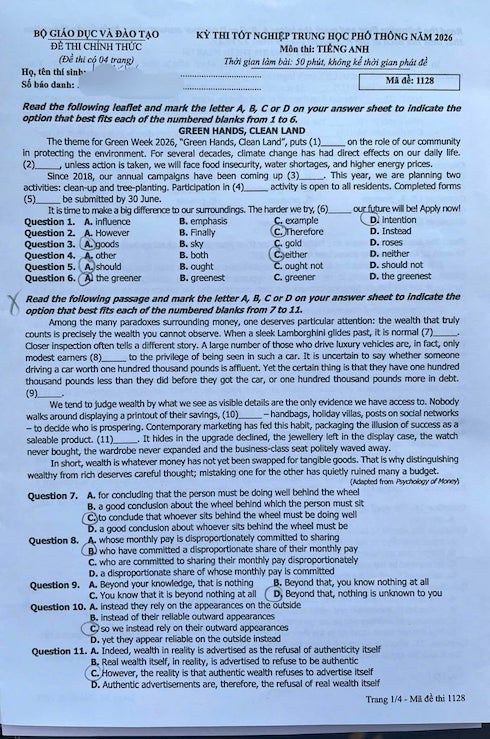
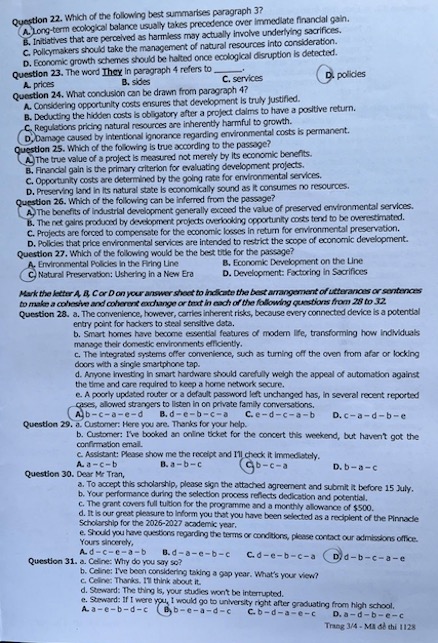
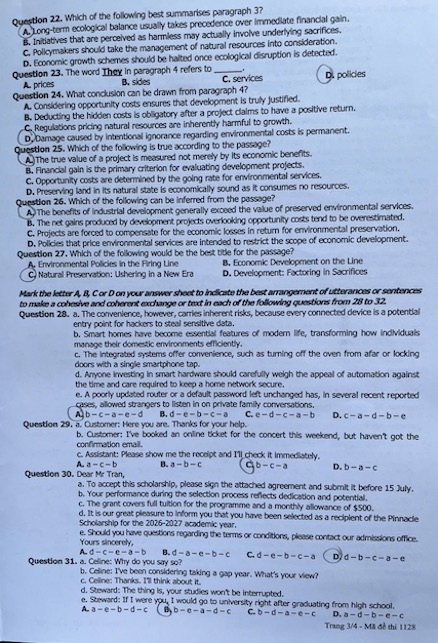
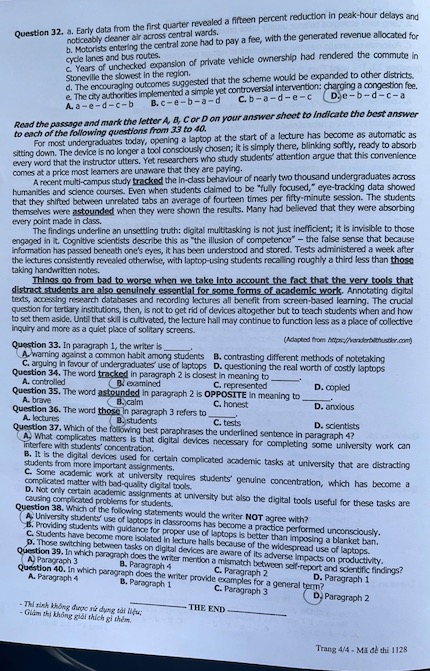
English score distribution prediction
Assessing this year's exam questions, Mr. Nguyen Quoc Sinh - English teacher at Luong The Vinh Secondary & High School (Tan Trieu, Hanoi) - said that the 2026 high school graduation English exam questions closely follow the general education program.
According to Mr. Sinh, the topics appearing in the exam, especially in the three reading passages including the information filling section (questions 1-6), the reading comprehension from questions 12-21 and the reading comprehension from questions 35-40, are all within the scope of knowledge students learn at the high school level. The punctuated reading passages also follow the familiar format, with relatively easy-to-understand content.
However, a noteworthy point is that the language and structure used in the exam have a fairly high academic level. Mr. Sinh assessed that many contents reached levels from B1+ to B2+, and even some vocabulary at C1 level appeared. This is a factor contributing to the differentiation between groups of candidates.
In the section on arranging conversations, exchanges and letters (questions 22-26), Mr. Sinh said that this is a relatively favorable group of questions for students to score points thanks to the familiar topic, easy-to-understand language and clear logical flow.
Reading lessons are the part that creates the biggest score difference in this year's exam" - the teacher commented.
Regarding the reading section filling out information from questions 1-6, teacher Sinh said that many students may be "shocked" from the beginning by the highly academic vocabulary. Independent questions such as questions 3 and 5 require candidates to closely follow the development of the reading idea, while the noise level of the answer key is also relatively high. In addition, question 4 is considered a question that can take candidates a lot of time to consider.
In the two reading comprehension lessons from sentences 12-21 and 27-34, although the topic is relatively familiar, the language used is highly academic with a lot of vocabulary and difficult structures.
Notably, vocabulary test questions such as questions 12, 30 and 31 are considered to be highly difficult because they contain many new words. Among them, questions 12 and 31 may cause many candidates to lose points if they do not apply good grammar knowledge and context reasoning skills" - the teacher said.

According to teacher Sinh's assessment, reasoning questions, questions requiring determining information that does not appear in the reading passage or identifying the author's point of view will be the most difficult group of questions for candidates.
From the above analysis, teacher Nguyen Quoc Sinh predicts that the score distribution for English this year mainly fluctuates in the range of 5.5-6 points. According to him, the exam questions for 2026 are somewhat "easier to breathe" than in 2025. In addition, students learning from the previous year's exam and having more careful preparation are also factors contributing to improving test results.


