
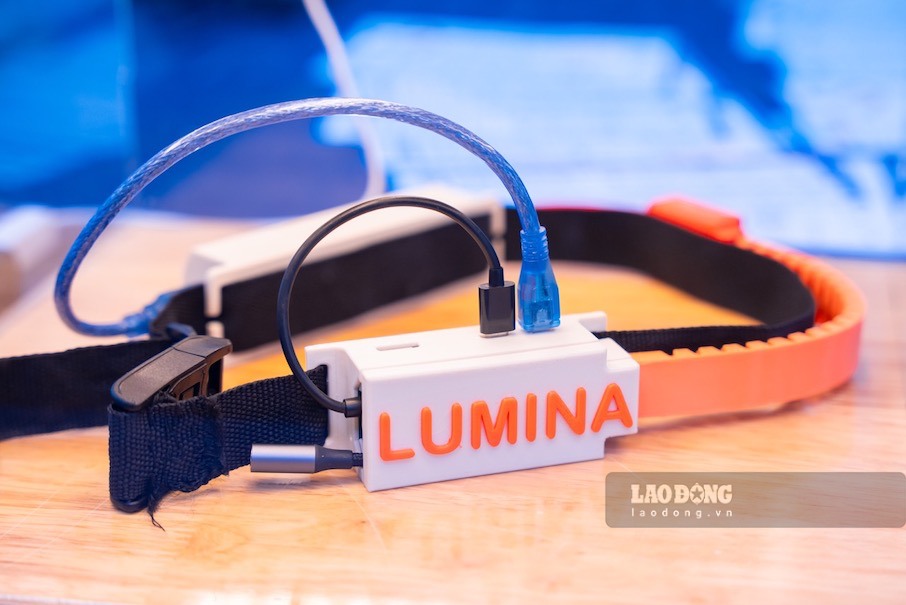
Lumina is a wearable AI assistant system for the visually impaired and people with low vision. The system converts images and text around into concise, contextual audio instructions, and connects to the phone to support daily tasks, selective memory, reading comprehension and navigation.
The product helped a group of 5 students win first prize in the ActTNE Green Intelligence Challenge: Innovating with AI competition taking place on the evening of July 29.
Sharing after the contest, Duong Quang Hung - a final year student, majoring in Information Technology, Hanoi University of Science and Technology - one of the 5 members of the group, said that the idea of AI glasses came from the desire to support loved ones who are visually impaired to be more confident in life.
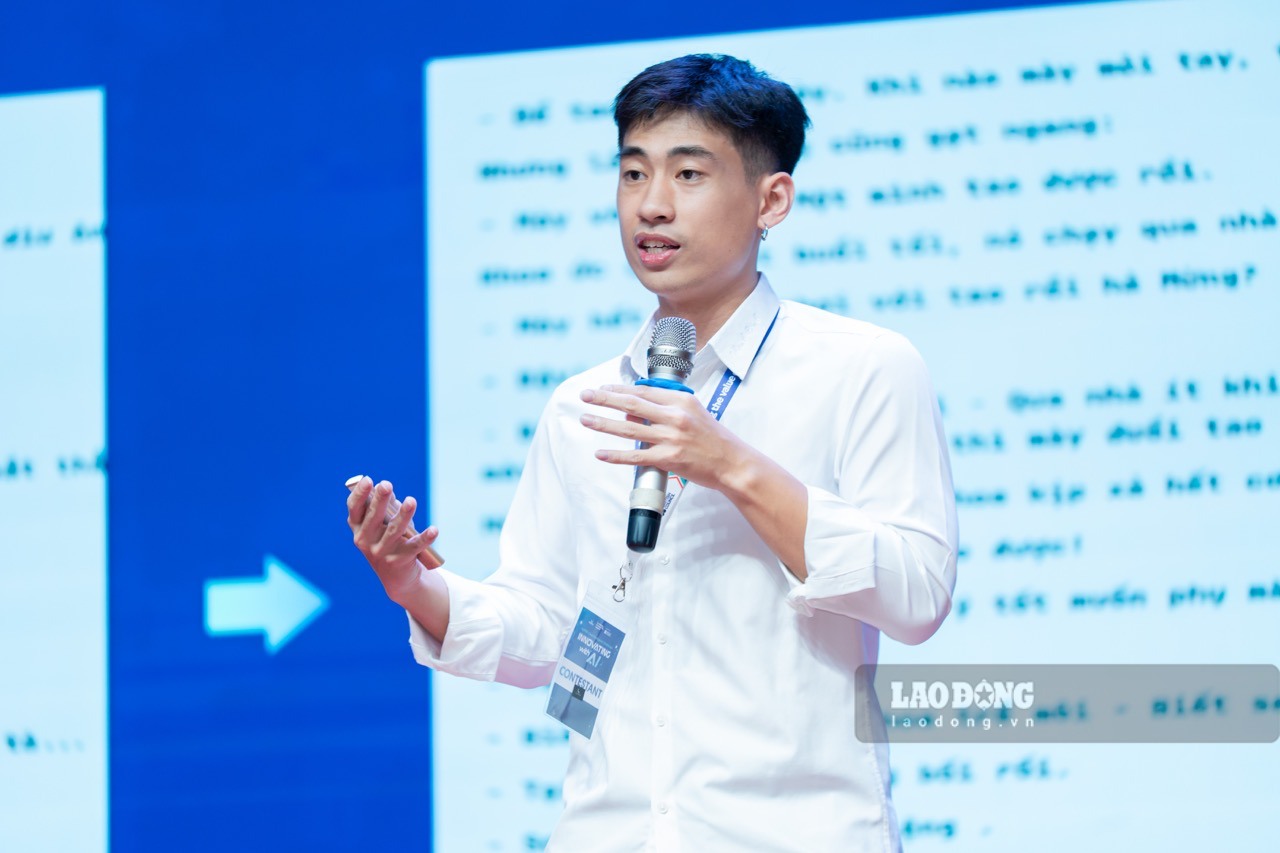
Initially, the group focused on the ability to remember the location of objects and space for the visually impaired. However, after the process of interviewing and getting opinions from users themselves, the group realized that the actual needs were different.
Visually impaired people have very good memory. What they want more is to be able to confidently go out and experience life" - Hung said.
From user feedback, the group decided to change almost the entire project orientation even though the time was close to the final round. Instead of just supporting memorization, the product was developed into an AI glass with 5 main functions including navigation, text reading, selective memorization, smartphone support and navigation. Thanks to that, the product can support visually impaired people to move safely and access the surrounding environment more conveniently.
Hung said that the biggest challenge of the project is the coordination between many fields such as AI, software, hardware, electronics and building product development models. Meanwhile, most members are final year students, both doing graduation projects and participating in internships.
The product has been tested by the group on 15 visually impaired people. Initial feedback helps the group adjust and improve the features to better suit the actual needs of users.
Nguyen Gia Bao, a final year student, majoring in Electronics - Telecommunications, Hanoi University of Science and Technology, another member of the group - said that in the near future, the group plans to continue to expand the scope of testing on more users to evaluate the effectiveness of the product in actual conditions.
In parallel with that, the group also hopes to improve technology, seek cooperation opportunities and call for investment to bring AI glasses closer to the visually impaired community.
ActTNE Green Intelligence Challenge: Innovating with AI is a competition under the ActTNE component of the UK–Vietnam EmpowerTNE Network, hosted by Phenikaa University.
The contest aims to encourage students to apply artificial intelligence (AI) to develop innovative solutions to address challenges associated with the 17 United Nations Sustainable Development Goals (SDGs).
In addition to expert support with rich experience, each team is also supported with 500 British pounds to develop, test and complete the project before the final round.
This year's competition attracted 29 ideas from more than 100 students from 44 high schools and universities at home and abroad. After the evaluation rounds, 6 best teams were selected to enter the Final round to compete.
Assoc. Prof. Dr. Nguyen Phu Khanh, Deputy General Director of Phenikaa University - Chairman of the UK–Vietnam EmpowerTNE Network, said that AI is opening up unprecedented opportunities in education, health, environment, production, business and social management. However, technology is only truly valuable when placed in the hands of responsible people who are able to understand the problem and have aspirations to serve the community.
Therefore, the contest is not only looking for solutions with technological elements. We want to find ideas that start from practical needs, built on empathy for people, capable of deploying and creating positive, long-term values" - Mr. Khanh emphasized.


