June is the time when overseas tours are chosen by many Vietnamese families when the school year has ended. For short trips, Singapore, Malaysia, or Thailand are still suitable choices for families. However, the heat sweeping through Southeast Asian countries every summer seems to slow down tourists' footsteps. Interspersed with the bustling schedule in Singapore, tourists can spend a few hours leisurely strolling in the unique number one garden in Singapore.
From the hotel, I took the orange train line "Circle Line" to the train station named "Botanic Gardens MRT Station". As soon as I got on the ground, tourists saw the entrance to the botanical garden. Singapore's modern public transport system is a plus point for tourists who like to travel alone. For a short trip, I did not choose to buy a Metro card but used a Visa card directly connected to a domestic bank account.
Singapore is a costly country for tourism, compared to other popular destinations in the region. Therefore, I was very surprised when the entrance ticket to the Singapore Botanical Garden is completely free. However, if tourists want to admire the beautiful orchids of the lion island nation, the Singapore orchid garden is located within the Botanical Garden, with a visit ticket price of 15 Singapore dollars, equivalent to about 300,000 VND.
Singapore Botanical Gardens fully converges the elements for a destination I love: Singapore's only UNESCO World Heritage Site to date (recognized in 2025), green space with diverse and quiet flora for walking after noisy and bustling days.
At the time it was built in 1859, it was the largest botanical garden in the world. It is estimated that the Singapore Botanical Garden is home to more than 10,000 species of plants and some animal species. I accidentally encountered a few water iguanas in the botanical garden grounds. Occasionally, otters also appear here with warning signs reminding visitors to be careful when they see otters passing by.
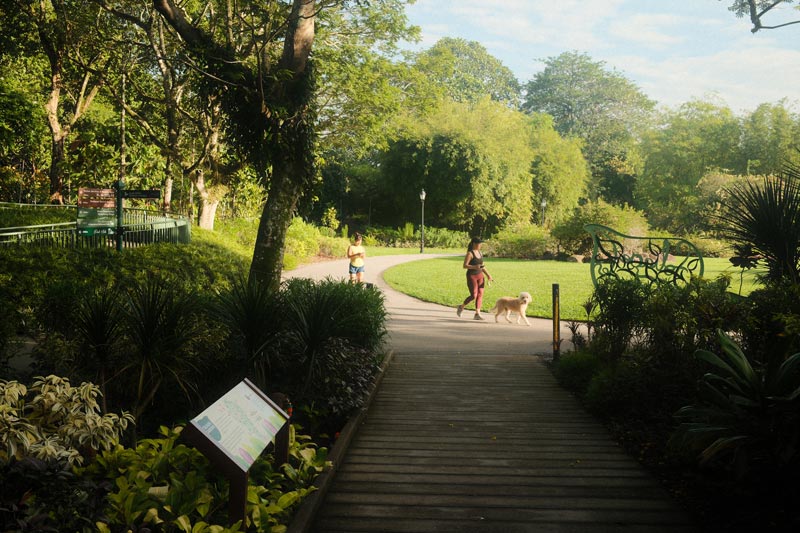
For tourists, this is a tourist destination to avoid the heat in Singapore's summer sunshine; for locals, the botanical garden is loved for outdoor activities such as exercise and picnics.
In Singapore's botanical garden, there are many different subdivisions, reflecting the diversity of the plant system stored and preserved here. If you have free time, visitors can spend the whole day exploring Singapore's botanical garden. Time is tight, so I only pass through the gardens that are rated as "must visit" here. From the entrance near the "Botanical Gardens" station, visitors will see a bamboo forest with a vast grass yard for everyone to relax in the early morning. Going a few more steps, visitors will encounter "foliage garden" - a garden with diverse plants in foliage colors.
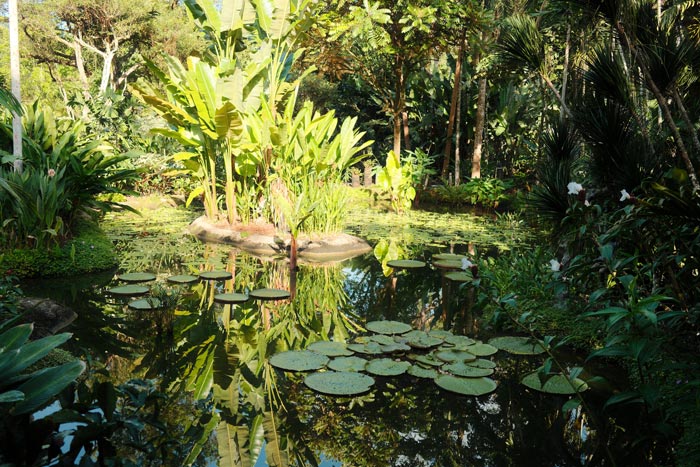
People say it correctly when you can find a rainforest right in Singapore's botanical garden. With the characteristic plant system of the hot and humid tropical climate, the rainforest model takes me to another world: The forest is darker, thicker with moisture, "bustling" with the sounds of the old forest. After walking the wooden road leading around the rainforest, I strolled to the ginger garden. This is where about 250 species of plants of the same family are concentrated, arranged in different types of landscapes. Not far from the rainforest, but the ginger garden has a different appearance; visitors seem to be strolling in a rainforest with lakes, waterfalls, water fountains, water lilies, alongside bird-shaped flowers hanging on both sides.
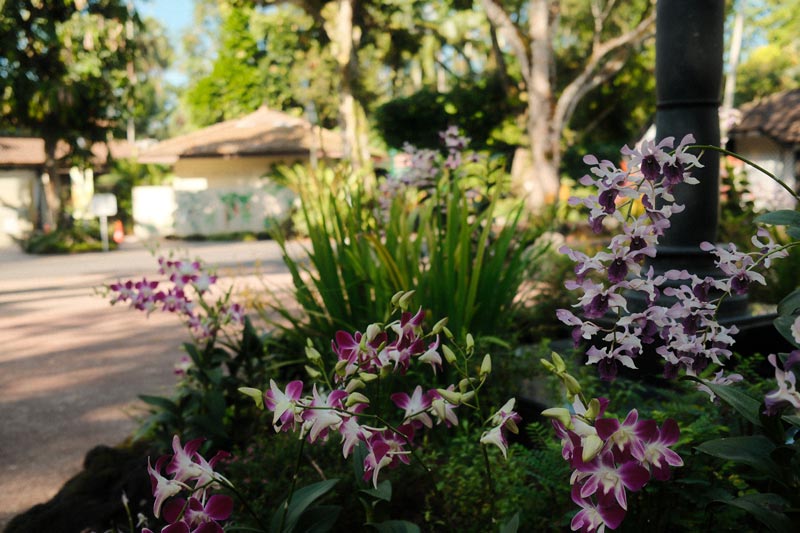
It is no coincidence that orchids are considered Singapore's national flower. I can feel that beauty when entering the National Orchid Garden - the "pearl" located in the middle of the botanical garden that visitors cannot just pass by. The National Orchid Garden of Singapore is considered the largest orchid garden in the world with more than 1,200 natural orchid varieties and 2,000 hybrid orchid varieties. As the pride of Singaporeans, the National Orchid Garden is also the venue for the orchid naming ceremony - a unique diplomatic ritual of the Lion City for high-level guests visiting the country. I did not witness any ceremony, but just looking at the way the garden is cared for and preserved, I also felt Singapore's respect for this flower.
If you still have time, visitors can visit Swan Lake - a particularly poetic area for a leisurely summer afternoon stroll, or The Bandstand - another symbol of Singapore's botanical garden. This area is often used for music performances, evoking a royal, noble Western garden scene.
From the National Orchid Garden, I followed a small path to another gate to return to the hotel, before the sunset. The ideal time to visit the Singapore Botanical Garden is from early morning until near noon or cool afternoon.
What remains after a morning of visiting Singapore's botanical garden is not only the majestic beauty of nature, condensed into a UNESCO World Heritage Site; I admire the way Singaporeans preserve green spaces for the city. With a national area only about 1/3 of Ho Chi Minh City, Singapore still creates green spaces in the heart of the city for people or tourists to have a stopover in the hot summer. For tourists like me, Singapore's botanical garden is a tourist attraction, but more importantly, for the people of the lion island nation, this is a green lung for humans.