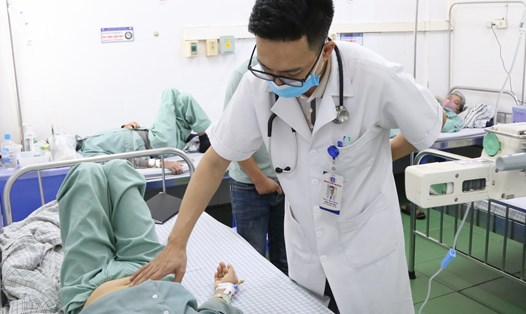
Gastrointestinal bleeding is a dangerous complication that can be life-threatening if not detected and treated promptly. Many patients are often subjective with symptoms such as abdominal pain, bloating or black stools, leading to late diagnosis and the risk of serious complications.
A typical case that has just been recorded at the Central Hospital for Tropical Diseases is Mr. N.T.D (64 years old, in Hanoi). He was hospitalized in a state of severe gastrointestinal bleeding, with a rupture of a vein in his stomach that was sprayed with blood. The cause was determined to be rapidly progressing gastric and duodenal ulcers.
Previously, Mr. D had a situation of diarrhea, dizziness, fatigue, bloating, blue skin, and pale mucous membranes. According to medical history, he had repeatedly had abdominal pain, was diagnosed with gastric ulcers and treated in many places. A month before being hospitalized, he suffered from dizziness, nausea, and endoscopy and recorded gastrointestinal bleeding but the specific location had not been determined. After being discharged from the hospital for about a week, the abdominal pain gradually increased, and he had to be treated at another hospital but did not improve, so he was transferred to the Central Hospital for Tropical Diseases.
At the General Internal Medicine Department, test results showed a serious decrease in the number of red blood cells. The patient was diagnosed with gastrointestinal bleeding with a severe prognosis and was given an emergency endoscopy to determine the bleeding location.
Doctor Ha Van Kim, Center for Gastroenteroscopy and Functional Examination, said: At the counter-canistic remover site, there is a level 3 varicose vein (IGV1), the rupture point is spraying blood into a beam. The team performed a technique of injecting extensed bulbs with a mixture of Histoacryl and Lipiodol solutions to stop emergency bleeding. Immediately after the injection, the rupture point was completely stopped.
Explaining further about this technique, Dr. Tran Viet Hung - Deputy Director of the Center for Gastroenter scanning and Functional Investigation - said: The Histoacryl - Lipiodol expansion fiber injection technique helps create blood vessel freezing and blockage, effectively stopping blood in cases of ruptured duodenal veins. After vaccination, the patient needs to be closely monitored because he/she may bleed again within 4-6 weeks.
Mr. D.'s case is a clear warning about the dangers of chronic digestive diseases. Digestive hemorrhage is one of the most serious complications, which can be life-threatening if treatment is delayed.
Dr. Tran Viet Hung recommends that people with gastric ulcers, especially the elderly or those with liver disease, should be monitored and endoscoped periodically. When there are signs such as abdominal pain, vomiting, diarrhea, fatigue, etc., you must go to a medical facility immediately to avoid dangerous complications.