
As the economic locomotive of the country and the largest production and trade center of Vietnam, Ho Chi Minh City is facing the opportunity to shape the next generation of growth based on the principles of circular economy, green transformation and sustainable production.
On June 11, at the German-Vietnamese Business Forum 2026 with the theme "Circular economy in production", Ms. Andrea Sühl - German Consul General in Ho Chi Minh City emphasized the importance of German-Vietnamese cooperation in promoting innovation, technology transfer and developing sustainable production models, thereby contributing to the implementation of Vietnam's green growth goals.
According to Ms. Cao Thi Phi Van - Deputy Director of the Ho Chi Minh City Trade and Investment Promotion Center, the city is promoting policies to support businesses in green transformation, develop ecological industrial parks and improve resource efficiency. This is an important foundation for deploying large-scale circular economy models in the coming time.
Ms. Phi Van said that with the strengths in technology, modern management experience and sustainable development thinking of German businesses, along with market potential, production capacity and the determination to transform of the Vietnamese business community, the two sides have many opportunities to expand cooperation in fields such as green production, supporting industries, automation, digital transformation, supply chain management and ecological industrial park development.
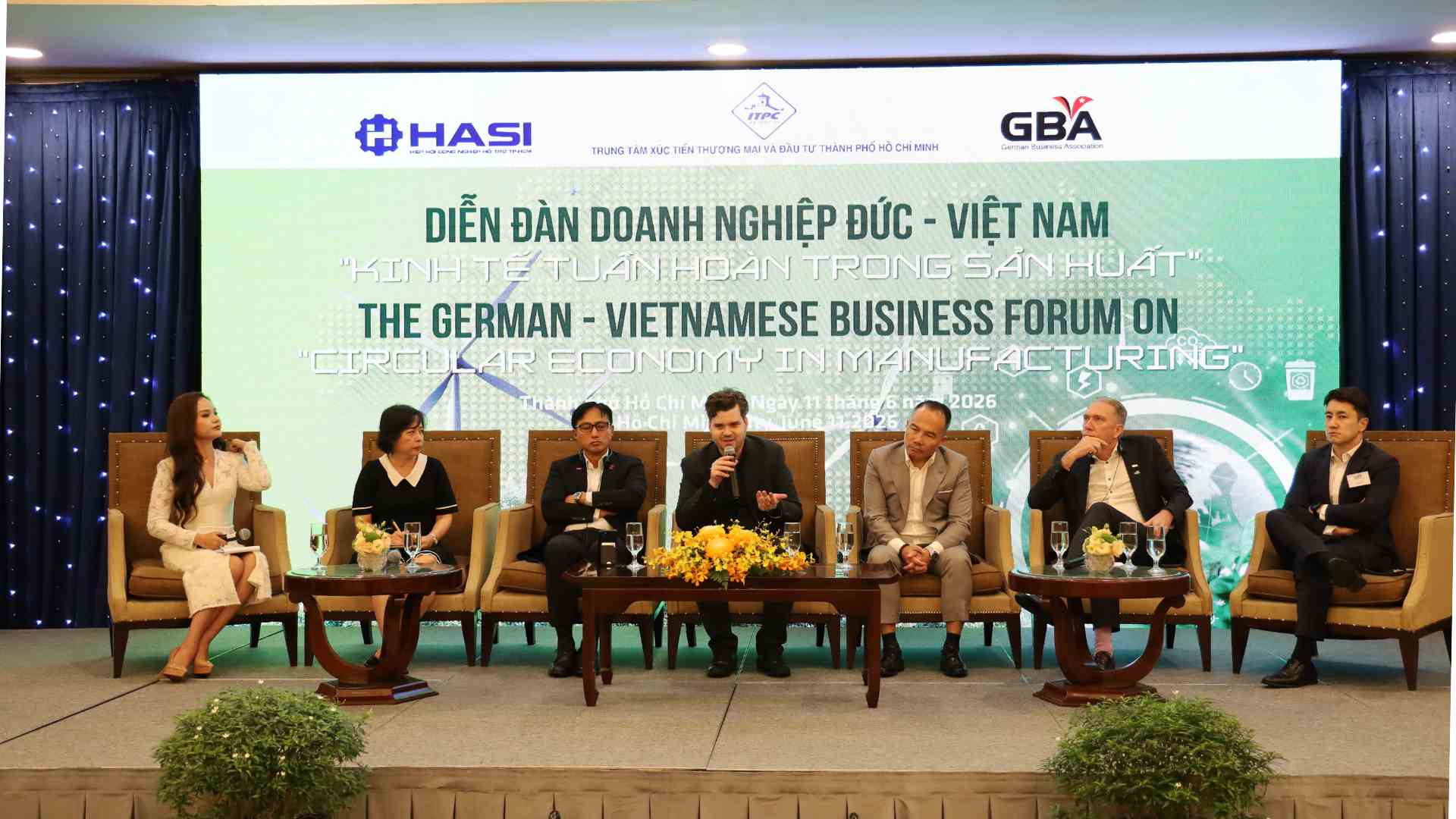
Assessing the prospects for cooperation, Mr. Alexander Ziehe - Chairman of the German Business Association in Vietnam (GBA), said that Vietnam, especially Ho Chi Minh City, is having the opportunity to integrate circular economic principles right from the next stage of industrial development. According to him, developing sustainable supply chains, improving the capacity of domestic suppliers and promoting technology transfer will help Vietnamese businesses participate more deeply in the global value chain.
From the perspective of supporting industry enterprises, experts believe that the transition to green production models and circular economy is not only a requirement to comply but also a condition to maintain the ability to participate in the global supply chain.
According to Mr. Nguyen Trong Luat - Vice Chairman of the Ho Chi Minh City Supporting Industry Association, the current pressure comes not only from the requirement to improve technological capacity but also from new regulations related to carbon emissions, traceability and transparency in the supply chain. The biggest gap for Vietnamese businesses lies in management capacity, technical human resources and connectivity with FDI corporations. Therefore, technology transfer, skills training and development of supplier connection mechanisms will be key factors to help businesses upgrade their competitiveness.
In the context that sustainable development requirements are increasingly shaping global investment and trade flows, the circular economy is considered an important driving force to help improve the competitiveness of Vietnam's manufacturing industry. At the same time, this is also a field with great potential to promote German-Vietnam cooperation, towards building a modern industry with high resilience and meeting international standards in the new development stage.


