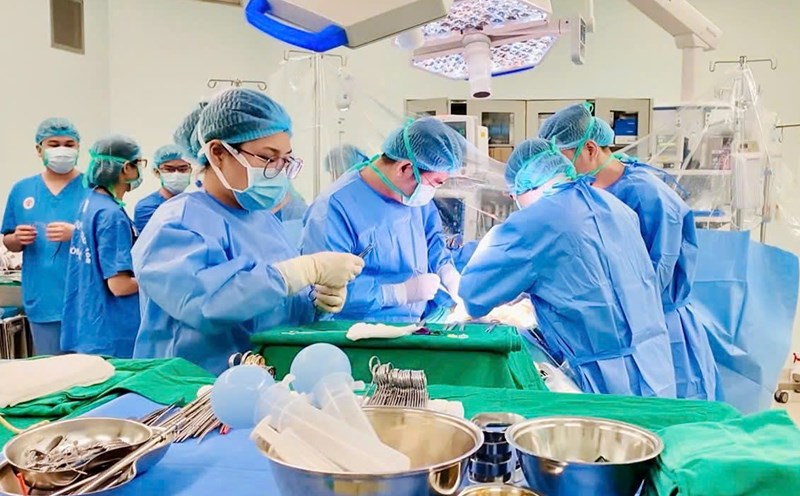
During treatment at the National Children's Hospital, doctors discovered a newborn baby boy with an extremely rare blood type - recorded for the first time at the hospital. After nearly two weeks of intensive treatment, the patient was out of danger and discharged from the hospital.
From jaundice symptoms to unprecedented cases
The patient is a 4-day-old baby boy, from Ha Tinh, born healthy but only after 8 hours, jaundice appeared and increased rapidly. At a local medical facility, the child was diagnosed with severe anemia of unknown cause.
On April 12, 2026, the child was transferred to the National Children's Hospital in a state of severe jaundice, neonatal infection and respiratory failure. Test results at the Neonatal Center showed that hemoglobin continued to decrease to 71 g/l, requiring emergency blood transfusion.
However, the process of finding compatible blood encountered a deadlock. The available blood type O units were not suitable. The blood sample was then sent to the National Institute of Hematology and Blood Transfusion for in-depth testing and identification of the child carrying anti-Jk3 antibodies - belonging to an extremely rare blood type.
Special decision in a life-or-death situation
The lack of suitable available blood puts doctors in a difficult situation. Although they found a relative with a compatible blood type, this person was not eligible to donate blood due to hepatitis B.
In the context of increasingly severe blood shortages, doctors are forced to make a special decision: using the mother's own blood - even though the pregnant woman has just undergone a cesarean section and this is not a priority choice in newborn blood transfusions.
After inter-specialized consultation, the plan was approved as the only solution to save the child's life. The blood collection process was closely monitored, ensuring maximum safety for the mother.
The blood is then processed, red blood cells are separated and strictly screened before being transfused to children to limit the risk of immune reactions.
Miraculous resurrection after two days
After transfusion and blood transfusion, in just about 48 hours, the patient's condition improved significantly: no longer needed respiratory support, jaundice decreased rapidly, and health gradually stabilized.
After nearly two weeks of intensive treatment, the baby was discharged from the hospital.
MSc.BSNT. Pham Thao Nguyen - Neonatal Center, National Children's Hospital - said that the patient's blood type belongs to the Kidd blood system with the Jk(a-b-3) type - an extremely rare form due to a SLC14A1 gene mutation on chromosome 18.
People with this blood type do not have Jka, Jkb and Jk3 antigens on red blood cells. Once anti-Jk3 antibodies are formed, they can only receive blood of the same type, making it extremely difficult to find a suitable blood source.
2025 statistics show that the hospital's Neonatal Center recorded 359 cases of jaundice (accounting for 10% of inpatients), of which blood group incompatibility accounted for 28.7%. However, this case is outside of common causes.
Doctors also emphasized that the case contributes to supplementing data on rare blood types in Vietnam, opening up a more proactive approach in screening, storing and connecting special blood sources - a key factor to improve treatment efficiency and blood transfusion safety in the future.