
Reconstructive aesthetics, AI and "beautiful as yourself" will lead the market
Answering an interview with Lao Dong Newspaper on the occasion of the 9th National Conference on Dermatology and Aesthetics, Assoc. Prof. Dr. Le Huu Doanh - Director of the Central Dermatology Hospital said that Vietnam's dermatology and aesthetics industry is entering a new stage of development, where scientific, safety and personalization criteria become the center.
According to him, the three prominent pillars of the industry today are "Regenerative aesthetics", "Longevity" and "Minimal aesthetics". This is a trend being pursued by many developed countries.

According to the leading expert, in the next 3-5 years, the dermatology and aesthetics industry will strongly shift to personalization and in-depth diagnostics. New technologies are not only limited to surface beauty but also aim to restructure the skin from the inside, optimize "cell energy", and promote ATP production to slow down aging.
The trend of multi-therapy will also become increasingly popular. Instead of using only one method, doctors will combine laser, filler, botox and proliferative active ingredients to optimize rejuvenation effectiveness, while reducing the dose of each technique to limit side effects.
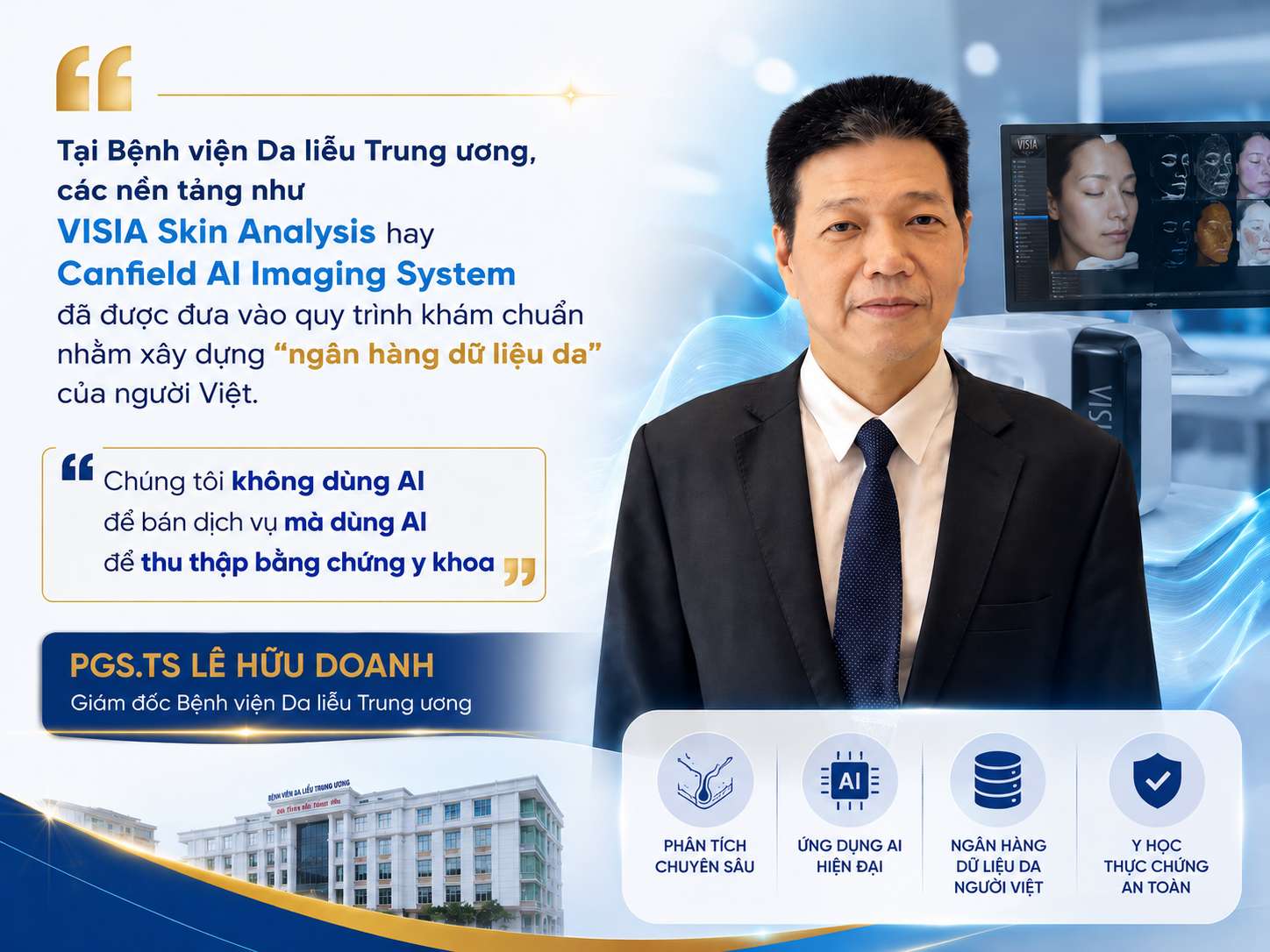
Notably, artificial intelligence (AI) is becoming a profound change factor in the cosmetic dermatology industry.
Assoc. Prof. Doanh said that AI today not only supports the analysis of skin lesions but also has the ability to predict the rate of aging, the risk of increased pigmentation after laser or the level of collagen reduction so that doctors can develop appropriate and safer regimens.
Bringing aesthetics back to the right medical orbit
Besides the explosion of technology, leaders of the Central Dermatology Hospital also frankly acknowledge that the current aesthetic market is facing many risks due to the lack of standardization in some facilities.
According to Assoc. Prof. Dr. Le Huu Doanh, even with "less invasive" methods, dermatological aesthetics still pose a risk of complications such as infection, vascular blockage or hyperpigmentation if performed incorrectly. Therefore, the most important thing is that interventions must be performed by well-trained dermatologists.
He gave three criteria to identify a standard medical aesthetic facility: human resources are genuine specialists; beauty based on evidence-based medicine; and having the ability to handle complications when incidents occur.
This is a life-and-death line between standardized institutions and non-standardized institutions," he said.
According to the direction of the Central Dermatology Hospital, in the coming time, the unit will coordinate with medical and pharmaceutical universities, the Vietnam Dermatology Association and local medical facilities to standardize training in the field of dermatology and aesthetics. Professional guidance on safe injection, multi-platform lasers, exosomal application or stem cells for Vietnamese people will also continue to be built and updated.
At the same time, a remote consultation network and aesthetic complication treatment are also being established to support lower levels during the "golden time" when accidents occur.


