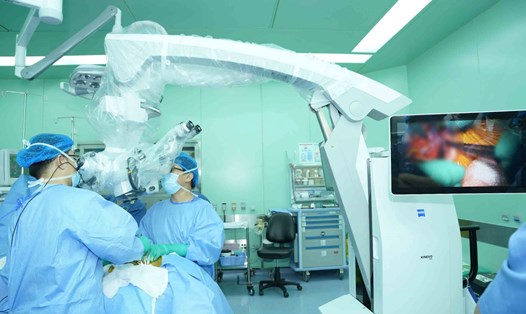
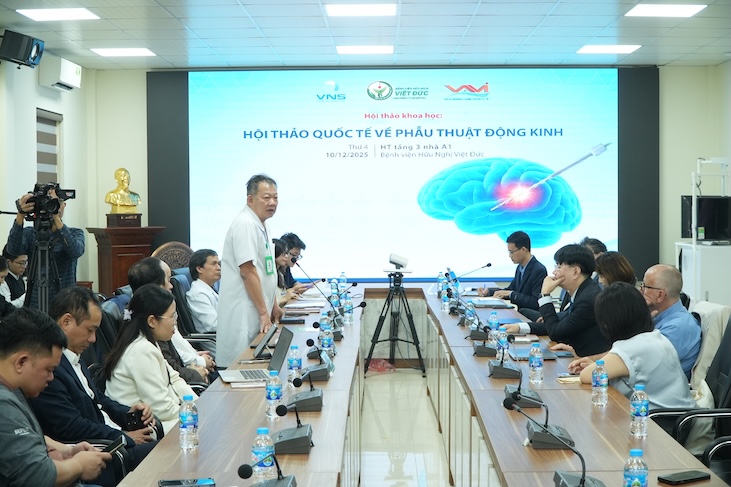
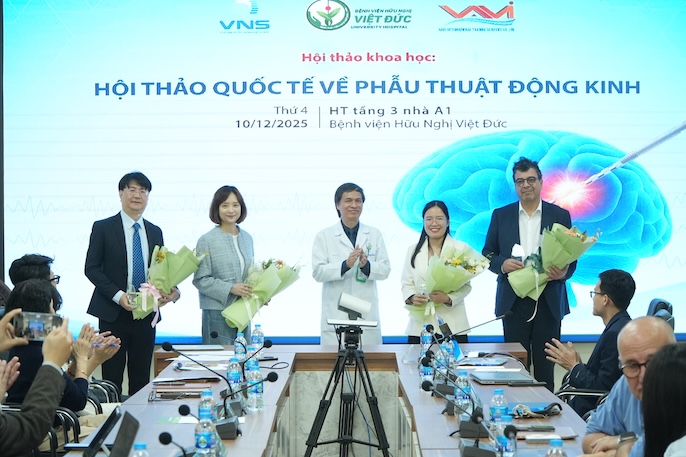
On December 10, at Viet Duc Friendship Hospital, an international conference on dong kinh surgery was held, providing information on many achievements in dong kinh surgery, emphasizing the role of selective electricity (SEEG) in preoperative assessment.
Currently, in Vietnam, there are about 710 thousand people with kinhlerosis, of which about 213 thousand people are resistant to medicine, the annual rate of kinhlerosis ranges from 4 to 14 people out of 1,000 people. Children with epidemics account for 30 - 40% of people with epidemics in Vietnam.
Anti-medical seizures (ie seizures that continue despite the use of at least 2 appropriate anti-seizure drugs) occur in about 30% of patients with seizures.
When drugs are uncontrolled, surgery is a very important choice to improve quality of life and reduce the risk of long-term complications.
However, one of the key conditions for successful surgery is to accurately identify the epileptogenic zone ( EZ): the part of the brain responsible for initiating and spreading seizures.
If this area is removed or intercepted without damaging too many normal functions, the possibility of the patient having no more seizures or a significant reduction is very high.
In cases where there is a suspicion of complex birth defects - for example, the start in remote areas, on both sides, or unexplained signed-handed image damage - deep brain electrolytes are necessary. That is when the transcranial brain electrical regulation (SEEG) becomes very valuable.
The method has many outstanding advantages
Information at the workshop said that the SEEG (Stereo-Electroencephalography) method is the technique of placing deep electrodes (depth electrodes) through the skull into the brain, accurately positioning in three dimensions, to record brain electricity activity from deep and complex areas.
Thanks to this approach, doctors can collect brain electrical data during the "extra-operative monitoring" phase in multiple regions at the same time - compared to "more" methods such as superficial ultrasound.
The transcranial brain electrical recording method has outstanding advantages such as being able to access deep brain areas such as the hippo, almonds, islet, and the inner/central surface of the ban cau - areas that are often difficult to access superficial electricity; Less encroachment than opening a large skull (craniotomy) to place electricity beneath the scrotum (SDE).
At the same time, it allows the formation of a network for initiating and spreading seizures more accurately - thereby increasing the possibility of successful surgery.
One of the major concerns is "Is deep power placement safe?". According to experts, current studies show that the complication rate of this method is low. In terms of overall safety: the method of transcranial brain electrical regulation is considered "safe and effective" if performed at a large surgical center with good process standards.
However, neurosurgical experts also emphasize that any invasive procedure is risky - bleeding in the brain, damage to small blood vessels, electrical infections or complications after cutting/operation. Therefore, doctors need to always carefully consider the potential benefits and risks and patients need to be deeply consulted before performing.
What is the solution for patients with resistant seizures?
Associate Professor, Dr. Dong Van Xeo - Deputy Director of Viet Duc Friendship Hospital, Chairman of the Vietnam Neurological Association said that over the past 10 years, the hospital's Neurosurgery Center has examined and screened hundreds of thousands of people with epidemics, including many cases of complex epidemics.
Doctors here have also operated on more than 150 cases of resistant eczema, using an important and modern examination system. "The results of controlling the seizure were up to 80%, bringing a significant change in the quality of life for patients" - Associate Professor, Dr. Dong Van Cuoc said.
This expert also emphasized: Epilepsia surgery is increasingly a life-saving solution for resistant epilepsia patients and accurately identifying the area of labor is a decisive factor for success.
The trend of applying SEEG is increasing globally, especially in specialized centers in the US, Europe, China, and India.
"In Vietnam, with the development of the Neurosurgery and Neurophysical Electricity, SEEG is an important development direction to improve the effectiveness of awkward surgery, helping many patients escape seizures and improve the quality of life" - Associate Professor, Dr. Dong Van sel said.
The number of people with kinhities in Vietnam compared to other countries such as Japan (870 thousand), Thailand (50 thousand), China (nearly 10 million people), India (more than 10 million people)...