
China's "artificial sun" project, also known as EAST (Experimental Advanced Tokamak Superconducting Reactor) has reached an important technical milestone in the development of superconducting magnet systems for fusion reactors.
Xinhua News Agency reported that the Plasma Physics Institute of the Hefei Institute of Physics, under the Chinese Academy of Sciences, has completed the development, acceptance and comprehensive testing of 2 key superconductive magnet systems for fusion reactors in the future.
These two systems include a spiral magnetic field superconducting magnet and a high-temperature ultraconducting central electromagnetic coil.
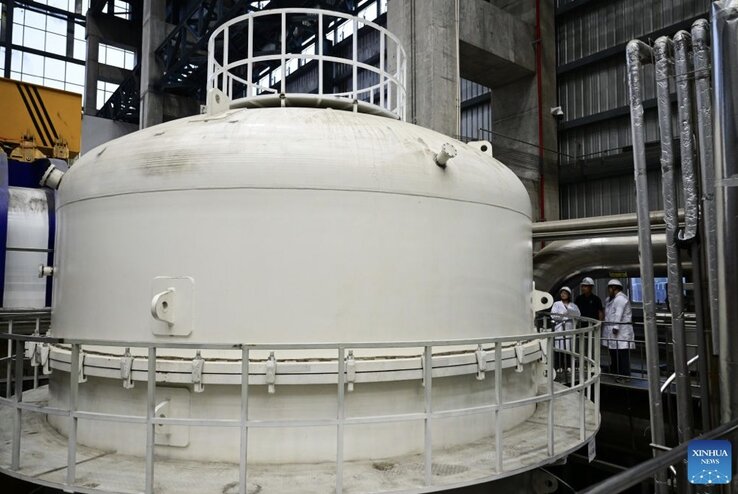
Xinhua News Agency emphasized that all key technologies are developed in China, with overall performance in the world's most advanced group.
The "artificial sun" has the ultimate goal of creating a nuclear fusion reaction similar to the reaction taking place in the Sun, thereby providing humanity with an almost endless source of clean energy, while opening up the possibility of exploring space beyond the Solar System.
Thermal energy has been identified as one of the strategic growth areas in China's 15th Five-Year Plan. Important technological breakthroughs are bringing prospects for getting closer to clean and abundant energy sources.
While EAST continuously breaks world records thanks to continuous upgrades and tests, another Chinese "artificial sun" project, Huanliu-3 (HL-3), is also being developed in this country. HL-3 is researched and developed by the Southwest Design and Research Institute of China National Nuclear Corporation in Chengdu, Sichuan province, China.


