
Domestic coffee prices
Coffee prices today in the domestic market simultaneously decreased compared to the previous session. According to giacaphe. com, coffee prices on September 8th averaged at 94. 300 VND/kg, down 500 VND/kg.
In Gia Lai and Dak Lak, coffee prices were recorded at 94. 200 VND/kg, down 500 VND/kg.
In Lam Dong, the listed coffee price is at 93.700 VND/kg, down 500 VND/kg.
The old Dak Nong area still maintained the highest price in the whole region, recording a level of 94,500 VND/kg, down 500 VND/kg.
The USD/VND exchange rate according to Vietcombank was recorded at 25,770 VND/USD, down 70 VND/USD.
World coffee prices
In the world market, coffee prices increase and decrease according to each term with different exchanges.
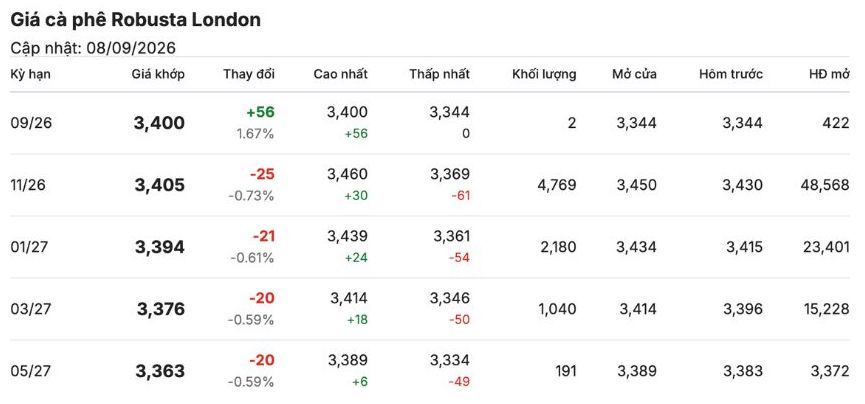
According to Barchart, the September 2026 Robusta contract increased by another 56 USD/ton, anchored at the 3,400 USD/ton mark. In the opposite direction, the November 2026 term was listed at 3,405 USD/ton, down 25 USD/ton. The term from January 2027 to May 2027 saw the largest decrease of 21 USD/ton, down to 3,363 - 3,394 USD/ton.
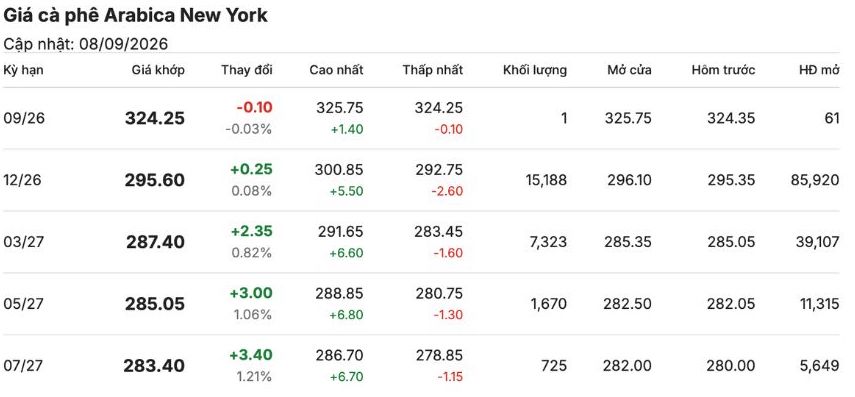
On the other hand, the September 2026 Arabica futures contract slightly decreased by 0.1 cent/lb (equivalent to 0.03%), maintaining at the 324.25 cent/lb mark. The December 2026 term increased slightly by 0.25 cent/lb, keeping the price at 295.60 cent/lb. Further forwards are anchored in the 287.4 - 285.05 cent/lb range.
Assessments and forecasts
According to the Vietnam Coffee - Cocoa Association (Vicofa), in the first 8 months of 2026, Vietnam's coffee exports reached nearly 1.7 million tons, worth more than 6 billion USD, an increase of more than 10% in volume, but a decrease of 11.2% in value compared to the same period in 2025 due to reduced export prices.
The EU and the United States continue to be the key export markets for Vietnamese coffee. In addition, some markets in Asia, especially China, are opening up new growth poles for the industry.
According to forecasts, coffee prices tend to increase in the coming time, thanks to the support of many factors such as climate change with heavy rainfall slowing down harvest time in Brazil; El Nino, hot sun, drought will occur in Asia at the end of 2026 and 2027, which may affect coffee production and supply; low inventory.
The biggest downward pressure currently comes from the world's largest coffee producer, Brazil.
The 2026/27 Arabica crop harvest in this country was almost completed by the end of August thanks to dry weather conditions helping to accelerate progress.
According to the latest forecast from brokerage company StoneX, Brazil's output this crop year may reach a record level of 77.2 million bags, up 2.6% compared to the forecast in March. Brazil's export growth also recorded a breakthrough, as the country's government announced exports in August reached 3.44 million bags, up 45% compared to the same period last year.


