
Domestic pepper prices
As of 11:30 AM today (July 29), domestic pepper prices are anchored in the high price zone, listed at 140,000 VND/kg. Currently, key areas are trading in the range of 139,000 - 142,000 VND/kg.
Domestic pepper prices after a simultaneous increase of 500 - 1,000 VND/kg in all regions. Currently, provinces and cities list prices as follows:
Gia Lai and Dong Nai simultaneously listed at the mark of 139,000 VND/kg.
In the same direction, pepper prices in Ho Chi Minh City are anchored at the threshold of 139,000 VND/kg.
Dak Lak and Lam Dong respectively offered for sale at the highest purchase price in the whole region of 142,000 VND/kg and 141,000 VND/kg.
Compared to the end of June, the current average domestic pepper price is trending upwards, increasing by 2,200 VND/kg.
World pepper price
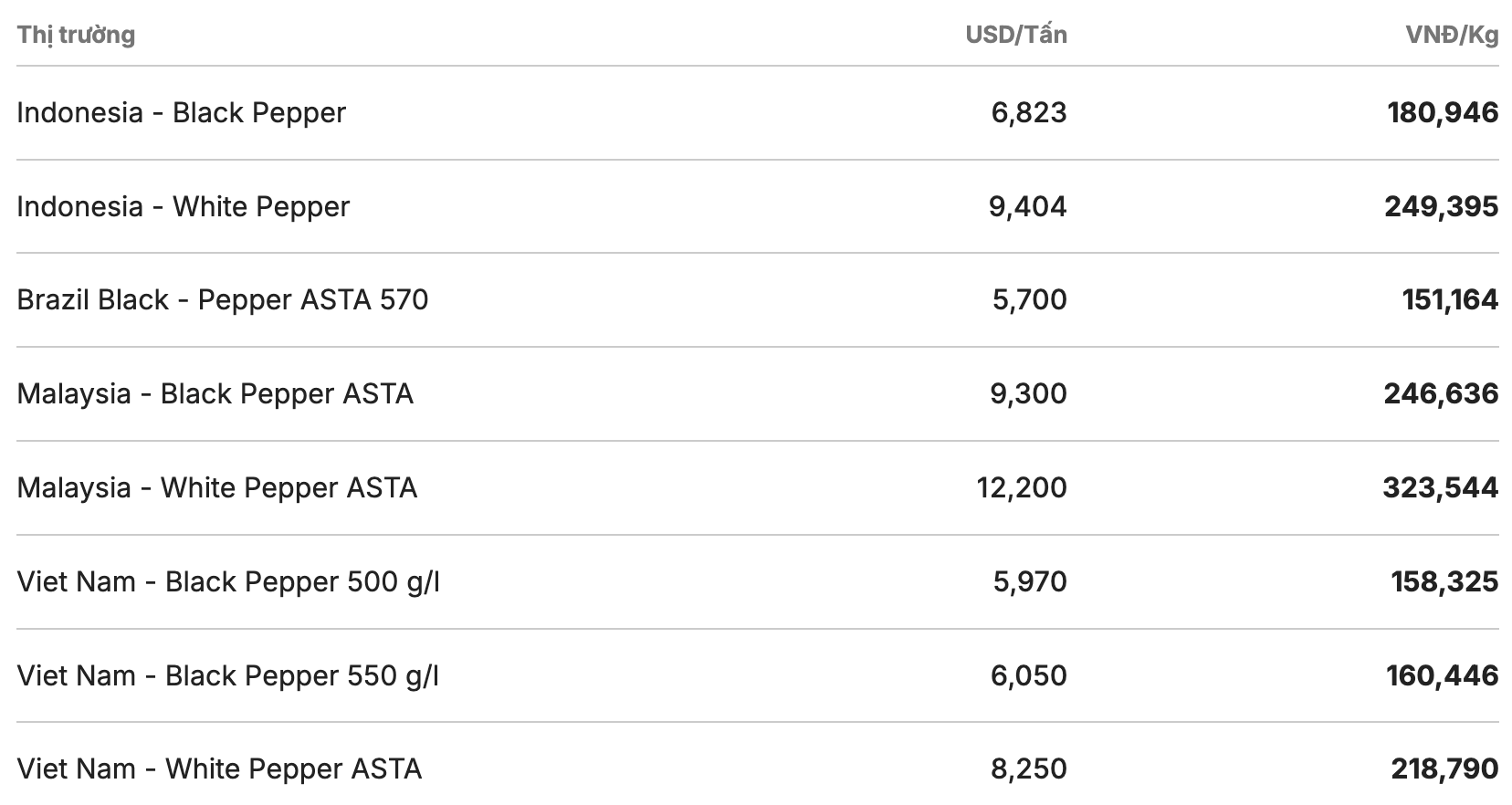
In the world market, pepper prices continue to remain unchanged in almost all countries. Indonesian black and white peppers are no exception, trading in the range of 6,823 - 9,404 USD/ton (equivalent to 180,946 VND/kg - 249,395 VND/kg).
Meanwhile, the price of black pepper in Brazil sold to the market is 5,700 USD/ton (about 151,164 VND/kg). Notably, black and white pepper in Malaysia are still trading at high prices, respectively 12,200 USD/ton and 9,300 USD/ton.
In Vietnam's pepper export market, black pepper prices of 500 g/l and 550 g/l remained unchanged at 5,970 - 6,050 USD/ton. In the same direction, ASTA white pepper price offered for sale at 8,250 USD/ton (equivalent to 218,790 VND/kg).
Assessments and forecasts
In recent days, the Vietnamese pepper market has been recording volatile developments. While export volume shows signs of decreasing compared to the same period, the average export price level continuously sets new milestones.
In areas famous for pepper such as the Central Highlands and Southeast, the plant's growth cycle is entering a key stage: fruit raising and solid accumulation from May to October every year. This is the time when pepper plants carry out the strongest metabolism process to create spiciness and characteristic flavor. However, the prolonged rainy season also contains many risks, which can affect the quality of the fruit.


