
World gold and silver prices simultaneously increased sharply last night as oil prices plummeted after positive diplomatic signals between the US and Iran, helping to reduce inflationary pressure and US bond yields.
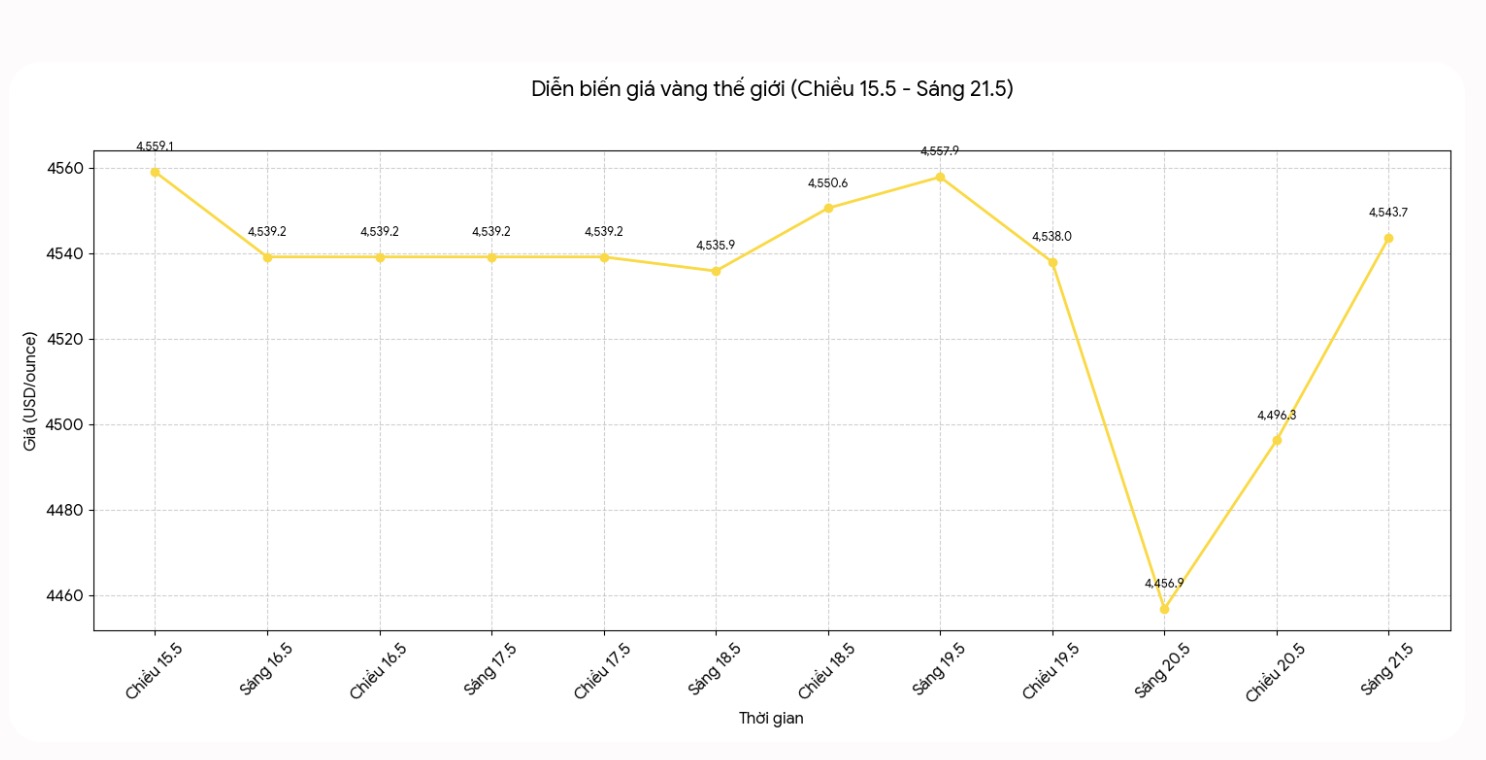
World gold prices are listed around the threshold of 4,543.7 USD/ounce. Meanwhile, spot silver prices fluctuate around the threshold of 75.6 USD/ounce.
This recovery took place after the previous strong sell-off of the precious metals market. However, analysts believe that risks from the interest rate policy of the US Federal Reserve (Fed) are still a significant factor putting pressure on gold prices.
The minutes of the Fed meeting on April 28-29 show that the Middle East conflict continues to be a major factor affecting global asset prices. Rising energy prices have pushed up short-term inflation expectations, pulling US Treasury bond yields up in the recent period.
The Fed also noted that the options market currently reflects about 30% of the possibility that the US will raise interest rates in the first quarter of 2027. This makes the recovery outlook for gold prices heavily dependent on whether bond yields continue to cool down or not.
The oil market recorded strong fluctuations as the Hormuz Strait shifted from an escalating tension to gradually reducing the risk premium. Oil prices fell nearly 6% after two Iraqi crude oil tankers heading to China passed through the Hormuz Strait safely. Another Kuwaiti oil tanker was also recorded appearing on this shipping route.
The total amount of oil transported through the strait in a day is estimated at about 6 million barrels, the highest level since the US-Israel conflict with Iran broke out in February.
US President Donald Trump said that US-Iran talks are in their "final stage", but also warned of the risk of retreating military action if negotiations collapse.
According to analysts, the current developments support gold prices in the direction of reducing inflationary pressure and pulling bond yields down. However, safe-haven demand for gold has somewhat weakened as geopolitical tensions ease.

On other financial markets, the USD depreciated, US bond yields fell and risk-averse sentiment improved significantly.
US economic data released on the same day showed that existing home sales in April increased by 0.2%, reaching an annual adjustment of 4.02 million units. Meanwhile, inventory increased by 5.8%, to 1.47 million units and midday selling prices increased by 0.9% compared to the same period last year, reaching 417,700 USD.
These figures show that the US economy has not weakened strongly, but high borrowing costs are still putting pressure on people's ability to pay. The bond market continues to play the role of the main channel affecting the price of precious metals.
US stocks simultaneously increased after oil prices and bond yields cooled down. The S&P 500 index rose 1.1% to 7,432.97 points, the Dow Jones rose 1.3% to 50,009.35 points, and the Nasdaq Composite rose 1.5% to 26,270.36 points.
Small-cap stocks led the gains as Russell 2000 jumped 2.6%. US 10-year Treasury bond yields fell below the 4.6% mark, while Brent oil prices fell 5.6%.
Technically, analysts believe that gold buyers are aiming to bring prices above the resistance zone of 4,552.2-4,572 USD/ounce. If successful, gold prices may reach the levels of 4,600 USD and 4,629 USD/ounce.
In the opposite direction, if losing the support level of 4,537 USD/ounce, gold prices are at risk of falling deeper into the 4,500 USD zone, even 4,481 USD/ounce.
For silver, the important resistance zone is currently in the range of 76.74 - 77 USD/ounce. If this zone is surpassed, silver prices may head towards the 78 USD and 78.92 USD/ounce marks.
Meanwhile, the nearest support zone for silver is at 75 USD/ounce, followed by 73.9 USD/ounce.


