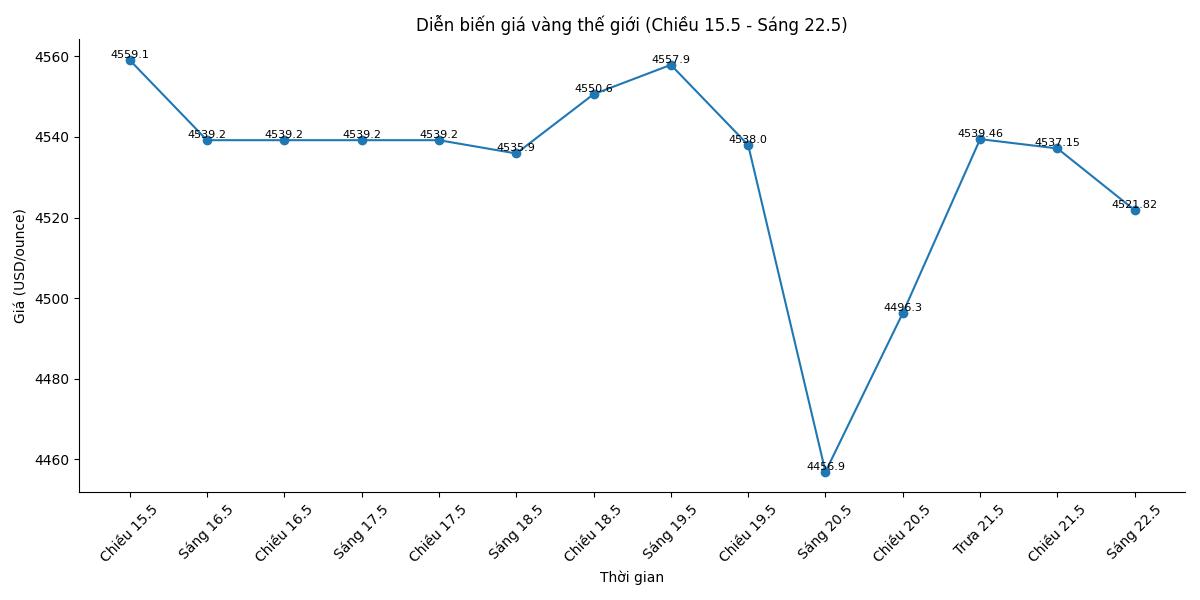
Gold prices continue to fluctuate in a narrow range as the market receives many mixed signals related to the US-Iran negotiation process, making investors still cautious about global interest rate prospects.
Spot gold is currently trading around 4,530 USD/ounce, almost unchanged compared to a week ago.
According to the semi-official Iranian Students' News Agency, Tehran is preparing to respond to a new proposal from the US aimed at a ceasefire agreement. The report said that the gap between the two sides has "reduced somewhat", although specific sources have not been specified.
This information once supported market sentiment. However, oil prices then rebounded after Reuters quoted sources as saying that Iranian Supreme Leader Mojtaba Khamenei requested that all high-enriched uranium in the country continue to be stored in Iranian territory, instead of being transferred abroad as part of negotiation proposals.
Meanwhile, US President Donald Trump also announced his opposition to the proposals of Iran and Oman regarding the possibility of applying a long-term toll mechanism to transportation through the Strait of Hormuz.
Conflicting statements from both sides make it impossible for the market to determine whether the negotiation process is really close to an agreement or not.
For the gold market, this means that concerns about inflation have not cooled down as energy prices remain high, thereby increasing the possibility that central banks will have to maintain high interest rates for longer to control inflation.
This is a factor that often puts pressure on gold because the precious metal does not generate profits and tends to benefit more strongly in a low interest rate environment.
TD Securities strategists, including Mr. Ryan McKay, believe that the current deadlock is reducing the attractiveness of gold and many other precious metals to trend trading funds (CTAs).
According to this analysis group, in the scenario where gold prices fall deeply to the 4,350 USD/ounce range, CTA funds may cut almost all current net buying positions for gold.
Since the conflict broke out at the end of February, gold prices have fallen nearly 14% as the market continuously weighs between high interest rate pressure and the risk of slowing economic growth accompanied by high inflation.
As of 09:37 am Vietnam time, spot gold prices slightly decreased by 0.23% to 4,521.82 USD/ounce. Silver prices decreased by 0.1% to 76.61 USD/ounce, while platinum and palladium prices remained almost unchanged. The Bloomberg Dollar Spot Index - a measure of the strength of the USD - also remained stable during the session.