
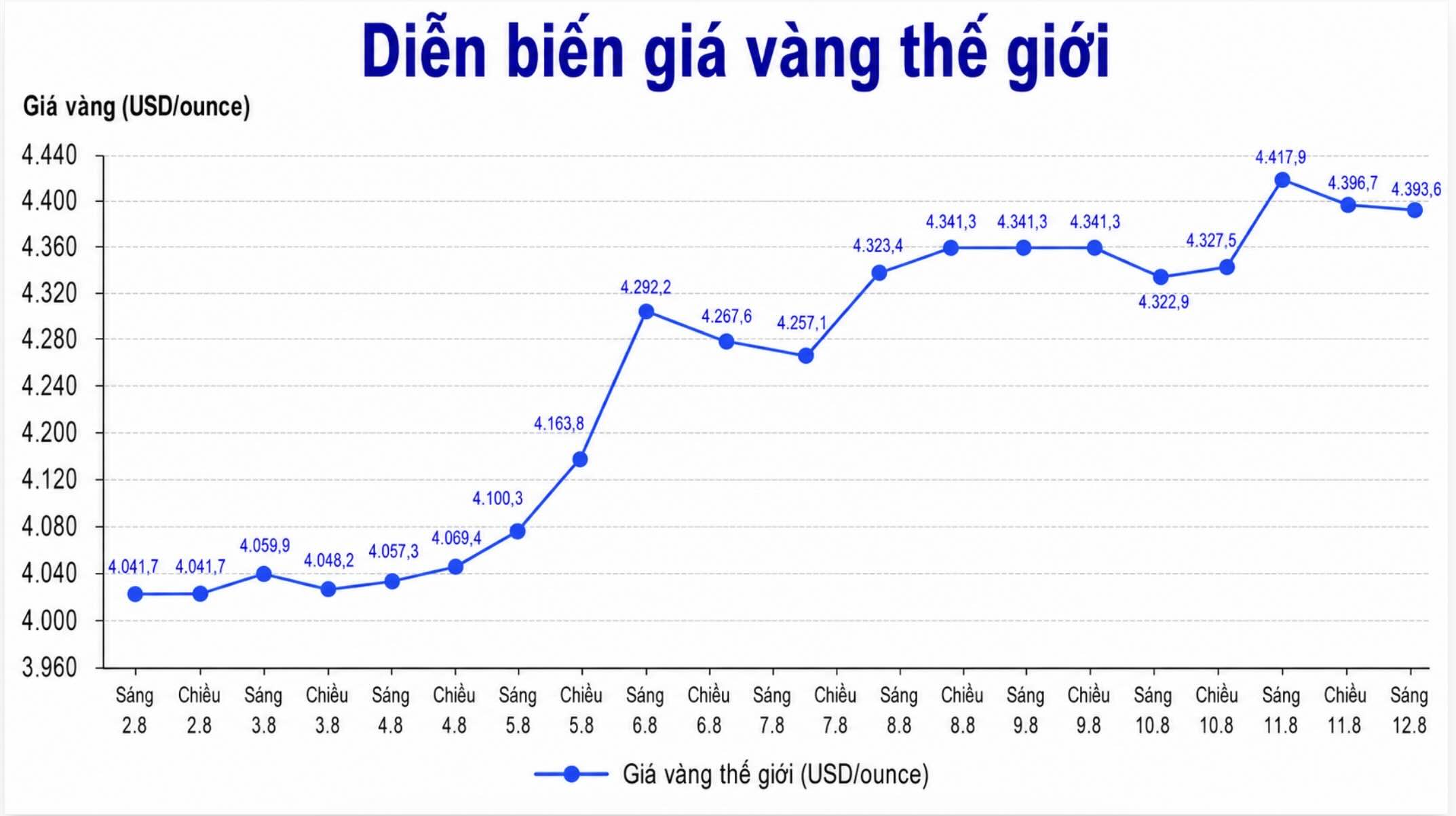
World gold prices fluctuate sharply
In the afternoon trading session on Tuesday in the US, gold and silver prices simultaneously increased slightly thanks to demand for safe haven assets related to tensions in the Strait of Hormuz.
At one point, spot gold was traded around 4,412.50 USD/ounce, up 0.56% in the session. Spot silver reached about 65.680 USD/ounce, up 0.13%.
However, gold prices then turned down when the market received new data on the US housing sector.
The US National Association of Realtors (NAR) said total existing home sales in July decreased by 1.7%, to 4.06 million units at an annual pace adjusted seasonally.
Despite the decline, this result is still better than the economic forecast of 4.04 million units. June data was also adjusted to increase from 4.09 million to 4.13 million units. After the data was released, spot gold at one point fell to about 4,385.57 USD/ounce, losing 0.11%.
Investors await US CPI
The gold market is in a stalemate ahead of the US consumer price index (CPI) report and production price data to be released next.
The weaker-than-expected jobs report previously supported gold as it increased expectations that the US Federal Reserve (Fed) could ease monetary policy.
However, the recovery of oil prices and the risk of continued high inflation make expectations about the possibility of the Fed adjusting interest rates in September more balanced.
The yield on 10-year US government bonds is fluctuating around 4.7%, while the USD index is increasing. These are two factors that limit the breakthrough potential of the precious metal.
The US stock market also adjusted after setting previous record highs. S&P 500 fell 0.3% to 7,728.20 points, Dow Jones fell 0.3%, while Nasdaq Composite lost 0.6%.
Tensions in the Strait of Hormuz continue to support gold
Tensions in the Strait of Hormuz remain one of the factors creating the largest risk premium for the precious metals and energy markets.
Iranian officials announced that this strategic sea route will continue to be closed if Washington does not accept Tehran's conditions. The new developments make the market not ready to bet on the possibility of the Hormuz Strait being reopened soon.
Brent oil prices rose 1.4% to $88.91 a barrel, while WTI oil rose 1.3% to $83.20 a barrel. Rising energy prices increased concerns about inflation, thereby supporting gold as a defensive asset.
Gold price may head towards 4,500 USD/ounce?
Technically, if the upward momentum is maintained, gold may head towards the 4,480 USD/ounce zone, followed by the psychological level of 4,500 USD/ounce.
In the opposite direction, the 4,350 USD/ounce zone is considered a noteworthy support level. If this level is broken, gold prices may retreat to 4,300 USD/ounce and deeper to the 4,180-4,200 USD/ounce zone.
For silver, the threshold of 66.51 USD/ounce is a near resistance zone. If this level is exceeded, the price may head towards 71.26-72.08 USD/ounce. Conversely, 64 USD/ounce is an important support zone to monitor.
In the short term, CPI developments, US production prices, bond yields, the USD and the situation in the Strait of Hormuz are forecast to continue to determine the trend of the precious metals market.
The information in the article is only intended to provide a reference perspective on the developments of the world gold market, not an investment recommendation.


