
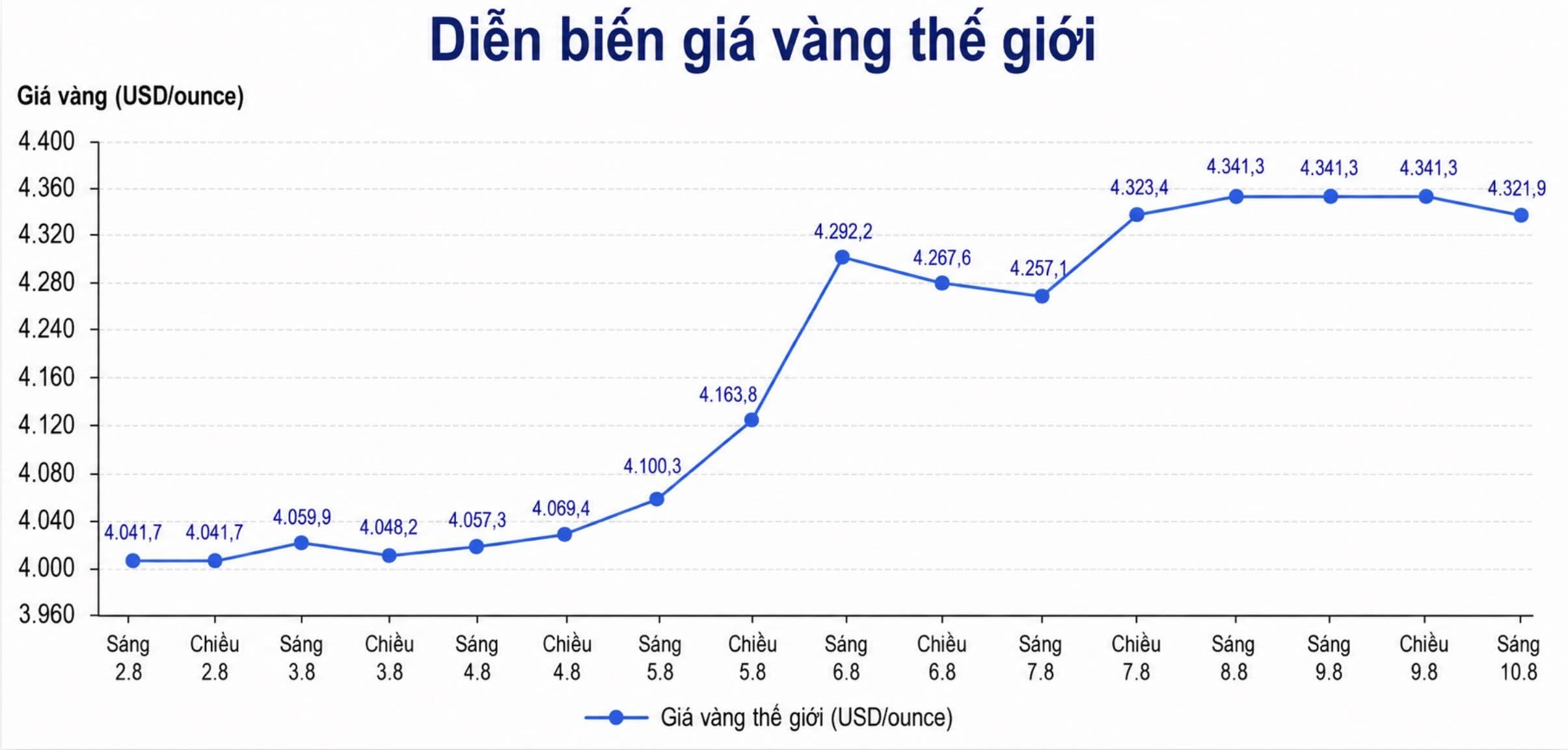
World gold prices opened the new week in a state of correction after just hitting a 7-week high. As of 10:50 am on August 10 (Vietnam time), world gold prices were listed around the threshold of 4,321.9 USD/ounce.
The decline appeared after the precious metal price increased sharply at the end of last week and reached the highest level since June 17. This development caused a part of investors to take short-term profit-taking.
However, the market is still receiving support from expectations related to the monetary policy of the US Federal Reserve (Fed).
Data released last weekend showed that the US economy unexpectedly lost jobs in July. In addition, the number of jobs added in the previous two months was also significantly reduced.
After the jobs report, market expectations for the Fed's policy meeting on September 15-16 have changed. The possibility of the Fed raising interest rates in September is no longer as highly assessed as before.
Low interest rate environments are often beneficial for gold because this precious metal does not yield yields. When the opportunity cost of holding gold decreases, the attractiveness of this safe-haven asset can be improved.
This week, the focus of investors will be important US inflation data.
The consumer price index (CPI) is expected to be released on Wednesday, while the producer price index (PPI) will be released on Thursday.
If inflationary indicators show that price pressure continues to cool down, expectations that the Fed will maintain interest rates may be strengthened, thereby creating more room to support gold prices.
Conversely, higher-than-expected inflation figures may make monetary policy prospects more cautious and put pressure on precious metals.
Besides the interest rate factor, the geopolitical situation in the Middle East is still a variable that the market closely monitors.
On August 5 (Tehran time), according to TASS news agency, Iran agreed to open a temporary maritime route through the Strait of Hormuz under an agreement with Oman. This route is expected to operate for 2 to 4 months and may be extended if negotiations achieve positive results. The information was released by Iranian Deputy Foreign Minister Kazem Gharibabadi and published by IRNA news agency.
According to Mr. Gharibabadi, the new maritime route is currently being jointly deployed by Iran and Oman, initially identified as a temporary solution to maintain traffic through the Strait of Hormuz.
This is a temporary route expected to operate for 2-4 months. However, in the current negotiations with Oman, the two sides are also considering the possibility of extending the application time of this route," he said.
Developments in the Strait of Hormuz are particularly noticed by investors because this is a maritime route that plays an important role in the global energy market. Any changes related to traffic flow in this region can also affect oil prices, market sentiment and demand for safe-haven assets, thereby affecting gold price movements.
On the precious metals market, spot silver price decreased 0.2%, to 63.45 USD/ounce. Platinum prices decreased 0.1%, to 1,742.5 USD/ounce, while palladium decreased 1.1%, to 1,362.97 USD/ounce.
The information in the article is for reference only, not investment recommendations.


