
According to Kitco, world gold prices are forecast to continue to fluctuate cautiously next week as investors simultaneously monitor the interest rate policy of the US Federal Reserve (Fed), inflation developments and geopolitical tensions in the Middle East.
Mr. Kevin Grady - Chairman of Phoenix Futures and Options - said that the gold market has not yet formed a clear trend due to low liquidity and anticipation sentiment overwhelming investors.
According to Mr. Grady, most of the current transactions are mainly position conversion activities between futures contracts, instead of new speculative cash flow participating in the market.
He assessed that the risk of gold increasing and decreasing is currently quite balanced because any geopolitical developments can strongly impact prices.
I think the risk of price drops is currently equal to the risk of price increases, because any news can strongly impact this market," he said.
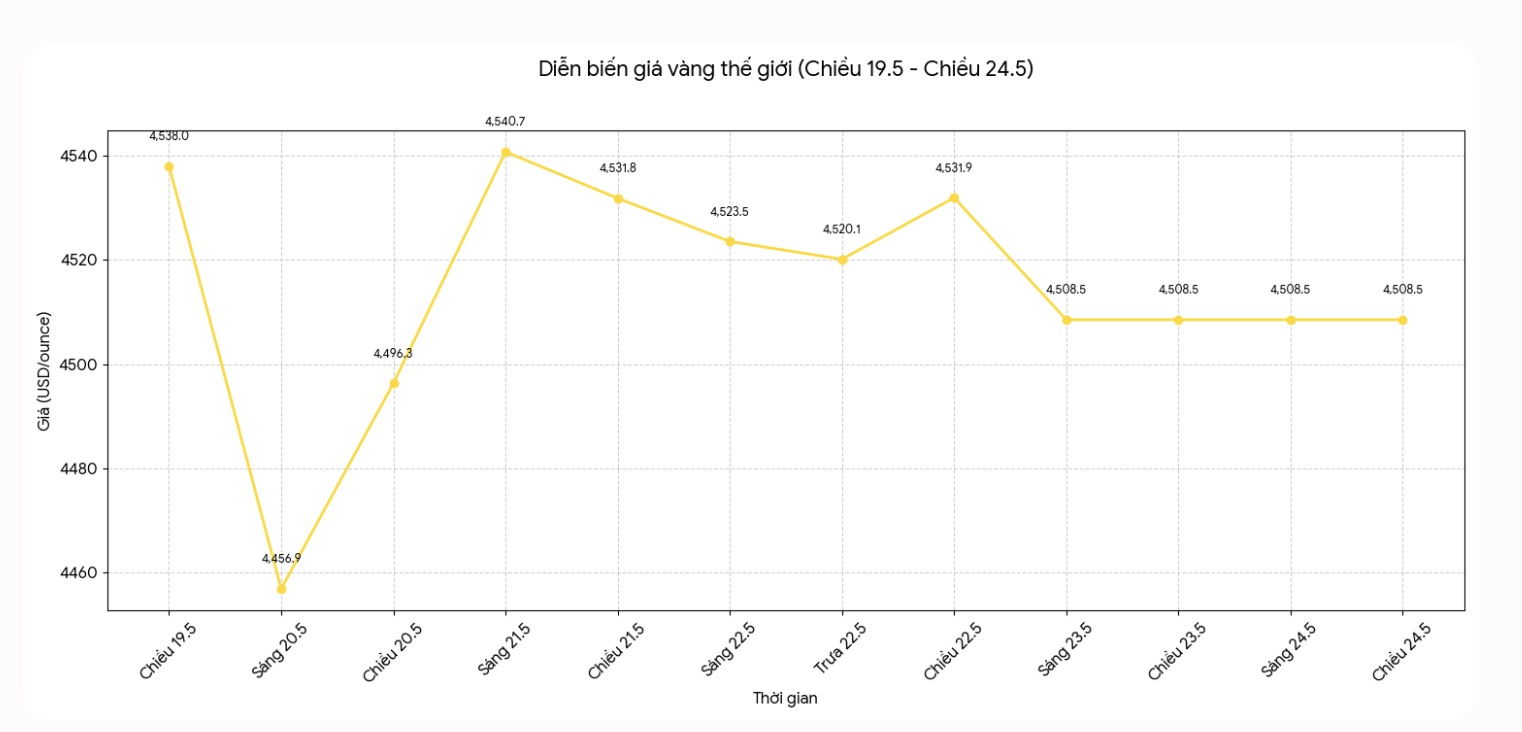
According to this expert, investors are limiting opening large positions in the context of the market entering a long holiday and liquidity decreasing. In the short term, gold prices are likely to continue to fluctuate in a narrow range and there has not been strong enough momentum to form a sustainable upward trend.
From a monetary policy perspective, Mr. David Morrison - senior market analyst at Trade Nation - believes that gold may face more pressure as the market increasingly bets heavily on the possibility of the Fed continuing to raise interest rates.
According to CME's FedWatch tool, the probability of the Fed raising interest rates by another 25 basis points before the end of the year is currently at 42%, higher than the probability of keeping interest rates unchanged at 30%. At the same time, the probability of the Fed raising a total of 50 basis points this year has increased to 22%, while a month ago it was almost zero.
Mr. Morrison said that this development is likely to be detrimental to gold. He also noted that although US public debt has exceeded 100% of GDP, the market is not really too concerned about the federal budget deficit.
According to Mr. Morrison, in the context of little important economic data next week, investors will continue to focus on monitoring risks related to the Iranian conflict. Vacations in Europe, the UK and the US may also make early week trading quite sluggish.

After a disappointing consumer psychology survey by the University of Michigan in the last session of the week, the market is now shifting its attention to the Consumer Confidence Report of the US Conference Board.
The University of Michigan said the consumer sentiment index fell to a new record low of 44.8 points, while one-year inflation expectations rose to 4.8%.
By the end of the week, the market will receive the US Q1 GDP data for the second time. However, according to analysts, the April inflation data and the Personal Consumption Expenditure (PCE) index are the most concerned focus.
Analysts believe that gold prices may become more sensitive if inflationary pressure continues to increase.
Meanwhile, Mr. Alex Kuptsikevich - senior market analyst at FxPro - said that gold is still in a medium-term downtrend.
He said that gold prices are currently near the mid- 50-day and 200-day moving averages. This shows that the long-term upward trend has not been broken, but the medium-term trend has shifted to more negative.
According to Mr. Kuptsikevich, the series of low peaks gradually forming from the end of January shows that buying power in the market is weakening.
It is highly likely that gold prices will fall to the 4,370-4,400 USD/ounce range by the end of next week," he warned.
He believes that this area will be a strong tug-of-war zone between buyers and sellers. If gold penetrates the upper support zone, selling pressure may increase significantly. Conversely, to confirm the possibility of returning to an upward trend, gold needs to maintain stability above the 4,800 USD/ounce zone.


