
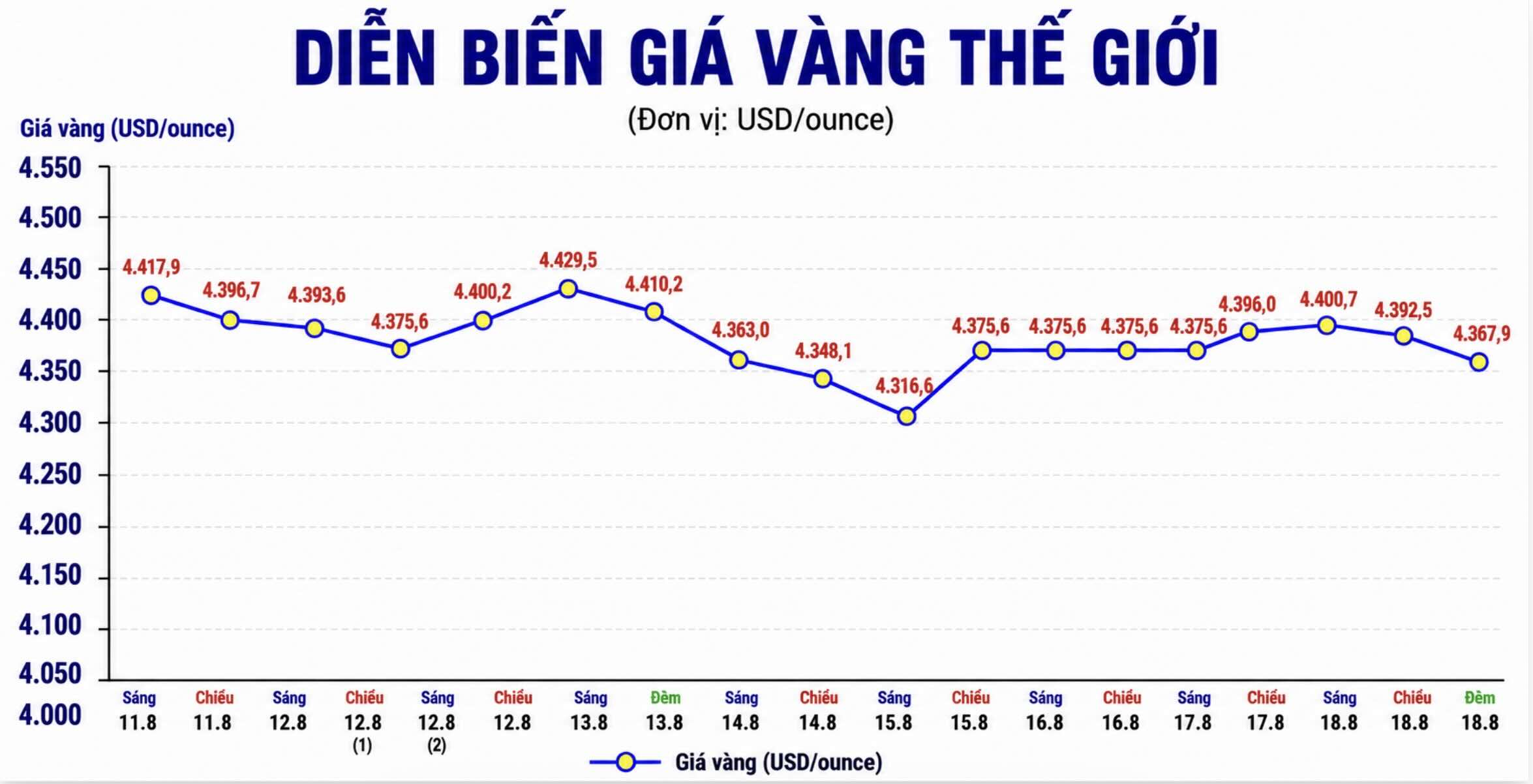
World gold prices are experiencing intertwined ups and downs as the market is simultaneously affected by US economic data, monetary policy expectations and the developments of the energy market.
In the trading session on the night of August 18, spot gold prices at one point retreated to about 4,390.4 USD/ounce, down 0.58%. Spot silver prices also decreased by 1.17%, to about 64.89 USD/ounce.
However, gold quickly narrowed its decline after the US released more data showing that the housing market continued to face difficulties.
According to the latest data, the US apartment sales index in July decreased by 2.3% compared to the previous month, contrary to analysts' forecast of an increase of 0.3%. Compared to the same period last year, this index decreased by 2.2%, while the market expects an increase of 1.4%.
Discounted house sales are decreasing monthly in all regions. Experts believe that high mortgage interest rates and expensive house prices continue to limit the ability of buyers to participate in the market.
After the data was released, spot gold prices jumped from the session's lowest level of about 4,376.19 USD/ounce to the 4,400 USD/ounce range. At one point, the precious metal was traded around 4,401.1 USD/ounce.
This development shows that investors are still reacting strongly to signs that the US economy may slow down. A series of recent data, from retail sales, inflation to consumer sentiment, have caused the market to lower expectations about the possibility of the US Federal Reserve (Fed) raising interest rates in September.
The probability of the Fed raising interest rates in the upcoming meeting is currently assessed by the market at around 30-35%. Expecting interest rates to be less "hawkish" is often beneficial for gold, as the precious metal does not bring a fixed yield.
However, the major drag on gold currently comes from US government bond yields. 10-year term yields fluctuate around 4.7-4.74%, while 30-year term yields at times reach 5.2-5.3%.
High yields increase the opportunity cost when holding gold, thereby limiting the breakthrough potential of the precious metal.
Oil prices and inflation continue to put pressure
The market is also paying special attention to oil prices. WTI oil is traded around 85 USD/barrel, while Brent oil is near 91 USD/barrel.
High energy prices increase concerns that inflationary pressure may return, thereby making interest rate expectations more unpredictable.
Developments related to transportation activities through the Strait of Hormuz are also being closely monitored as this is an important shipping route for the global energy market. Risks to transportation activities may boost demand for defensive assets, supporting gold.
However, if oil prices rise more sharply, concerns about inflation and high bond yields could simultaneously create reverse pressure on the precious metal.
In that context, gold prices are being affected by two opposing groups of factors. Weak US economic data and the possibility of the Fed being more cautious with monetary policy are supporting prices. Conversely, high oil prices and rising bond yields limit the recovery momentum.
The market is currently awaiting the minutes of the Fed's July meeting along with new data on the labor market and manufacturing activities to have more signals about the direction of interest rates.
Technically, the 4,448 USD/ounce zone is a noteworthy resistance level. If this zone is surpassed, gold may head towards 4,518 USD/ounce. In the opposite direction, the 4,333 USD/ounce zone is considered near support.
In the short term, when supporting and pressing factors are still intertwined, gold prices are likely to continue to struggle strongly around the 4,400 USD/ounce range before forming a clearer trend.
The article only updates market developments, not investment recommendations.


