
Why did gold prices rebound?
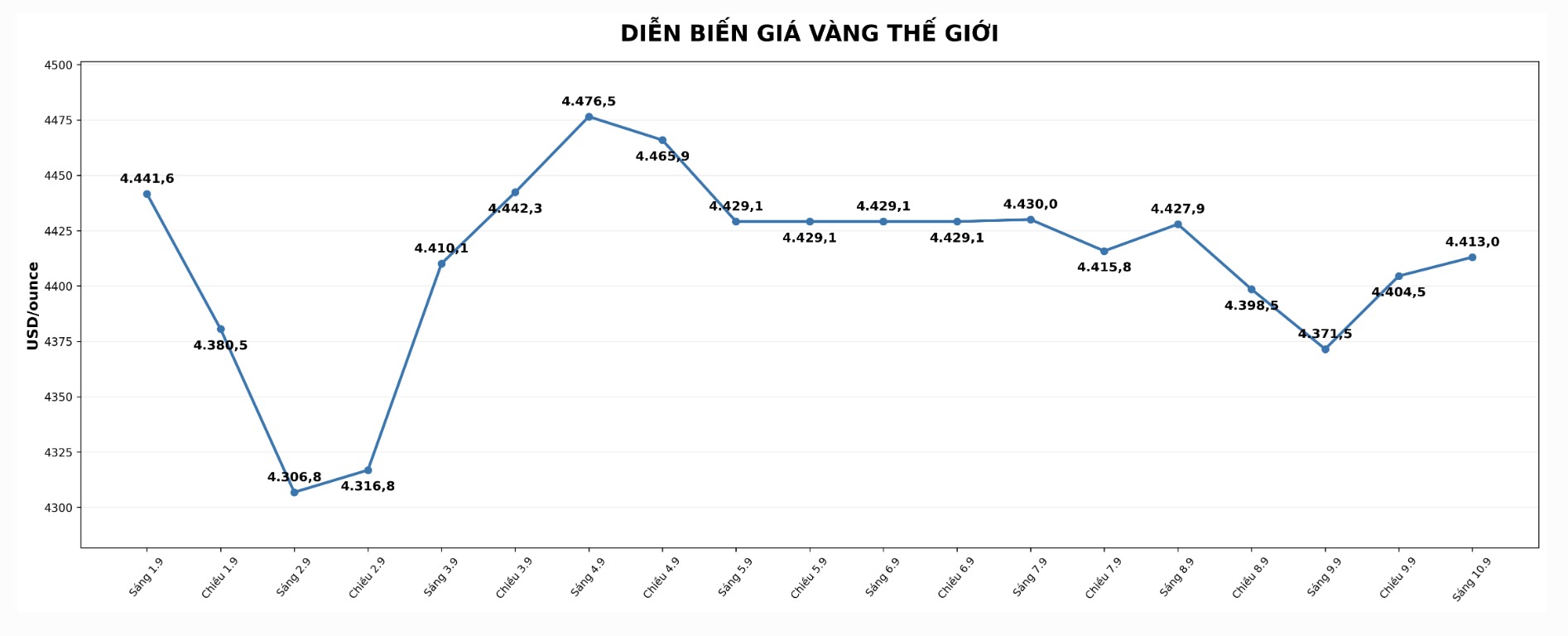
Recorded at 8:15 am on September 10 (Vietnam time), world gold prices were listed at 4,413 USD/ounce, up 0.27% compared to the previous session. Silver prices also increased by 0.29%, to 67.35 USD/ounce. This recovery took place after gold underwent selling pressure in the previous session, showing buying power returning when prices retreated to the attractive zone.
One of the important factors supporting gold prices is the weakening of the USD. As the greenback depreciates, gold becomes more attractive to investors holding other currencies, thereby boosting buying demand.
In addition, defensive sentiment in the financial market continues to increase as the geopolitical situation in the Middle East becomes complex. Concerns related to the risk of energy supply disruptions, especially in areas that play an important role in the global oil market, have led investors to look for safe assets such as gold.
The sharp increase in oil prices also contributes to creating more momentum for gold in the short term. Brent oil has surpassed the 100 USD/barrel mark again, raising concerns about the risk of inflation returning. In the context of increasing instability, gold continues to be seen as a defensive tool against economic and geopolitical risks.
However, the upward momentum of gold is still struggling due to interest rate factors. US bond yields are maintained at a high level, causing the opportunity cost of holding gold to increase, because precious metals do not generate periodic cash flow.
Market awaits signal from US inflation
Currently, investors are focusing on important US economic data, including the producer price index (PPI) and the consumer price index (CPI). These are considered information that may directly impact interest rate policy expectations of the US Federal Reserve (Fed).
If data shows that inflationary pressure is cooling down, the market may increase expectations that the Fed will maintain a softer policy, thereby supporting gold prices. Conversely, if inflation is higher than forecast, the possibility of interest rates remaining at a higher level longer may put pressure back on the precious metal.
Currently, the market is still in a state of tug-of-war between two groups of factors. One side is the shelter demand from geopolitical risks, the weakening USD and concerns about inflation. The other side is pressure from US bond yields and the possibility that the Fed will continue to maintain a cautious monetary policy.
The 4,400 USD/ounce mark becomes an important area
Technically, the return of gold prices above the 4,400 USD/ounce mark helps improve market sentiment. If the upward momentum is maintained, the next resistance zone is expected to be around 4,422 USD/ounce. In case of surpassing this level, gold may head towards higher price zones.
In the opposite direction, if selling pressure returns, the 4,347 USD/ounce zone is considered an important support area. Losing this zone may put gold prices under further adjustment pressure.
For silver, this precious metal is showing more positive developments when maintaining above the 67 USD/ounce zone. If it surpasses the 68.17 USD/ounce resistance zone, silver may expand its upward momentum to higher price zones. Conversely, the 67.25 USD/ounce zone will be an area to be monitored in the short term.
In the current context, gold prices are forecast to continue to fluctuate strongly as the market simultaneously monitors geopolitical developments, oil prices, the USD and new signals from US monetary policy.
The article only updates the developments of the gold market and factors affecting the price of precious metals, not investment recommendations.


