
World gold prices just closed a week of deep decline, strong selling pressure in the last session of the week after the market received a series of more positive US economic data than forecast.
Although instability in the Middle East still creates a certain shelter demand, this factor is not enough to help the precious metal maintain its upward momentum in the face of pressure from the USD, US Treasury bond yields and monetary policy expectations of the US Federal Reserve (Fed).
According to Kitco, spot gold opened the week at 4,539.42 USD/ounce on Sunday evening. The precious metal had a period of upward movement in the early sessions of the week as investors reacted to new information related to Iran and the Strait of Hormuz. Geopolitical risk concerns once helped gold approach highs, before the price set a weekly peak at 4,545.55 USD/ounce on Monday.
However, the upward momentum quickly weakened. Reports show that tensions in the Middle East are causing oil prices, US Treasury bond yields and the USD to rise together. In that environment, gold no longer maintains its dominant shelter role, because the opportunity cost of holding precious metals also increases accordingly.
Moving into Tuesday's session, gold prices tried to stabilize as the market showed some cautious expectations about the possibility of cooling down conflicts in the region. However, the recovery did not last long. US JOLTS data in April showed that the number of job positions increased to 7.6 million, reinforcing the view that the US labor market is still relatively solid. This makes investors believe that the Fed does not have many reasons to soon ease monetary policy.
Pressure continued to extend into Wednesday's session as the ADP private sector jobs report signaled that the US labor market remained stable. Yields sensitive to monetary policy expectations increased, keeping gold in a defensive position. Gold is a non-performing asset, so when bond yields increase, the attractiveness of precious metals usually decreases.
By Thursday's session, gold prices were supported at one point when the USD and US bond yields cooled down. Expectations for regional tensions to ease, along with signals related to the reopening of the Strait of Hormuz, helped market sentiment become less tense. However, this recovery quickly reversed in the last session of the week.
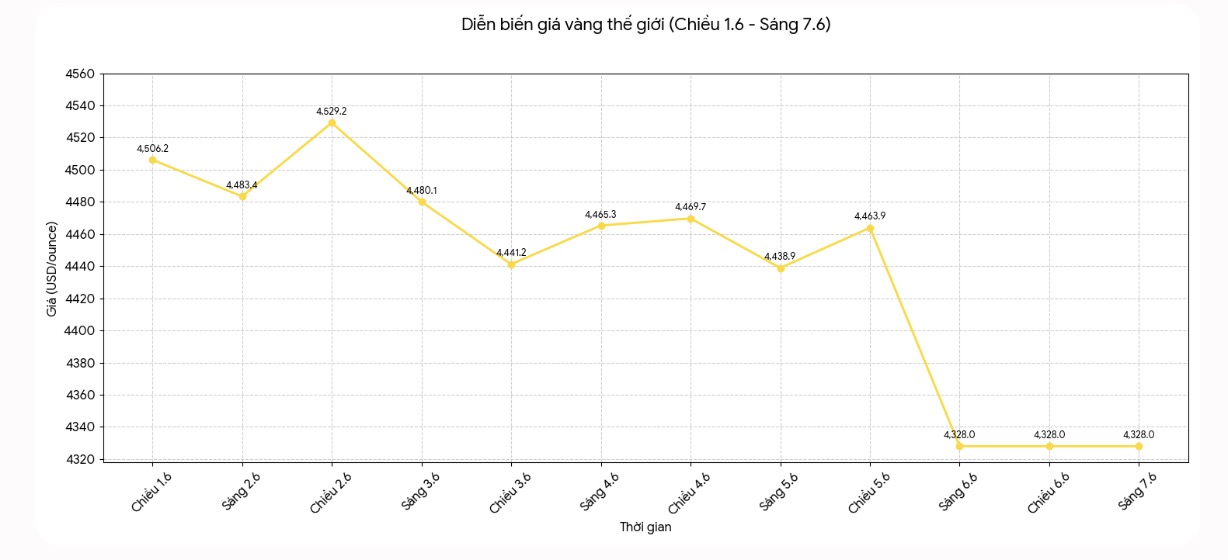
The US May jobs report became the main factor causing gold prices to plummet. According to Reuters, the US economy created an additional 172,000 jobs in May, much higher than the forecast of 85,000 jobs. The unemployment rate remained at 4.3%. This data increased expectations that the Fed would maintain high interest rates for a longer time, even raising the possibility that the agency may have to raise interest rates if inflation continues to persist.
After the jobs report, the market strongly adjusted monetary policy expectations. Reuters said that the probability of the Fed raising interest rates in December was market-valued to increase to about 72%, from 50% before the data was released. This change is clearly detrimental to gold, because high interest rates increase the cost of opportunities to hold assets that do not generate cash flow.
The USD also recovered strongly after the jobs data. According to Kitco, the strength of the greenback is one of the factors that put great pressure on gold prices in the last session of the week. As the USD increases, gold becomes more expensive for investors holding other currencies, thereby weakening buying demand in the international market.

Along with that, US Treasury bond yields increased after the jobs report. This is a particularly important factor for gold prices last week. As yields increase, investors have more profitable options from other safe assets such as US government bonds, while gold does not pay interest. Therefore, cash flow tends to leave gold in the short term.
In addition to macroeconomic factors, technical developments also make the decline stronger. Kitco believes that gold prices have broken through some important support zones after many sideways sessions. When technical levels are broken, selling pressure may be further activated, especially from short-term investors and trend trading orders.


