The beauty of things forgotten by the times
My friend's garden - Ms. Nguyen Binh Minh - is not like any other garden where we live. While other land plots are mostly planned into straight rows of durians - the main crop that brings high economic value - this garden retains the trees that people think are out of season, not many people need anymore.
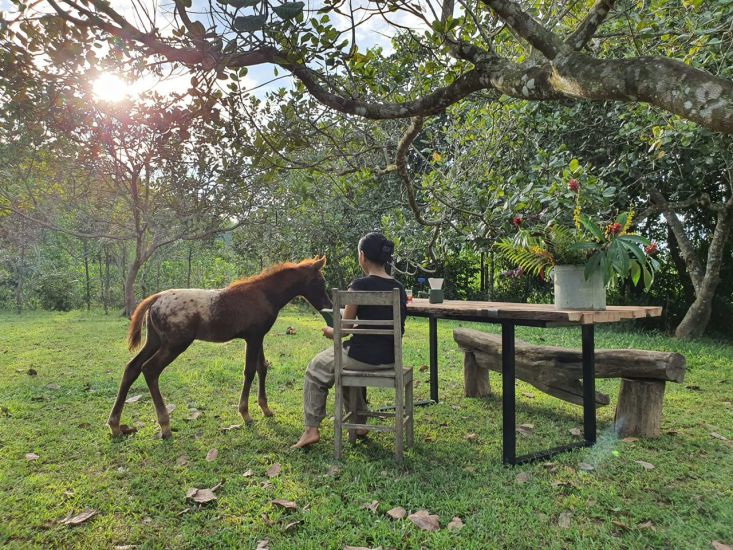
A person who "knows how to make a living" when entering that garden will look at the old cashew trees - trees preserved to provide shade for the horses - and say: "This place should have been planted with several hundred grafted durian trees." People are also confused when they see her family for decades determined to keep the majestic forest trees just as shelter for squirrels, birds, and wild chickens. In the garden, trees such as cold rice, huts, leisurely - fruits that few people eat anymore - still grow along the path. Few places still retain a forest edge with dense bamboo trees, shady for the horses to come every afternoon, becoming a green wall to keep the wind and quiet for the garden.
Her father-in-law - Mr. Dinh Chi Nghia - was originally a person who pursued a passion for horse training, once roamed with the herd of horses through many different lands. Wherever he set foot, he chose to live closest to the forest, where there was shade and enough space for the herd of horses to be comfortable. About twenty years ago, he agreed to take care of the herd of horses for a forest tourist area. The whole family lived in a house built close to the edge of the forest. For three years, he did not care about the outside world.
One day, when he set foot on the national highway and heard the noise of traffic, he suddenly shuddered, feeling afraid of those noisy sounds. He understood that he needed a truly quiet place to live, a place where horses could leisurely graze. So he decided to choose a pristine piece of land for the whole family to start a business - a land that later became a green garden where the members were living together.
He and his wife have three children. They went to school and work in many places and then gradually returned to live together in that garden. Two years ago, after getting married, Ms. Minh and her husband decided to leave the city and return to their hometown to live. Being an architect, Ms. Minh and her husband renovated their dilapidated old house into a warm bedroom. The abandoned goat cage was converted into a lovely kitchen. A few dozen steps away are small houses - where Mr. Nghia, Ms. Son and Ms. An gather to live together. Mr. Nghia often tells his children, no need to worry about economic issues, just do what they are good at, what they like; those who love architecture draw and build; those who like cooking just cook; those who like taking care of horses take care of their herds. The garden is also not divided among anyone, the land is just a place to live and work together. When people think less "this is mine, that is yours", then they naturally live lighter.
Ms. Minh often jokes that before getting married, she "fell in love" with her husband's family first and then decided to go on a long road with him. She is fascinated by the green and peaceful garden as if forgotten by the times, fascinated by the herd of horses leisurely grazing in the sun and wind. The garden for her is not just a place to live, it is a way of life, a world where people and nature also know how to listen to each other. And the person who will become her relative must also be "cool" enough to choose that not-hurried life.
When the horse is a silent teacher
Mr. Nghia is originally from Saigon. From a young age, he observed and tried to understand anything he raised. When he first came into contact with his horse, he began to be attracted by it because of the so-called "spirit of horses". A kind of spirit hidden deep in his eyes, in his breath that only when living nearby, patiently observing, can he reach.
He leads his increasingly crowded herd of horses through pristine lands. Where there is still enough space and quietness to raise horses, he chooses. But after pondering for a moment, he corrects: "To be more precise, horses lead me, because of horses, I go through lands. It's like many people think I train horses, I teach them, but in fact they are the ones who teach me many things.
After decades of roaming with herds of horses, he believes that horses are a species that carries a special, explosive, sensitive and extremely "fast" energy. The speed of horses lies not only in their galloping steps or galloping, but also in their reflexes, intuition and how they read people's intentions.
The first moments when entering a horse's energy cycle are always a test of patience, observing their eyes and very gentle gestures. The trainer is forced to pull his rhythm down, slower than usual, as if removing layers of waves that are moving in it, slow so that they realize their presence is not a threat. The horse will respond with eyes – eyes about to run away or greet – and when they wait for them to approach, it must also be within a speed range they allow.
He also believes that horses are so sensitive that they can feel love through the way they sit, the way they hug, the way they touch. The way this person sits is for you, the way that person sits is for the user, the owner. Horses feel that difference with a very deep and very accurate intuition – a form of "hidden anger" accumulated from the experiences they have experienced with humans. People often say dogs have owners, but with horses, no. Horses do not belong to anyone in terms of absolute obedience. They only distinguish between the person who raises them, the person who buys them, the person who cares for them... and the person they choose to see as friends.
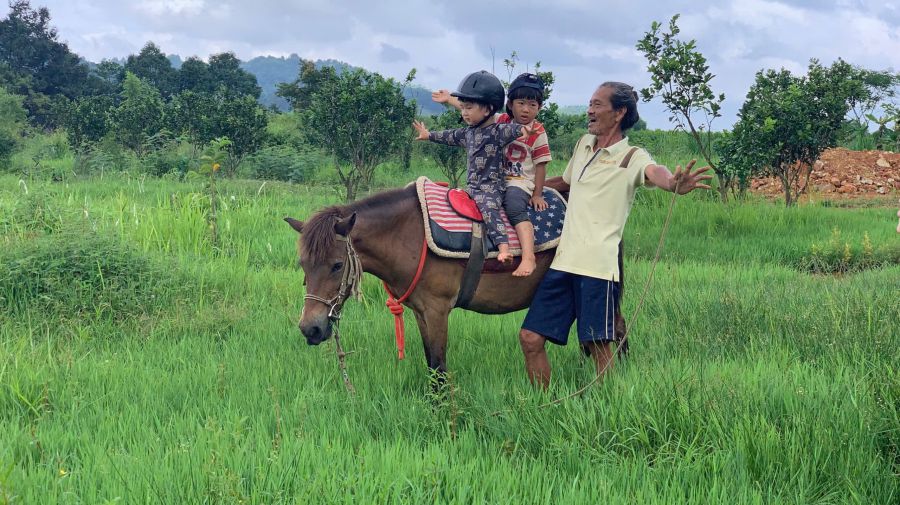
Therefore, for him, riding a horse is a way to "examine oneself". This animal reads human emotional fluctuations through very gentle movements such as a sigh that cannot be hidden, a angry rhythm that is trying to be suppressed in the chest, or a slightly impatient leaning. Everything that passes by in his body is transmitted to it as a signal. He pointed to the five-year-old baby Tet - Ms. Son's son - leisurely riding a horse: "Therefore, children are always the best horse trainers. Because they are innocent, easily connected to animals and have not been infected with complex thoughts and emotions like adults.
Once, some neighboring children were playing shuttlecocks, the shuttlecock accidentally fell into the garden, close to the foot of the leading horse. A boy rushed in, picked up the shuttlecock from the horse's foot very naturally without knowing that the horse reacted quickly, possibly kicking him off. But the horse also calmly continued to eat grass. It felt that the child was just a small life, completely without malice.
The depth of horses lies in such quiet but signal-rich moments. They always force people to slow down, soften, and be more honest with themselves. Therefore, even though he is a master in the horse training industry, Mr. Nghia believes that horses are the silent teachers by his side.
Family routine
Mr. Nghia's children and now, his grandchildren have all grown up in the family's life, attached to the sound of horses' neighs and the smell of sunlight hanging on their backs. In the early morning, when the mist was still thin on the grass, the children went to the stable, both rubbed their eyes and fed the horses, caressed them, played with them for a while before going to school. In the afternoon after school, the children went with him to the paddock (horse training area) to practice riding and the "further lessons" that are only available in their own home school.
The herd of thirteen horses, each horse has a name, a personality, a corner in the memory of the whole family. The stories always revolve around the horses Kamly, Mina, Zan, Cách... The children show off their new personality or the wonderful jump in a horse member they have just discovered. Each child learns to observe tiny changes.
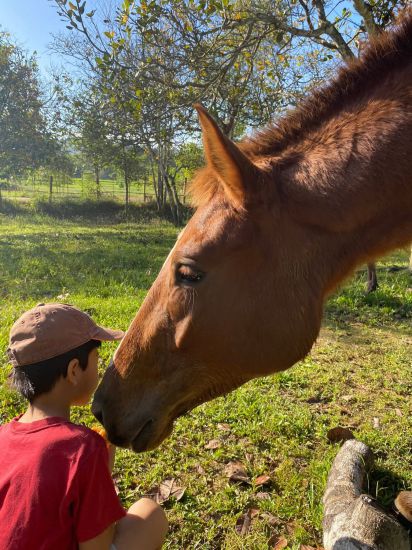
Living in the lush green garden, children love nature in a very instinctive way and do not need anyone to teach them what love is and patience. Because that lesson is already in the way they tie the rope for the horse, comb its mane, wash its hooves, or in the moment they stand still for a long time just to let a horse touch its forehead.
For him and his wife, this place is the home, allowing slowness to be a teacher, the herd of horses to become friends, and people to learn to live lightly - a luxury in modern society. When material things are no longer the standard of wealth, happiness will be present everywhere, just as small as a gentle ginger grass carpet growing along the footsteps of the herd of horses, like a few rays of early morning sunshine or a flower bud blooming under the porch... In the garden of people who are not in a hurry, fullness is always in moments of peace and simplicity like that.