
It is not strange to see the scene of basket-trading women, motorbike taxi drivers, telecommunication cable pullers gathering around a fried dough cart, their faces cheerful like a group of new students who are excitedly waiting for their fried dough. Their stomachs are pounding, craving a few crispy pieces of dough to be able to last until dinner.
Fried dough is a simple dish of the Chaozhou Chinese (belonging to Guangdong region, China today) that followed the footsteps of the migrants to Cho Lon region hundreds of years ago. It was a dish of low-income workers, of children and then became a dish of this city.
Perhaps, we cannot find this frying flour anywhere else besides Ho Chi Minh City, even though Chinese people do not only reside in this land. This is completely different from other Chinese-origin dishes such as wonton noodles, Yangzhou roast rice, Chao Qiu porridge... many everywhere in the "six provinces".
I don't understand why, but if you want to eat fried dough, you have to go to Saigon. And if you want to eat the most authentic and delicious fried dough dish, you have to go to Cho Lon area, you have to eat in fried dough carts pushed on the sidewalk, not in restaurants.
What is frying flour? It's simply flour that is fried. People use rice flour mixed with tapioca starch (cassava flour) and knead it into a flexible block, then compress it into cakes and steam until cooked. After steaming, it will be cut into bite-sized rectangular pieces and then continued to be fried on a cast iron pan.
Extremely simple but also very special. Because, this is a rare dish that Chinese people do not use flour, but only ordinary rice flour. It is outside the Chinese culinary identity system including flour, mustard greens and shrimp, as well as complex processing methods.
The fried dough is cut into long rectangular pieces, marinated with a strong flavor of tàu xì (a type of Chinese soy sauce) before being fried in a hot cast iron pan with fragrant fatty pork fat. But not the style of frying over oil to make it crispy as usual, the frying dough is prepared in a way that absorbs as little grease as possible.
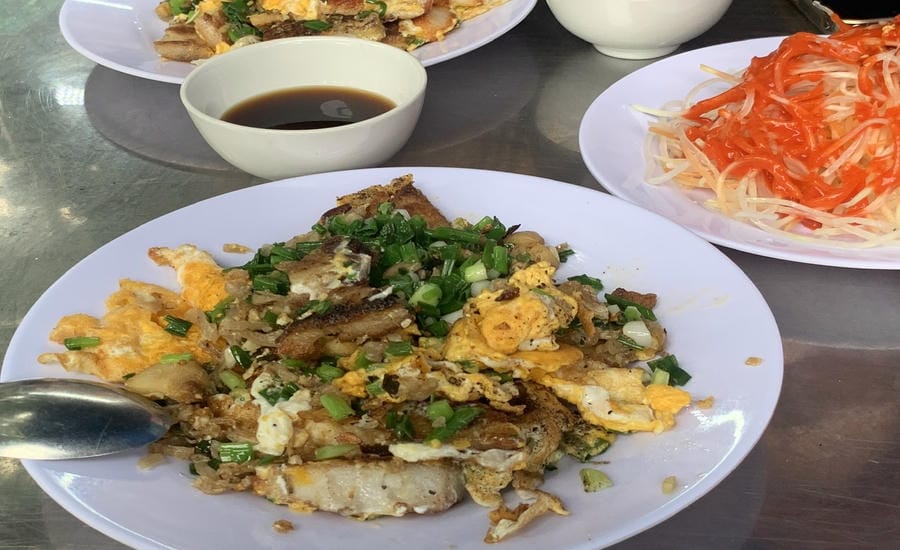
The dough is fried slowly in a cast iron pan over low heat, evenly to avoid overheating the crust. When the dough is just cooked, immediately crack the chicken egg on the surface of the pan, add a little scallions, a few crispy sesame seeds to enhance the flavor and fry with the dough. Therefore, the dough when eaten feels soft, fluffy and has a certain degree of flexibility.
You can't eat frying flour if you are in a hurry because only when there are customers does the owner start frying the flour, with all the slow steps as above. Therefore, watching the frying flour uncle prepare dishes is as interesting as the "omakase" culinary style of Japan, witnessing the chef directly cooking their dishes.
Only then can you feel the soft values of the frying flour plate. From the sizzling sound of hot oil, the crackling sound of iron pans touching the cast iron pan, to the attractive aroma slowly emanating from the cast iron pan, especially the smell of green onions, surrounding the frying flour cart and spreading to where you are sitting, making the gastric juice secreted reluctantly.
Later, in the early 2000s, the Saigon frying flour style appeared with slices of flour spread thinly and crispy. To fry in this style, more cooking oil is needed and larger heat is used. That is also a form of variation to suit the taste of young people.
The dishes served with frying flour are also simple, the protein content is only eggs and pork cracklings. In addition, there is no shortage of sheb (salted radish mixed with spices), sour dishes (carrot greens, carrots, white radish shredded and soaked in sweet sourness), scallions (put in a pan when the frying flour is almost done, still must maintain its green color but no longer have a pungent smell) and fried garlic.
A delicious plate of frying flour must meet 2 criteria: The outer piece of flour is crispy, the inside is soft and not mushy; the egg part must be evenly covered on the flour part. Dipping sauce for frying flour mixed with light soy sauce, ground chili sauce, fresh chili and sugar along with red vinegar (Vietnamese rice vinegar).
When eating, it is not about dipping a piece of flour in a bowl of dipping sauce, but to spread the dipping sauce evenly on the plate of flour, then slowly sipping the frying flour with raspberries and sour dishes. That piece of frying flour, although without delicacies, is enough to warm people's hearts in the late afternoon.
A serving of frying flour is not worth much money, only from 15 thousand to 20 thousand VND. That's why poor workers choose frying flour as a "favorite" dish. That price makes a student have enough "economic conditions" to fight hunger after school.
From there, I think broadly that the fried dough carts exist for their reasons. The carts are pushed along the streets, temporarily fixed at points with customers, without having to rent a store for anything. Thanks to that, the price is cheap, suitable for the ability of workers today as well as in the old days.
People say, the fried dough cart is full of memories of this most prosperous city in the South. It was originally a product of workers for workers, before becoming a snack for those looking for the flavor of a delicious dish.
On the stroller, fried dough creeps through every corner and alley, bringing a rustic dish to everyone. Through generations and years, fried dough has become a part of the soul of Cho Lon and Ho Chi Minh City.


